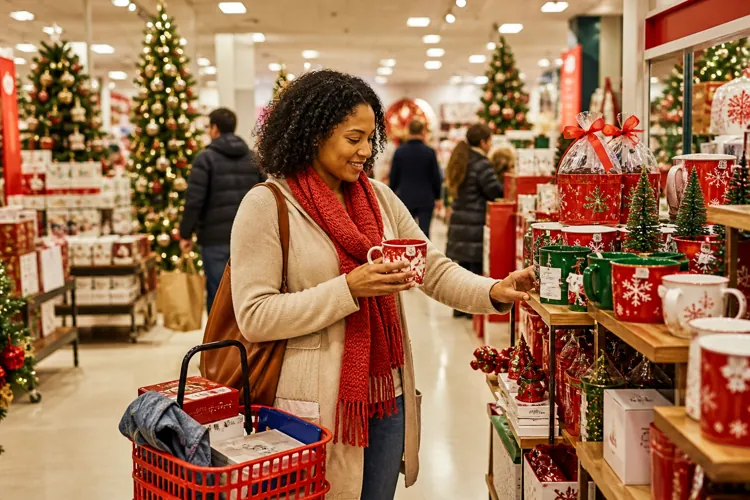

Holiday spending is expected to stay strong despite ongoing concerns about inflation, jobs, and the economy, as many shoppers continue to prioritize gift buying.
Higher-income households are expected to drive much of this year's holiday sales, while many lower- and middle-income consumers are making everyday budget trade-offs to keep spending in check.
Retailers won't all fare the same, with beauty and apparel expected to perform well, while some mid-range department stores and home-related categories could face greater challenges.
Before the holiday shopping season kicks into high gear, many Americans are feeling conflicted about their finances.
Concerns about inflation, the job market, and the broader economy remain high, but those worries haven't translated into a major pullback in spending. In fact, retail sales have stayed surprisingly strong, raising an important question: Will anxious consumers continue opening their wallets this Christmas?
According to new research from Coresight Research, the answer may be yes. While shoppers are likely to stay price-conscious and hunt for deals, many still plan to make holiday spending a priority — a trend that could shape this year's retail season.
ConsumerAffairs spoke with John Mercer, Head of Global Research at Coresight Research, who offered insight into why consumer confidence and consumer spending aren't moving in the same direction and what that could mean for shoppers this holiday season.
Budgeting trade-offs
One way to ensure holiday spending remains at high levels: day-to-day tradeoffs. It’s not uncommon for many consumers to make tough budgeting decisions in the months leading up to the holidays.
“We are seeing evidence of consumers on modest incomes make trade-offs in grocery,” Mercer said. “For example, Albertsons recently reported that it was seeing lower-income customer segments pull back most significantly, exhibiting softness in both units and overall basket sizes. Conversely, it saw higher-income customer segments demonstrate greater spending resilience.
“This aligns with Coresight Research data that show close to three in five (57%) U.S. consumers are engaging in trading-down behavior in grocery (such as switching to cheaper brands, cheaper retailers or private labels/store brands).”
High-income consumers are contributing the most
Coresight’s research also found that high-income consumers are driving the charge behind much of the expected holiday shopping that’s anticipated this coming season.
“Higher-income consumers remain the primary growth engine for retail,” Mercer said. “In our June 2026 consumer survey, 38.8% of households earning $100,000+ expected to spend more on holidays versus only 25.0% for the $50,000–$99,999 bracket. The net proportion (‘more’ minus ‘less’) expecting to spend more was 18.2% for $100k+ households versus (1.9)% for $50,000–$99,999 households.
“Higher-income consumers remain the most bullish despite broader economic concerns. Coresight Research weekly sentiment data confirm that forward-looking personal financial sentiment remains correlated to income — our weekly demographic breaks show $100k+ consumers as the most confident.”
How the economy can affect retailers this holiday season
Should economic pressures continue to mount, some categories could be affected more than others when it comes to holiday shopping
“Positively, beauty is experiencing strong cyclical growth, since early 2025,” Mercer said. “And apparel and footwear is experiencing a GLP-1 tailwind (wardrobe renewal) and is a key beneficiary of higher tax refunds, and tends to be a priority category when consumers receive windfalls like this. Big-ticket is weaker, and home-related categories are exposed to the housing market, which in turn is seeing elevated mortgage rates dampen housing transactions.”
On the other end of the spectrum, mid-range department stores could be especially vulnerable.
“Retailers such as Kohl’s are exposed to middle-income shoppers who can easily migrate to lower-price channels,” Mercer said. “Once consumer spending migrates to value alternatives, we believe legacy mid-range/full-price retailers struggle to regain that in full.
“Over the medium term, the traditional supermarket channel is losing share in grocery to nontraditional grocery retailers such as warehouse clubs, mass merchandisers, and discount retailers — we would expect any increased economic pressure to amplify this trend (as supported by Albertsons’ commentary, noted earlier).”