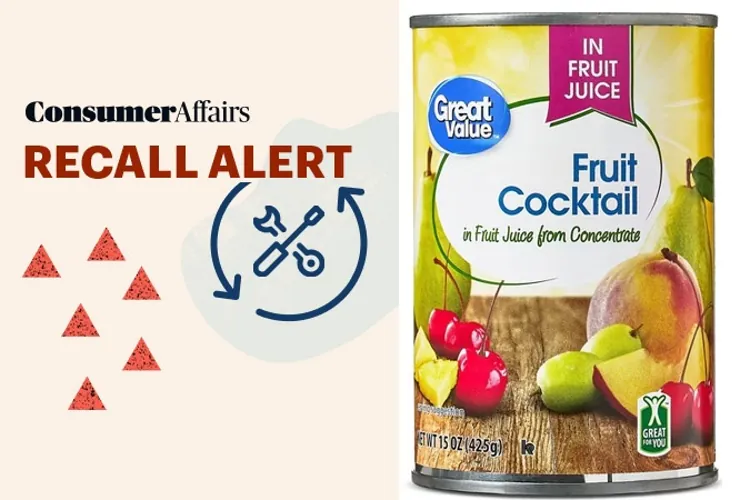

More than 44,000 cans of Great Value fruit cocktail are being recalled because they may contain elevated levels of lead.
The affected 15-ounce cans were distributed in seven states and carry a best-if-used-by date of Sept. 1, 2027.
Consumers should stop eating the recalled fruit, check their pantry and contact a health care provider if they are concerned about exposure, particularly involving children.
A manufacturer has recalled more than 44,000 cans of Walmart’s Great Value fruit cocktail because of potential contamination with elevated levels of lead, prompting a warning for consumers to check their pantry.
Pacific Coast Producers initiated the voluntary recall Oct. 1. The Food and Drug Administration classified it as a Class II recall on Oct. 20. The affected shipment totals 1,836 cases containing 24 cans each.
The recalled product is Great Value Fruit Cocktail in Fruit Juice from Concentrate, packaged in 15-ounce cans. Consumers should check for these identifying details:
UPC - 078742369570
Lot code - 6FCB 04 C2263
Best-if-used-by date - SEP 01 2027
The fruit cocktail was distributed in Alabama, Arizona, Louisiana, New Mexico, Pennsylvania, Washington and Wyoming, according to the recall information.A Class II designation means exposure may cause temporary or medically reversible health consequences, or that the probability of serious consequences is remote. The classification does not mean consumers should continue eating the product.
Why lead exposure matters
The FDA says there is no known safe level of exposure to lead. The metal can enter food through environmental contamination where ingredients are grown or during processing. The available recall information does not establish how the potential contamination occurred in this fruit cocktail.
Children are particularly vulnerable. According to the Centers for Disease Control and Prevention, lead exposure can damage the brain and nervous system, slow growth and development, and contribute to learning, behavior, hearing and speech problems. Young children may have no obvious immediate symptoms.
Consumers cannot determine whether food contains lead by looking at it or tasting it. Laboratory testing is needed to detect the contamination, the CDC says.
What shoppers should do
Consumers with matching cans should stop using them and either discard them or contact Walmart about return and refund options.
Anyone concerned that a child ate the recalled fruit should contact the child’s health care provider. A clinician can determine whether a blood lead test is appropriate; the absence of symptoms does not rule out exposure.
Walmart told PEOPLE that it removes affected products and blocks purchases at registers and online when notified of recalls, while working with suppliers on their investigations.