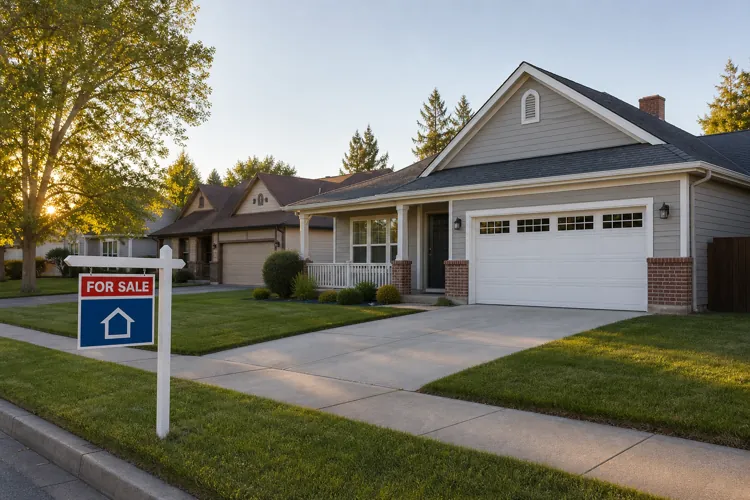

The U.S. housing market remains frozen by a "mortgage lock-in" effect, with millions of homeowners reluctant to give up 3% mortgages and buyers priced out by high home prices and elevated borrowing costs.
Real estate experts say a nationwide housing crash is unlikely because a long-running shortage of homes continues to support prices, even as affordability has reached its worst levels in decades.
Most analysts expect the market to remain sluggish through the rest of the decade, with modest price growth, more negotiating power for buyers, and regional differences replacing the pandemic-era housing boom.
The spring home-selling season ended on a subdued note, as fewer homeowners put their properties on the market, reflecting caution among both buyers and sellers. Sellers have withdrawn listings at a record rate as buyers have balked at record-high home prices.
The story of how we got to this point – where millions of Americans can’t afford to buy a home – and whether the market will ever return to normal goes back to before the COVID-19 pandemic. According to the National Association of Realtors, the median price of an existing home in January 2020 was $266,300 – a 6.8% increase from the year before.
However, at that price, the monthly payment with 20% down and a 6% mortgage rate was about $1,277, before taxes and insurance. By January 2026, the median home price had climbed to $396,800, an increase of more than $130,000 in six years. The mortgage payment on that home had risen to roughly $1,900, with taxes and insurance pushing the monthly housing cost to around $2,300.
Building houses had not become dramatically more expensive during that period. Instead, economists point to an unusual convergence of events: record-low mortgage rates, pandemic-driven demand for more living space, years of under-building after the Great Recession, and millions of millennials entering their prime home-buying years.
Market standoff
"In tons of markets people aren't necessarily under pressure to sell but they are choosing not to sell because of the fact that they have 3% mortgages," Jim Chamberlin, a Realtor at Vulcan7, told ConsumerAffairs. "What that has done is create a market where buyers don't really love today's prices, but sellers don't have much reason to discount either."
That phenomenon has become known as the "mortgage lock-in effect." Millions of homeowners refinanced or purchased homes during 2020 and 2021 when 30-year mortgage rates fell below 3%. Selling today would likely mean financing another home at more than twice that rate, dramatically increasing monthly payments even if the replacement home costs about the same.
The result is a housing market that appears frozen. Buyers face some of the least affordable conditions in decades, while existing homeowners have little financial incentive to list their properties. Inventory has improved from the extreme shortages of the pandemic years but remains below the level economists consider a balanced market.
Despite the affordability crisis, the experts we consulted see little chance of a nationwide collapse in home prices.
Price fundamentals still intact
"I don't believe we will see any significant fall in home prices," said Kaine Arkinson, managing director at Shepherd Commercial. "The fundamental support for pricing, namely chronic undersupply and consistent demand, remains intact. The issue is now affordability and wage growth."
Instead of a crash, Arkinson expects a prolonged period of sluggish price movement in which home values remain relatively flat while incomes gradually catch up. He predicts annual price appreciation of just 1% to 3% over the next four years, meaning inflation-adjusted home values could actually decline slightly.
Salim Chraibi, founder and CEO of workforce housing developer Bluenest, agrees that supply remains the market's defining issue.
"The structural reason is simple: we do not have enough homes," Chraibi said. While some Sun Belt markets that experienced heavy pandemic-era construction are already seeing price declines, he expects national prices to remain resilient because demand still exceeds supply in most regions.
Effect of the pandemic
Chraibi believes today's affordability problems would look very different had the pandemic not occurred. Without historically low mortgage rates, remote-work migration, and the buying frenzy they unleashed, he estimates the median U.S. home price today would likely fall between $310,000 and $340,000, rather than nearly $400,000.
"The more damaging legacy of those low rates is the lock-in effect," he said. "Homeowners sitting on 2.5% to 3% mortgages are not selling. That is compressing resale inventory in a way that will take years to unwind."
Other real estate professionals reached similar conclusions.
Mike Chambers, CEO of AI home-buying platform Ridley, estimates the median home price today would likely range from $325,000 to $375,000 if the pandemic-era buying boom had never occurred. While ultra-low interest rates accelerated appreciation, he argues the underlying housing shortage would still have pushed prices higher over time.
"The pandemic accelerated demand in ways we rarely see," Chambers said. "Those forces compressed many years of appreciation into a relatively short period."
Correction is unlikely
Alexei Morgado, founder of Lexawise, a company providing services to the real estate industry, said a significant nationwide correction is unlikely without an economic shock that forces large numbers of homeowners to sell.
"What I see now is a change in expectations," Morgado said, noting that buyers have become increasingly focused on monthly payments, while sellers who continue to price homes as they did during the peak of the pandemic often face longer selling times and must make concessions.
That distinction between prices and affordability has become a defining feature of today's market. While home prices have largely stopped their rapid ascent, elevated mortgage rates mean monthly payments remain near record highs for first-time buyers.
Regional impact
The experts also agree that the housing market is becoming increasingly regional.
Areas that saw explosive pandemic growth, particularly parts of Florida, Texas, and the Mountain West, are experiencing softer prices as inventory increases. Meanwhile, many Midwestern and Northeastern markets continue to post price gains because housing supply remains especially limited.
Looking ahead
Looking ahead, none of the experts expect a return to either the frantic bidding wars of 2021 or a repeat of the housing crash that followed the 2008 financial crisis.
Instead, they foresee a slower, more balanced market where buyers regain negotiating leverage, homes take longer to sell, and sellers must price properties more realistically. Price appreciation is expected to remain modest, but affordability is unlikely to improve dramatically unless mortgage rates fall meaningfully, wages rise faster than housing costs, or the nation substantially increases home construction.
For would-be homebuyers, that means patience may be rewarded with more choices and greater bargaining power, but not necessarily with dramatically lower prices. The consensus among industry experts is that America's housing affordability crisis is more likely to be solved by adding millions of new homes than by waiting for existing home values to fall.