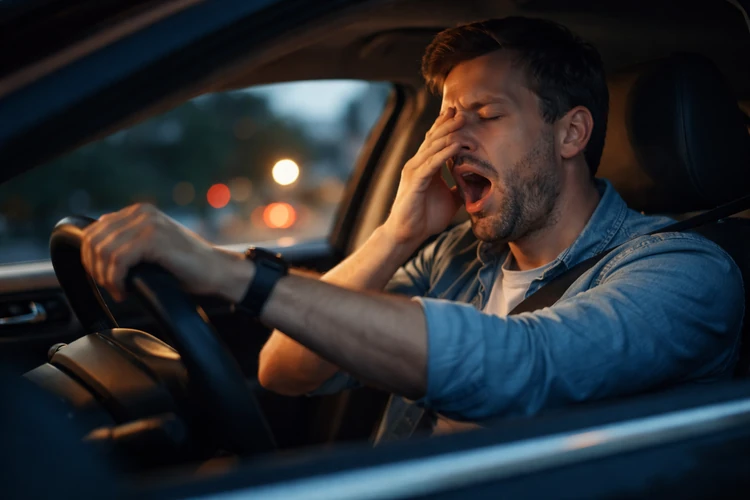

A significant share of U.S. adults — about 41% — report feeling so sleepy while driving that it affected safe driving.
Men are more likely than women to report drowsy driving, and adults aged 35–44 show the highest incidence.
The data come from a naåtionally representative online survey of 2,007 adults conducted in June 2025.
Ever felt your eyes get heavy on the drive home? You’re far from alone.
New results from a 2025 survey commissioned by the American Academy of Sleep Medicine reveal that a large portion of Americans admit to driving while so tired that it reduced their ability to drive safely — and that’s more than just an uncomfortable nod.
The term “drowsy driving” might conjure up images of someone struggling to keep their head up on a long road trip, but the new data show that it’s a widespread experience across everyday drivers in the U.S. These moments of sleepiness behind the wheel are not just annoying — they’re a safety risk worth taking seriously.
“Drowsy driving is a serious health and safety risk, and like drunk driving, it is completely avoidable,” researcher Dr. Andrea Matsumura said in a news release. “Driving while drowsy can reduce alertness and decrease reaction times to put drivers, their passengers, and everyone on the road in danger.”
The survey
This snapshot of how often Americans battle sleepiness behind the wheel comes from an online survey of 2,007 adults across the United States. The research was carried out by Atomik Research in early June 2025, and the sample was designed to reflect the broader U.S. adult population within a margin of error of about ±2 percentage points at a 95 percent confidence level.
Participants were asked a straightforward question: have you ever felt so sleepy while driving that it affected your ability to drive safely? From there, answers were broken down by gender and age group to get a clearer picture of who is most likely to experience drowsiness on the road.
What the numbers say
Overall, about 41 percent of U.S. adults reported that yes — they’ve felt too sleepy to drive safely at some point. That’s a pretty notable chunk of drivers.
When you look closer, the difference between genders stands out: half of men said they’d experienced drowsy driving, compared with about one-third of women.
Age also seems to play a role. Adults between 35 and 44 years old reported the highest incidence (47%), followed closely by those aged 45–54 (46%). Younger adults (18–24) and older drivers (65+) reported lower rates, but not negligible ones — even among the oldest group surveyed, nearly 28% admitted to feeling too sleepy to drive safely.
These findings don’t just signal that drowsy driving happens — they point to a pattern of widespread sleepiness behind the wheel that many drivers may be overlooking. Putting enough sleep on the priority list could be a simple, effective way to make roads safer for everyone.