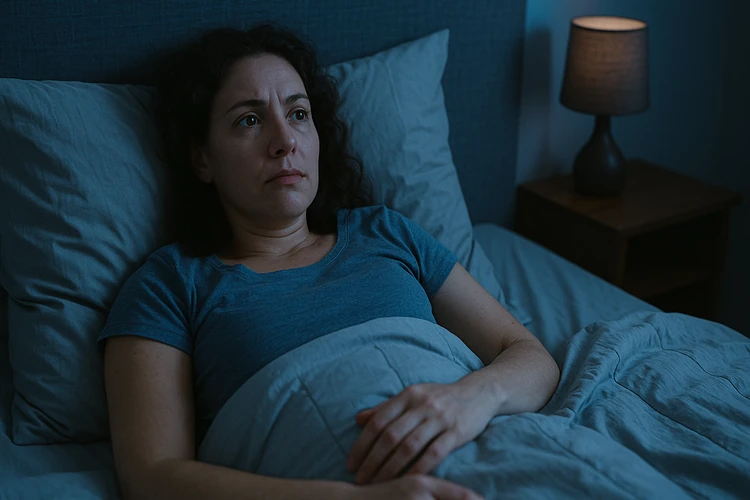

Researchers found that worse sleep habits were tied to brains that appear, on average, about one year older than a person’s real age.
The study looked at 27,500 adults, using MRI + machine learning to compute a “brain age gap” (brain age minus real age).
About 10% of the link between poor sleep and older-looking brains were explained by low-grade inflammation in the body.
We all know a night of bad sleep can leave us groggy and foggy the next day.
But could poor sleep actually make your brain age faster?
That’s the idea behind a new study from researchers at the Karolinska Institutet, which suggests that people with chronically unhealthy sleep patterns tend to have brains that look “older” than they really are.
“The gap between brain age and chronological age widened by about six months for every one-point decrease in healthy sleep score,” researcher Abigail Dove said in a news release. “People with poor sleep had brains that appeared on average one year older than their actual age.”
The study
The researchers tapped into data from the UK Biobank, a large health database in the U.K., selecting 27,500 middle-aged and older participants (mean age ~54.7 years). At baseline, participants answered questions about five sleep-related traits:
Chronotype (morning person vs. evening person)
Sleep duration
Insomnia symptoms
Snoring
Daytime sleepiness
Each person was given a “healthy sleep score” from 0 to 5, based on how many of these traits were favorable. They were grouped into three categories: healthy (four to five good traits), intermediate (two to three), or poor (zero to one) sleep quality.
Years later (average follow-up ~ 8.9 years), all those participants underwent brain MRI scans, capturing over a thousand brain imaging features (so-called MRI phenotypes). Using a machine learning model, the researchers estimated each participant’s “brain age” from the scans, and then calculated the brain age gap (BAG) — the difference between brain age and chronological (actual) age.
To examine mechanisms, the team also measured low-grade systemic inflammation (via a composite “INFLA” score based on inflammatory biomarkers). They used statistical techniques to test to what extent inflammation mediated any link between sleep and brain age.
They adjusted for many potential confounders, including age, sex, education, lifestyle factors, and cardiometabolic health.
The results and what they mean
At baseline, only a small slice of participants (~3.3 %) were classified as having poor sleep, while 55.6 % fell in the intermediate group and 41.2 % in the healthy group.
Compared with the healthy sleep group, those with intermediate sleep had a modestly higher brain age gap (~0.25, meaning roughly 0.25 years or ~three months older) and those with poor sleep had a stronger effect (~0.46, or about 0.46 years, i.e. about five to six months).
In real terms, the difference accumulates: for each single point drop in the sleep score, the brain-age gap increased by about six months.
On average, people in the “poor sleep” group had brains that appeared about one year older than their actual age.
When the researchers looked at the role of inflammation, they found it accounted for about 10.4 % of the association between poor sleep and increased brain age gap (and about 6.8 % for intermediate sleep).
The authors caution that this is an observational study, so it cannot prove that bad sleep causes accelerated brain aging. Also, sleep traits were self-reported, which can introduce bias, and participants in the U.K. Biobank tend to be healthier than the general population (which may limit how generalizable the findings are).
Nevertheless, the study adds weight to the idea that sleep might be a modifiable factor in protecting brain health. If poor sleep really does push the brain to age faster (even slightly), then improving sleep — better consistency, treating insomnia or sleep apnea, managing daytime sleepiness — may help slow down some of that wear and tear.