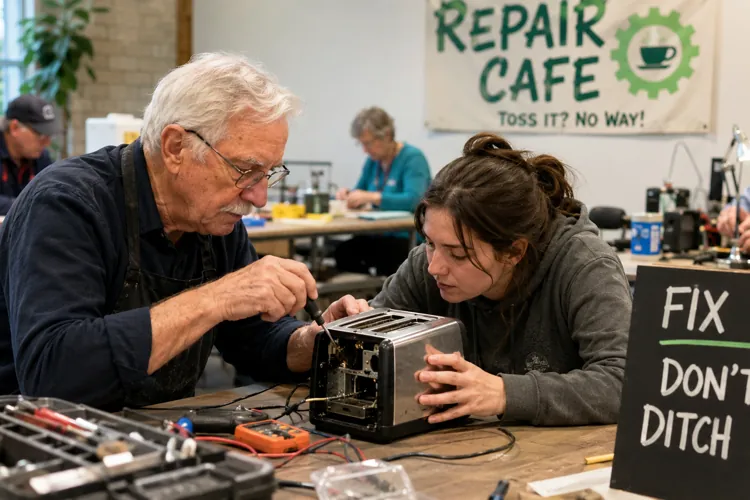

More Americans are repairing instead of replacing: Rising prices are fueling interest in Repair Cafés, where volunteers help fix everything from toasters and lamps to clothing and bikes.
Many "broken" items can be saved: A bad zipper, loose wire, or worn-out battery is often much cheaper to repair than replace.
The repair movement is growing: Repair Cafés, tool libraries, and right-to-repair efforts are helping consumers save money and reduce waste.
A broken lamp. A torn jacket zipper. A clock that hasn't ticked in years.
For decades, the solution to many household problems was simply to throw it away and buy a new one.
But as prices continue to rise and consumers look for ways to stretch their budgets, a growing movement is encouraging Americans to do something different: repair what they already own.
A recent Associated Press report highlighted the growing popularity of Repair Cafés, community events where volunteers help people fix everything from electronics and household appliances to clothing, jewelry, bicycles, and musical instruments. What began as a small initiative in the Netherlands in 2009 has grown into a global nonprofit network with more than 4,000 Repair Cafes and nearly 850,000 repairs completed annually.
For consumers facing higher prices on everything from groceries to household goods, the concept is gaining traction.
Why replacing everything is getting expensive
For years, many products were designed around convenience and low prices. When something broke, replacing it often cost less than repairing it. That's changing.
Household budgets have been squeezed by inflation, and many consumers are taking a closer look at the true cost of constantly replacing items. A $40 toaster, $80 pair of headphones, or $150 vacuum cleaner may not seem expensive individually, but replacing multiple items every year adds up quickly.
Many repair experts say that most consumers live in a disposable world and throw away products that need only a minor fix. Could be a loose wire, worn-out battery, broken zipper, or a damaged switch. Many of which can be repaired for a fraction of the cost of buying new.
The rise of Repair Cafés
According to the AP report, Repair Cafés bring together volunteers with skills in electronics, sewing, woodworking, jewelry repair, and other trades. Instead of dropping off an item and paying a repair bill, participants work alongside volunteers and learn how repairs are made.
At a recent Repair Café in New Paltz, New York, volunteers repaired 71 of the 85 items brought in by local residents.
The appeal to fix stuff isn't limited to just saving money. Many people bring items that have incredible sentimental value, including family heirlooms, vintage clocks, and musical instruments.
Pro tip: Get in the mindset of not throwing stuff away immediately. When something breaks, resist the urge to toss it in the trash. Spend a few minutes researching the problem online. YouTube tutorials and repair forums often provide step-by-step instructions for common fixes.
What items are often worth repairing?
Not everything should be fixed. Sometimes replacing an item just makes more financial sense.
However, consumers are often surprised by how many items can be repaired economically.
Here are a few to consider fixing instead of trashing:
Lamps and lighting fixtures
Small kitchen appliances
Vacuum cleaners
Furniture
Clothing and jackets
Bicycles
Jewelry
Musical instruments
Power tools
Small electronics
In many cases, the repair costs are far lower than replacement costs and not very difficult to do yourself.
Pro tip: A good rule of thumb is to compare the repair estimate to the cost of a new item. If the repair costs less than half the replacement price and the item is otherwise in good condition, fixing it is often the smarter financial choice.
How to find a repair event near you
Here are some easy steps to find a repair event in your area.
1. Visit the official Repair Café website
Start by going to the Repair Café International website and using their location finder. Most registered Repair Cafés around the world are listed there.
2. Search your city plus "Repair Café"
Not every event is listed on the official website. Try doing a Google search for:
"Repair Café near me"
"Repair Café [your city]"
"Repair event [your city]"
Many local events post on a Facebook page or community website instead of an official website.
3. Check local libraries and community centers
Many repair events are hosted at:
Public libraries
Churches
Community centers
Senior centers
Maker spaces
Get in the habit of checking their event calendars regularly.
4. Search social media
Facebook Events is often one of the best places to find upcoming repair workshops near you. Many operate only once a month (or quarterly) and promote events primarily through social media.
The growing 'repair, don't replace' movement
Repair Cafes are just one part of a broader shift. Another aspect is the Buy Nothing Project, which allows neighbors to give away items they no longer need instead of throwing them away.
Meanwhile, the "right to repair" movement continues pushing manufacturers to make replacement parts, tools, and repair information available to consumers and independent repair shops.
Supporters argue that consumers should have the ability to repair products they own rather than being forced to replace them or rely solely on manufacturers for service. Several states have already passed right-to-repair legislation covering certain products and industries.
Pro tip: Use tool libraries. Need a specialty tool for a one-time repair? Check whether your community offers a tool library. Borrowing a tool can cost far less than purchasing one you'll rarely use again.