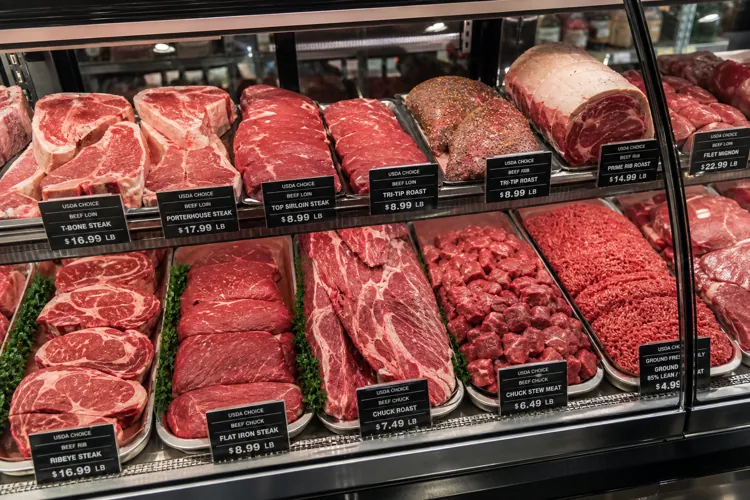

The Justice Department has expanded its beef-price investigation to eight major retailers, including Walmart, Costco, Amazon, and Kroger.
Investigators are examining whether market concentration or anticompetitive practices have contributed to rapidly rising beef prices.
A historically small U.S. cattle herd remains a major cause of high prices, suggesting consumers may not see relief anytime soon.
The U.S. Justice Department has expanded its investigation into rising beef prices, bringing eight of the nation’s largest grocery retailers under federal scrutiny.
The retailers are Walmart, Costco, Amazon, Kroger, Publix, Albertsons, Aldi, and Ahold Delhaize, the parent company of such chains as Food Lion, Giant Food, and Stop & Shop.
Associate Attorney General Stanley Woodward sent letters to the companies concerning recent increases in retail beef prices, according to the department. The action expands an antitrust investigation that initially focused on the companies that process most of the nation’s beef.
“Beef prices are a critical concern to Americans, and a priority for this Justice Department,” the agency said in announcing the expansion.
The investigation does not mean the retailers have been accused of wrongdoing. Federal officials have not disclosed whether they are investigating a specific pricing practice or requesting particular records from the companies.
The retailers had not publicly responded to the investigation when it was announced.
Investigation began with meatpackers
The Justice Department launched its current investigation in May, focusing on the four dominant meatpacking companies: JBS, Cargill, Tyson Foods, and National Beef.
Together, those companies control more than 85% of U.S. beef processing, according to the department. Federal investigators are examining whether the high level of concentration has reduced competition or contributed to higher prices.
The government says it has reviewed more than three million documents and interviewed industry participants as part of that investigation.
By turning its attention to major grocery companies, the department is examining another stage of the beef supply chain — the point at which wholesale beef is priced and sold to consumers.
Retail beef pricing can be affected by several factors, including the price stores pay suppliers, transportation and labor costs, promotions, local competition, and the profit margin retailers apply to meat sales.
Antitrust investigators may examine whether companies coordinated prices, exchanged competitively sensitive information, or used their size to limit competition. However, the department has not publicly alleged that any of the eight retailers engaged in those practices.
Beef prices have risen sharply
The investigation comes as families are paying historically high prices for hamburgers, steaks, and roasts.
The average price of a pound of ground beef reached $6.89 in July, up about 10% from a year earlier and nearly 57% from July 2021, according to federal inflation data. Steak prices increased by approximately 35% over the same five-year period.
A lack of cattle is widely considered one of the biggest reasons for the increase. The United States had approximately 86.2 million cattle and calves at the beginning of 2026, the smallest herd since 1951, according to the Department of Agriculture.
Years of drought, high feed costs, and other financial pressures caused many ranchers to reduce their herds. Restrictions on cattle imports from Mexico, imposed because of concerns about the New World screwworm, also tightened supplies.
Strong consumer demand has allowed prices to remain elevated despite the higher cost.
What it means for consumers
The expanded investigation could eventually result in enforcement action if officials uncover evidence of price-fixing, collusion, or other violations of federal antitrust law. It could also end without charges if investigators determine that market forces, rather than illegal conduct, explain the price increases.
Consumers should not expect the investigation itself to lower supermarket prices immediately. Even if competition problems are identified, rebuilding the U.S. cattle herd could take several years because of the time required to breed and raise cattle.
In the meantime, shoppers can reduce costs by watching weekly promotions, comparing unit prices, and choosing less expensive cuts such as chuck roast, round steak, or higher-fat ground beef. Chicken and pork may also offer lower-cost alternatives when beef prices rise.
The central question for the Justice Department is whether today’s high beef prices are entirely the result of tight supplies and strong demand — or whether business practices by dominant processors and retailers have made the problem worse.