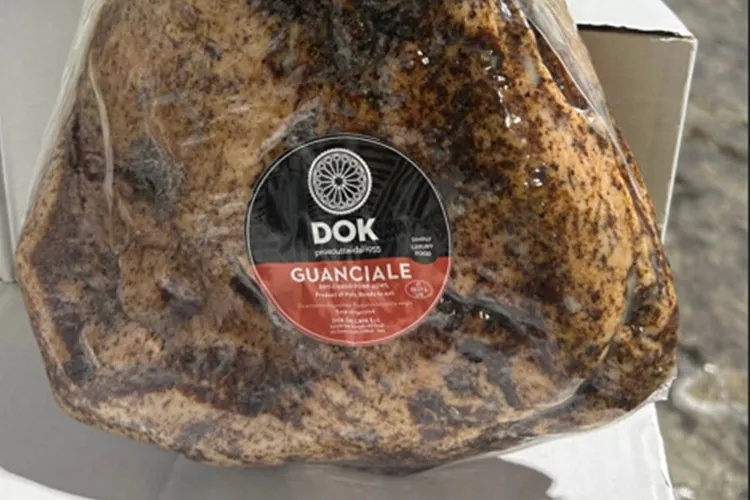

Prime Line Distributors and Ferrarini USA are recalling about 1,513 pounds of imported ready-to-eat pork guanciale because of possible Listeria contamination.
The products carry lot number 263311US, a best-if-used-by date of May 16, 2027, and were distributed in eight states.
No illnesses have been reported, but consumers and businesses are being urged not to eat, sell, or serve the recalled pork.
Consumers, restaurants, and retailers are being warned to check their refrigerators and freezers for imported Italian pork that may be contaminated with Listeria monocytogenes.
Prime Line Distributors Inc., of Fort Lauderdale, Florida, and Ferrarini USA Inc., of Hoboken, New Jersey, are recalling approximately 1,513 pounds of ready-to-eat dry-cured pork jowl, commonly known as guanciale, the U.S. Department of Agriculture's (USDA's) Food Safety and Inspection Service (FSIS) announced.
The pork was produced by Bome SRL in Italy on May 21, 2026, and imported into the United States on various dates in July. Federal inspectors discovered the problem during routine import re-inspection testing, when a product sample tested positive for Listeria monocytogenes.
So far, there have been no confirmed reports of illness associated with the recalled products.
How to identify the recalled pork
The recall covers several versions of vacuum-packed guanciale sold under the Prime Line Distributors and Ferrarini names.
Consumers and businesses should look for lot number 263311US and a best-if-used-by date of May 16, 2027. The products also bear establishment number “IT 1937 L CE” inside the Italian inspection mark or on the case label.
Products include packages labeled:
“PRIME LINE DISTRIBUTORS, INC. GUANCIALE PORK JOWL PRODUCT OF ITALY”
“GUANCIALE PORK JOWL PRODUCT OF ITALY,” including some packages carrying an additional “DOK GUANCIALE” label
“FERRARINI GUANCIALE DRY-CURED PORK JOWL”
Prime Line products were shipped to food service and retail locations in Florida. Ferrarini products went to distributors and food service locations in California, Florida, Idaho, Illinois, Michigan, New Jersey, New York, and Texas.
Because guanciale is frequently supplied to restaurants and specialty food businesses rather than sold exclusively in supermarkets, consumers may also have been served the affected pork in prepared dishes.
Why Listeria is a concern
Listeria monocytogenes can cause listeriosis, a potentially serious infection. Older adults, pregnant women, newborns, and people with weakened immune systems are particularly vulnerable.
Symptoms can include fever, muscle aches, headache, nausea, and other flu-like symptoms. More serious infections can involve confusion, loss of balance, or convulsions. In pregnant women, infection can lead to miscarriage, stillbirth, premature delivery, or infection of the newborn.
One complication with Listeria is that symptoms may not appear immediately. Food Safety News notes that symptoms can develop as long as 70 days after exposure.
What to do
FSIS is concerned that some of the recalled pork may still be in refrigerators or freezers because the products have a May 2027 best-by date.
Consumers who have the affected guanciale should not eat it. It should be thrown away or returned to the place of purchase. Restaurants, retailers, and distributors should not sell or serve it. USDA guidance generally advises consumers who discover they have a recalled meat product not to consume it and to return it to the place of purchase.
Anyone who develops symptoms after eating the recalled pork should contact a healthcare provider and mention the possible exposure to Listeria.