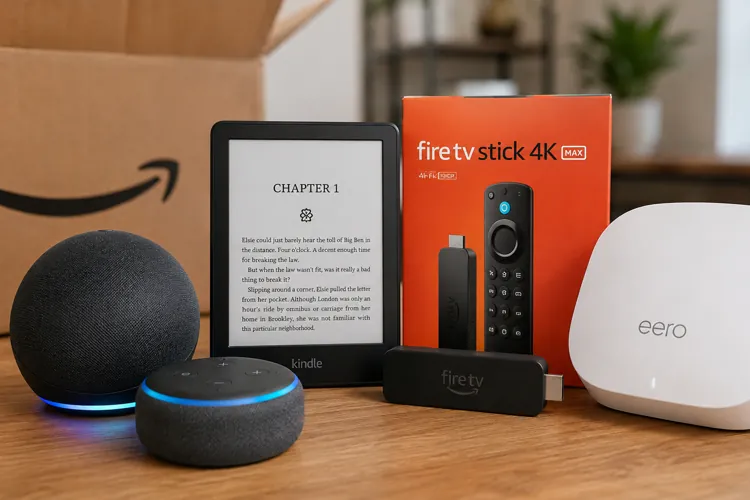

Amazon raised prices on a long list of devices: The Echo Dot is jumping from $49.99 to $79.99, while the Kindle 16GB jumped higher by $40.
Don't assume Amazon has the best price: Other retailers like Target may still have inventory available at the old prices.
Waiting could pay off: Amazon says it plans to run promotions across its device lineup throughout the year so pay attention to deals as we approach the holidays.
Thinking about buying an Echo, Kindle, or Fire TV? Do some comparison shopping first.
Amazon raised prices across much of its device lineup on Aug. 21, with increases hitting Echo speakers, Kindle e-readers, Fire TV streaming devices, and eero Wi-Fi systems.
And some increases are significant.
The Echo Dot jumped from $49.99 to $79.99 — a 60% increase. The 16GB Kindle went from $109.99 to $149.99, while the Kindle Paperwhite increased from $159.99 to $199.99.
The Fire TV Stick 4K Max climbed from $59.99 to $84.99, and the eero Pro 7 three-pack went from $699.99 to $799.99.
Amazon attributed the increases to rising memory and storage component costs.
Here's how shoppers can avoid overpaying.
Check other retailers first
When a manufacturer raises its price, every retailer doesn't necessarily change its price at the same time. Stores may still have inventory available at the old price.
TechRepublic reported that Target was still listing the Echo Dot for $49.99 on Aug. 26 — that's Amazon's old price and $30 below its new $79.99 price.
There's no guarantee this will necessarily last, but it illustrates why comparison-shopping matters right now.
Pro tip: Search the exact model at Target, Best Buy, Walmart, and other retailers. Make sure you're comparing the same generation and storage capacity.
Don't assume the new price is what you should pay
Amazon's new list price doesn't mean you have to pay it.
The company says it plans to offer promotions across its device lineup throughout the year. So if your current Echo, Kindle, or Fire TV still works, consider waiting for a sale.
And remember what these products used to cost. A future Echo Dot sale at $59.99 may look good compared with its new $79.99 price, but its previous regular price was $49.99.
Know which prices changed
A few notable increases include:
Echo Dot: $49.99 → $79.99
Kindle 16GB: $109.99 → $149.99
Kindle Paperwhite 16GB: $159.99 → $199.99
Fire TV Stick 4K Max: $59.99 → $84.99
Fire TV Cube: $139.99 → $199.99
eero 7 three-pack: $349.99 → $399.99
eero Pro 7 three-pack: $699.99 → $799.99
Ring cameras and video doorbells reportedly weren't included in the increases, nor was the Echo Studio.
Check the price history
Before buying, check what the device has actually sold for in recent months.
A price tracker such as CamelCamelCamel can show Amazon price history and help you determine whether today's "sale" is actually good. Or you can use Amazon’s own internal ‘check the price history’ feature.
That's especially useful after a price increase as a retailer might eventually advertise a device as $20 off its new price while still charging more than shoppers routinely paid before Aug. 21.
Pro tip: It’s smart to screenshot or save the old prices listed above. They'll make useful benchmarks when holiday deals start appearing so you can figure what’s actually a bargain.
It's time to consider competing products
A large price increase can change whether an Amazon device is still the best value.
If you wanted an Echo Dot because it was an inexpensive smart speaker, $79.99 deserves more comparison shopping than $49.99 did.
The same applies to Fire TV and eero.
Get in the habit of comparing the price on competing smart speakers, streaming devices, and mesh Wi-Fi systems rather than automatically buying the Amazon option.
Why are prices rising?
Amazon says the electronics industry is facing significant increases in memory and storage component costs.
The price increase can be attributed to growing demand for memory used by AI data centers which has contributed to tighter supplies, thus putting pressure on electronics manufacturers.
That means Amazon may not be the only company where shoppers encounter higher hardware prices in the near future.