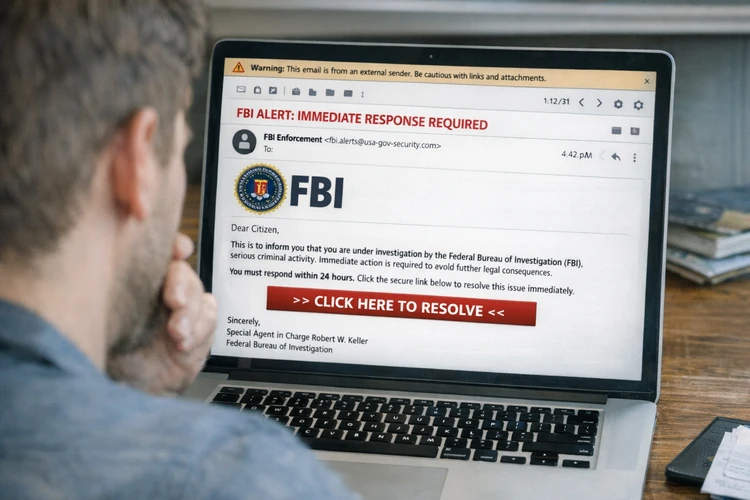

Scammers are increasingly posing as FBI agents, using fear and urgency to pressure people into sending money or sharing sensitive information
Losses from government impersonation scams have surged, with reports doubling year over year and costing victims hundreds of millions of dollars
Red flags include unsolicited contact, urgent legal threats, demands for payment, and requests for secrecy — and real law enforcement will never ask for money this way
Getting a call from the FBI would rattle just about anyone — and scammers are counting on that reaction.
A growing number of fraudsters are posing as federal agents, reaching out by phone, email, or text with alarming claims that pressure people to act fast. Whether it’s a supposed criminal investigation or a warning about financial trouble, the goal is the same: create panic and push victims into making quick decisions they might not otherwise make.
ConsumerAffairs spoke with Silviu Stahie, a security analyst at Bitdefender, who explained that these scams are becoming more convincing by the day.
Increase in FBI impersonation scams
Stahie explained that the FBI’s Internet Crime Complaint Center reported receiving more than 1 million complaints in 2025, and government impersonation scams alone accounted for over 32,000 complaints and nearly $800 million in losses.
“If we look at 2024, with $400 million in losses from this type of scam, we can easily see a 100% increase,” Stahie said. “Unfortunately, this shows that the scam works, and we can expect an increase in the coming years as attacks become more sophisticated.”
Scammers are gathering data
For these types of scams, criminals rarely use a single information source.
“They gather data from data breaches, publicly available social media profiles, scraped profiles, and recycled information from previous scams that worked,” Stahie explained. “In fact, once someone becomes a victim, there’s a good chance that attackers will try again at a later date.
“People don’t realize just how much personal information about themselves is out there. And, for the most part, that information is shared voluntarily on social media, forums, and many other channels. Even if they’ve been careful not to share anything about their private life, the online services people use daily can get compromised.”
Know what to look for
Stahie said that despite the increase in sophistication, these scams follow the same pattern. Here are some red flags to look for:
These scams usually begin with unsolicited contact and quickly escalate into a situation involving urgency or legal threats.
Criminals will say that the victims are part of an investigation, have missed a legal obligation, or need to act urgently to avoid consequences.
The urgency is the first pivot in the attack, as cyber criminals need the victims to believe they must act NOW.
The financial request itself is another big red flag. Any demand for money, especially for wire transfers, gift cards, or cryptocurrency, should raise suspicion immediately.
Another thing to look for: the pressure for secrecy, as attackers often warn victims that they can’t contact anyone else.
“The clearest rule we can follow is simple: no law enforcement agency will ever ask for money or sensitive financial information over the phone or via unsolicited messages,” Stahie said.
Healthy skepticism can help
With much of our lives existing digitally, Stahie says that healthy skepticism can be one of the best ways to protect ourselves.
“Healthy skepticism is the first line of defense,” Stahie said. “Any unexpected communication that involves urgency, authority, or financial requests should be treated with the same measure. Close any communication, verify the claims independently and contact law enforcement.
“Reducing your digital footprint is also vital. The less publicly available personal information, the harder it becomes for scammers to build convincing narratives. On the technical side, tools that filter or block suspicious calls can significantly reduce exposure to these attacks. Free online tools such as Reverse Phone Number Lookup scan security databases to verify callers and determine if a call is safe, spam, or a potential scam.”