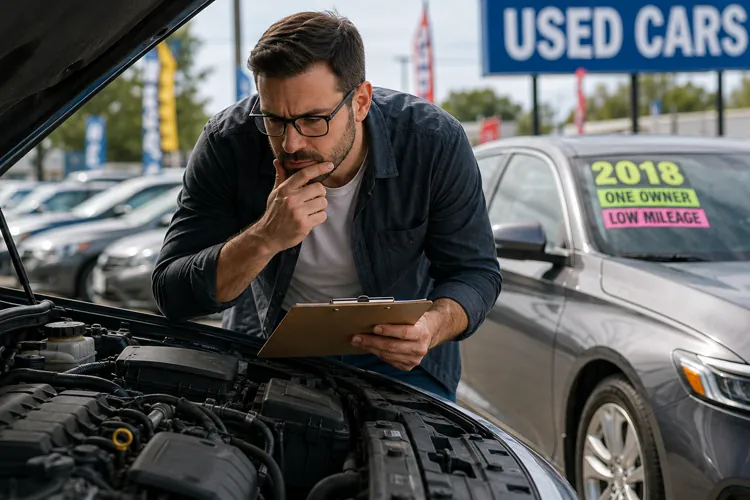

Six years may be the sweet spot: Depreciation tends to level off after year five, making a well-maintained older car a potential bargain.
Condition matters more than age: Mileage, maintenance history, and a pre-purchase inspection can reveal more than the model year.
Save money for repairs: Keep at least $1,000 available for maintenance and unexpected repairs after buying.
The conventional wisdom when buying a used car is pretty simple: Buy the newest vehicle you can afford. But that could have you paying more than necessary.
A Bumper analysis of vehicle depreciation and repair costs found that the fifth year of a car's life brings the first significant jump in repair costs, while depreciation tends to level off after that point.
So is buying newer really better?
ConsumerAffairs interviewed Jeffrey N. Ross, an automotive expert at Bumper with more than two decades in the automotive industry, and his advice is don't get too hung up on the number of candles on the car's birthday cake.
A well-maintained 6-year-old vehicle may actually offer a better combination of price, remaining life, and expected repair costs than the newer car sitting next to it.
Here's what Ross says used-car shoppers should look for.
Don't shop by the vehicle’s age alone
A 6-year-old car isn't automatically a better buy than an 8-year-old one, and a 4-year-old vehicle isn't necessarily the safer financial choice. Things like mileage, condition, and maintenance history often matter more than the age of the vehicle.
"Specific repairs are generally dependent more on mileage and maintenance than on pure vehicle age," Ross told ConsumerAffairs.
A typical 5-year-old vehicle may have around 60,000 miles, according to Ross. That's when buyers can begin encountering worn suspension components and brakes, along with more expensive scheduled maintenance such as transmission service.
By eight years, a typical vehicle may be approaching 100,000 miles, when Ross says repairs can start involving the water pump, air conditioning, and timing belts on vehicles equipped with them.
So instead of asking only "How old is it?" ask: "What maintenance should have been done at this mileage — and was it actually done?"
Pro tip: Before looking at a particular model, find its factory maintenance schedule online. If a major service is due at 100,000 miles and the car has 97,000 miles, factor that expense into what you're willing to pay.
Some brands may have considerably more life left
Here's where Bumper's numbers get particularly interesting.
Its analysis found that at around 105,000 miles, Toyota, Lexus, Honda, and Acura vehicles may have approximately 42% of their expected lifespan remaining.
For Mazda, Subaru, Hyundai, Kia, GMC, Chevrolet, Ford, and Nissan, the estimate was closer to 32%.
That doesn't guarantee a 105,000-mile Toyota will be trouble-free or that another brand won't last much longer. Maintenance and individual vehicle condition can make an enormous difference.
But it illustrates why mileage alone shouldn't automatically scare you away. A higher-mileage car that's been meticulously maintained could be a better purchase than a lower-mileage vehicle whose owner neglected it.
Look for signs the seller knows something you don't
Here's a question worth asking yourself when looking at any used vehicle: “Why is this person selling it right now?”
Sometimes the answer is completely innocent. Other times, the owner may have just learned that a $3,000 repair is coming.
Ross recommends reviewing the vehicle's history and getting a professional pre-purchase inspection.
But there are clues shoppers can spot themselves.
A suspiciously spotless engine compartment could mean someone cleaned away evidence of fluid leaks. Dark engine oil or transmission fluid can suggest poor maintenance.
And pay attention if the car is already running when you arrive.
Ross says a seller can pre-warm an engine to conceal symptoms that are more noticeable during a cold start, such as timing-chain rattles.
Another potential clue is a sudden end to an otherwise consistent maintenance history. If regular oil changes and tire rotations abruptly stopped, it's worth asking why.
Pro tip: When scheduling the test drive, ask the seller not to start the car before you arrive. You want to see and hear how it behaves from a completely cold start. Then when you’re on the test drive, be sure to press every expensive button. Check the A/C at full blast, power seats, windows, locks, cameras, infotainment system, heated seats, sunroof, and every other electronic feature. Small problems can become surprisingly expensive repairs in modern vehicles.
Spend the $150 before you spend $15,000
This may be Ross' most valuable piece of advice. Be sure to get a pre-purchase inspection from an independent mechanic.
Ross estimates it'll cost around $150. "The best $150 (ish) a buyer will ever spend!" he said.
A mechanic can look for fluid leaks, worn brakes and suspension, previous collision repairs, trouble codes, and other problems that aren't obvious during a quick test drive.
And don't let a clean vehicle-history report replace an inspection.
A history report can provide valuable information about mileage, ownership, accidents, and documented maintenance. But it can't tell you everything that's mechanically wrong with the car today.
Pro tip: If a seller refuses to let an independent mechanic inspect the vehicle, that may tell you everything you need to know. There are plenty of other used cars.
Have $1,000 left after you buy the car
Don't spend every dollar of your used-car budget on the car itself.
Bumper's data found that average repair costs jump about 31% in year give to roughly $760. By year eight, average repair costs reach about $1,079.
For this reason, Ross recommends having at least $1,000 set aside for immediate maintenance or repairs. He even goes a bit further and recommends putting aside another $100 per month moving forward.
If you’re buying a luxury or performance vehicle, he recommends an even bigger cushion as parts and labor can be quite a bit more expensive.
So, the takeaway is this, if you have $16,000 available, don't go out and buy a $16,000 car. Instead, consider buying a $15,000 vehicle, or negotiate the price down to $15,000, and keep the remaining $1,000 untouched for possible repairs.
A 6-year-old car may beat a 4-year-old one
This might be the most surprising takeaway from Ross.
Imagine choosing between a more expensive 4-year-old car that's still under warranty and a cheaper 6-year-old version of the same reliable model.
Ross would generally take the six-year-old. "Financially, the 6-year-old car is usually the better overall buy because, on average, a car has reached its depreciation floor after year five," he said.
The newer vehicle's remaining warranty certainly has value, particularly with a luxury model that could be expensive to repair.
But if you're financing the car, there's something else to consider. That warranty could expire long before you've finished making payments, potentially leaving you with both a higher car payment and repair bills.
Ross says opting for the cheaper 6-year-old vehicle and maintaining an emergency repair fund will generally leave a buyer ahead, assuming it's a reliable model with a documented service history.
Pro tip: It’s smart to price an insurance policy before you buy. Two similarly priced used cars can have very different insurance costs, often based on factors like repair costs, theft risk, and the vehicle’s claims history. Also, be sure to get a quote using the actual VIN before signing anything so there won’t be any insurance premium surprises down the road.
The used-car sweet spot isn't really an age
Six years may look attractive in the data, but don't turn it into another rigid buying rule.
A poorly maintained 6-year-old car can be a terrible purchase. A meticulously maintained 9-year-old vehicle could be an excellent one.
Instead, look at age + mileage + maintenance history + inspection + price.
Run the VIN and examine the vehicle's history. Compare the odometer against previous mileage records. Look for consistent maintenance. Take a real test drive. And pay an independent mechanic to inspect it.
Most importantly, don't use every dollar you have just to get the newest car possible.