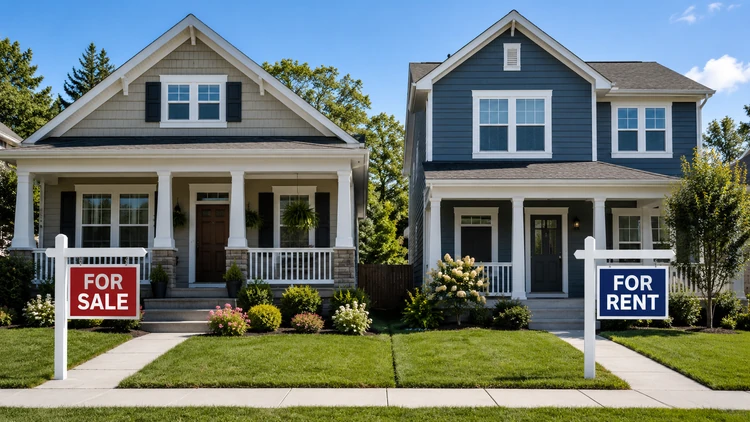

Zillow finds the typical U.S. homebuyer now breaks even on a home purchase after about six years, down from a peak of 8.4 years in 2023.
In some Midwest and Southern metros, buyers can come out ahead of renters in as little as four years, while in several expensive coastal markets renting remains cheaper even after 30 years.
Researchers say the rent-versus-buy decision increasingly depends on location, expected length of stay and lifestyle preferences.
A home purchase is once again becoming a better financial bet for many Americans, though where you live remains the biggest factor in determining whether buying beats renting.
A new Zillow analysis found the typical U.S. homebuyer reaches the financial break-even point after about six years, meaning the costs of buying and owning a home are eventually offset by the benefits of homeownership compared with renting. That timeline has improved significantly from a peak of 8.4 years in October 2023.
The study found large differences among metropolitan areas. Buyers in Columbus, Ohio, Memphis, Tenn., and Buffalo, N.Y., can break even in about four years, while buyers in Indianapolis also face a relatively short payback period.
At the other end of the spectrum, Zillow found that buying never becomes financially advantageous over renting during a 30-year mortgage term in San Francisco, San Jose and New Orleans because of the combination of high home prices and local rent levels.
"For generations, Americans have been told that buying a home is the smartest financial move they'll ever make," Zillow senior economist Orphe Divounguy said in announcing the findings.
He said the research shows that both renting and buying can be smart financial choices depending on the market.
What changed?
According to Zillow, conditions for buyers have improved in recent years, shortening the time required for ownership to outperform renting. The analysis examined the financial outcomes of buying versus renting over the life of a 30-year fixed-rate mortgage in each of the nation's 50 largest metropolitan areas.
The model included mortgage payments, property taxes, insurance, maintenance expenses and closing costs. It also accounted for the opportunity cost of tying up money in a down payment rather than investing it elsewhere.
One finding challenges conventional wisdom about down payments. Zillow said buyers who make smaller down payments may sometimes reach the break-even point sooner because they can keep more money invested. In Cincinnati, for example, a buyer putting 5% down breaks even about six months earlier than a buyer putting 20% down.
More than a financial decision
While the study focuses on economics, Zillow researchers stressed that housing decisions also involve lifestyle considerations.
Buying offers benefits such as building equity, payment stability and the ability to customize a home. Renting, meanwhile, provides flexibility, fewer maintenance responsibilities and greater access to cash for other investments.
The report suggests that Americans planning to stay in one place for more than six years may find buying increasingly attractive, especially in lower-cost markets. Those expecting to move sooner or living in some of the nation's most expensive housing markets may still come out ahead by renting.