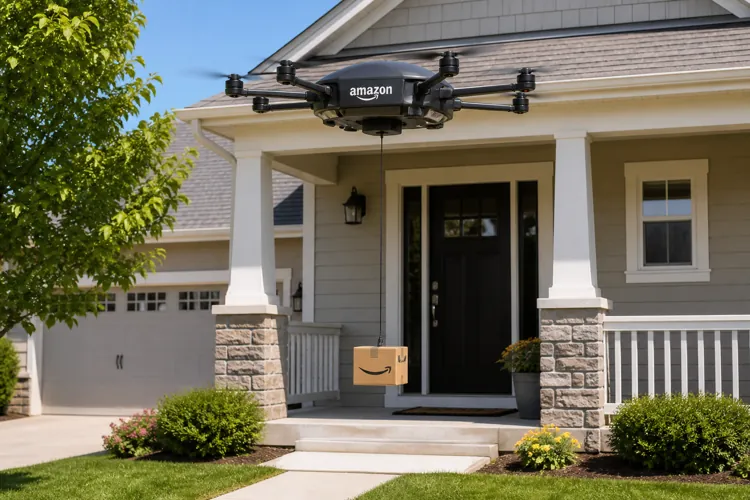

Amazon plans to expand its Prime Air drone delivery service to nearly 500 U.S. cities and towns by the end of 2026, roughly six times its current footprint.
The service can deliver eligible packages weighing up to 5 pounds in as little as 30 minutes, with most orders arriving about an hour after checkout.
The expansion could make delivery drones far more common over American neighborhoods, while renewing questions about safety, noise, privacy and the economics of replacing traditional last-mile deliveries.
Amazon is preparing for its biggest expansion yet of drone delivery, with plans to bring its Prime Air service to nearly 500 cities and towns across the United States by the end of 2026.
The expansion represents a sixfold increase from Prime Air's current footprint and will bring drone deliveries to communities around major metropolitan areas including Chicago, Atlanta, Cleveland, Syracuse, New York, and Boise, Idaho. Amazon currently operates the service from 11 U.S. locations.
The move could turn what has largely been an experimental delivery option into a much more visible part of Amazon's logistics network.
"We've already delivered hundreds of thousands of packages to customers by drone this year," David Carbon, vice president of Amazon Prime Air, said in announcing the expansion. Amazon says the service will reach communities encompassing tens of millions of customers by year's end.
What customers can get by drone
Prime Air is designed for relatively small orders. Nearly all products weighing 5 pounds or less and fitting inside a large shoebox can qualify, according to Amazon. The company says that covers more than 60% of the products its customers buy most frequently.
Eligible products include groceries, household goods, electronics and medications. Deliveries can arrive in as little as 30 minutes, although Amazon says most reach customers about 60 minutes after checkout.
Prime members will receive free drone delivery on orders of at least $50. Prime orders below that threshold carry a $2.99 delivery fee.
A much bigger presence over neighborhoods
Amazon's expansion will rely on its electric MK30 drone, which has a maximum operating range of 7.5 miles. FAA documents for proposed Prime Air operations show that an individual delivery center can potentially cover about 174 square miles.
The scale could be substantial. For proposed Chicago-area operations, for example, Amazon has sought approval for three drone delivery centers. FAA documents say each center could handle as many as 1,000 MK30 delivery flights per operating day, seven days a week, although actual traffic would depend on demand and other conditions.
Amazon says its autonomous drones use multiple safety systems, including Detect-and-Avoid technology that monitors surrounding airspace and allows the aircraft to make decisions while flying.
Safety, noise and privacy remain concerns
Rapid expansion also means Amazon will have to convince more communities that thousands of autonomous flights can coexist safely with homes, businesses and existing air traffic.
Drone delivery companies have faced regulatory hurdles as well as public concerns about crashes, privacy and noise. Weather can also restrict operations, and the industry is still working to make individual drone deliveries cost-competitive with packages transported by vans, cars or bicycles.
The FAA's environmental review process illustrates the scrutiny accompanying the rollout. Amazon's proposed Chicago operations, for example, underwent a public-comment period as the FAA evaluated potential environmental effects. The agency has conducted similar reviews of Prime Air operations in states including Florida, Nebraska, Arizona and Michigan.
Amazon isn't alone in the race
The expansion comes as some of the country's biggest retailers and delivery companies increase their own investments in drones.
Walmart has been expanding drone delivery through a partnership with Alphabet-owned Wing, while DoorDash has pursued commercial drone operations and received a key FAA certification in July. The growing competition suggests companies increasingly view drones as a potential piece of the last-mile delivery network rather than simply a technology demonstration.
For Amazon, however, conventional delivery will remain overwhelmingly dominant for now. The company already provides same-day delivery of millions of products in more than 10,000 U.S. cities and towns.