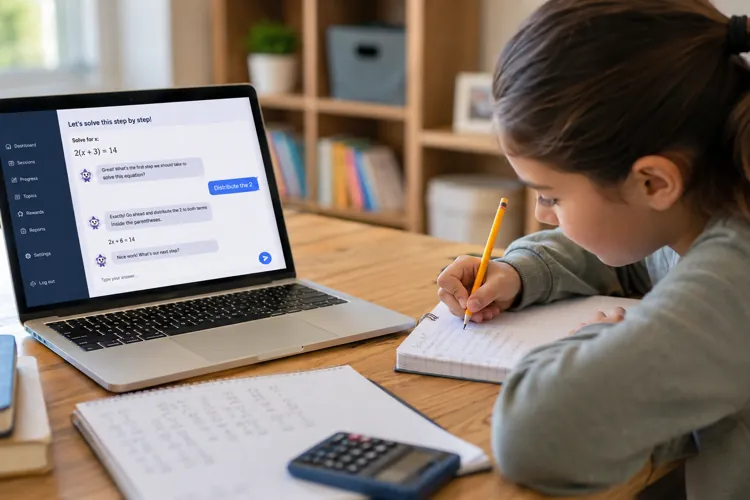

The best AI tutor shouldn't simply hand over answers. Look for tools that break problems into steps, ask questions, and make your child do the thinking.
Set one simple rule: Try it yourself first. If your child reaches for AI before attempting the problem, it may be becoming a homework crutch.
Test whether they're actually learning. Take the AI away and ask your child to explain or solve a similar problem on their own.
As students increasingly use artificial intelligence for homework help, parents face a new problem of figuring out whether AI is actually teaching your child or simply doing their homework for them.
ConsumerAffairs interviewed Ashish Bansal, a tech executive and father who created AI-powered math tutor StarSpark.AI, who says parents should pay less attention to whether AI gets the right answer and more attention to how it gets their child there.
“Watch what happens when your child asks for the answer,” Bansal told ConsumerAffairs. “A real teacher doesn't just hand it over. It asks a question back, breaks the problem into steps, and makes the child do the thinking.”
So before turning AI into your family's new math tutor, here are some ways to make sure your child is actually learning.
1. Give your child the closed-laptop test
There's an incredibly simple way to determine whether AI taught your child something.
Take the AI away. After your child gets help solving a problem, close the laptop or put down the phone and ask them to explain how they got the answer.
“If they can, it's teaching,” Bansal said. “If they can't, it's copying.”
You can take the experiment one step further by giving them a similar problem and see if they can solve it without AI.
This helps expose one of the biggest potential problems with AI homework assistance: It can make tonight's homework look successful without preparing your child for tomorrow's test.
Parents should also look at progress over several weeks. Are they getting faster? Are they asking for less help? Can they solve problems that previously gave them trouble?
Or are they returning to AI every time they encounter the same type of equation?
Pro tip: Once or twice a week, pick one problem similar to something your child completed with AI assistance and have them solve it without AI. Consider it a two-minute reality check.
2. Establish one simple rule: Try it yourself first
You probably don't need a 12-page family AI policy.
Instead, Bansal recommends starting with one straightforward rule: Try the problem yourself first. Then use AI to get unstuck.
That changes AI from an answer machine into something closer to raising your hand and asking a teacher for help.
“The line is about who does the thinking,” Bansal said. “If the AI explains a step and your child does the work, that's help — the same as a good tutor or a patient parent.”
But if AI generates the completed answer and your child copies it?
“They've only cheated themselves out of the learning,” he said.
There's another behavior parents should watch closely: When does your child reach for AI?
If they read a difficult problem, struggle with it, and then ask AI to explain something, the technology is serving a useful purpose. If they open AI before even attempting the problem, it may already be becoming a crutch.
3. Look for these AI tutoring red flags
Parents shouldn't assume that something marketed as an “AI tutor” necessarily behaves like a good tutor.
Specifically, Bansal identified several warning signs worth watching:
Your child can't solve the same type of problem without AI.
It gives your child the final answer immediately.
There's no dashboard, history, or progress report for parents.
The AI regularly gets the math wrong.
That last one might be especially surprising. General-purpose AI chatbots can produce incorrect answers, according to Bansal, making accuracy something parents should consider when choosing a tool.
And don't be fooled by those overly confident explanations bots toss back to you. It’s no secret that an AI response can sound absolutely convincing and still be wrong.
Pro tip: Before letting your child regularly use an AI math tool, give it several problems where you already know the correct answers. Also, ask it to explain why the answer is correct. By framing it this way, you're testing the tutor before letting the tutor test your kid.
4. Don't let AI become invisible
Bansal recommends keeping AI homework use out in the open rather than having kids disappear behind a closed bedroom door with it. That doesn't mean parents need to hover over every equation. Instead, periodically ask what your child is using AI for.
Specifically, have them show you an interaction. Is the AI asking questions and providing hints? Or is your child typing in homework questions and copying whatever appears?
When picking an AI tool to help your child, try to make sure there’s a parent dashboard or chat history available. This can be super useful because it lets you see progress without constantly supervising.
StarSpark, for example, is designed around mastery, according to Bansal. Students move forward once they understand a concept, and the system walks them through steps rather than simply providing the final answer, even when they ask for it.
That's an important feature to look for in any AI tutor.
5. Know when your kid needs an actual person
AI has one significant limitation: It's not human.
A good tutor doesn't only understand math, they can also recognize when a child is frustrated, embarrassed, anxious, distracted, or ready to give up.
There's also built-in accountability when dealing with a human tutor. “A tutor appointment is a fixed time,” Bansal said. “Your child has to show up and be ready.”
That structure can be particularly important for children who struggle with discipline or motivation.
Bansal says a human may also be a better choice when a child has significant math anxiety, a diagnosed learning difference, or an IEP, or has fallen several years behind academically.
And sometimes the best solution doesn't have to be AI or a human. It can actually be both.
AI might provide everyday practice and quick homework assistance, while a tutor handles more difficult concepts and the motivational side of learning.
Parents can then provide the structure. “You don't need to know the math,” Bansal said. “You just need to set the time, keep it consistent, and show your child it matters.”