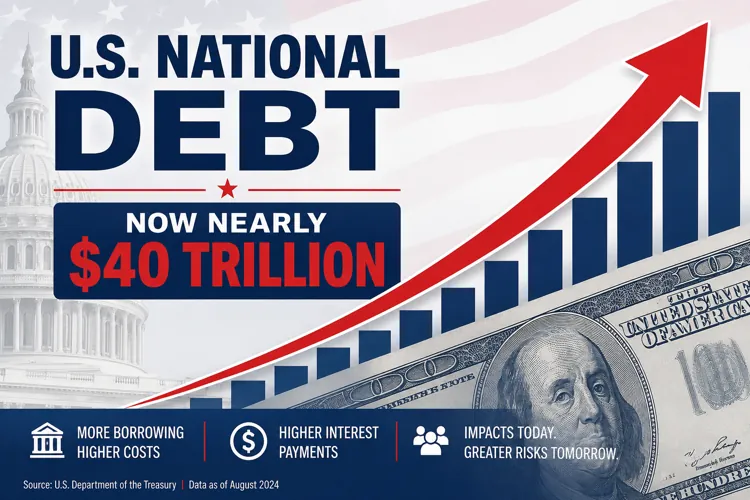

The U.S. national debt is hovering around $40 trillion, according to the latest available Treasury Department data.
Rising debt doesn’t automatically make household borrowing more expensive, but persistently large federal borrowing can put upward pressure on longer-term interest rates and leave the government spending more of its budget on interest.
For consumers, the longer-term consequences could show up through higher borrowing costs, slower economic growth, or difficult choices in Washington over taxes and government spending.
The federal government’s debt is approaching another major milestone, and while $40 trillion may be difficult for the average household to put into perspective, the consequences of an increasingly indebted government could eventually become much more tangible.
The U.S. Treasury Department’s latest available daily figures put total public debt outstanding at roughly $39.9 trillion in August. Of that, about $32.2 trillion is debt held by the public, with the remainder consisting largely of intragovernmental holdings. The Treasury updates its Debt to the Penny figures at the end of each business day.
The national debt represents the accumulation of years in which federal spending, along with other financing needs, has exceeded revenue. When the government runs a budget deficit, it generally borrows to make up the difference by issuing Treasury securities.
And deficits remain large. The Congressional Budget Office projects a federal budget deficit of about $1.9 trillion in fiscal year 2026. Debt held by the public is projected to equal roughly 101% of the nation’s gross domestic product this year.
For consumers, however, the most important question isn’t simply how large the debt gets. It’s what happens as the government has to borrow more money — and pay interest on what it has already borrowed.
More debt means a bigger interest bill
Just like a household carrying a large credit card balance, the federal government has to pay interest on its debt.
The scale is already substantial. CBO projects that net federal interest spending will total about $1.04 trillion in 2026. By 2036, it projects annual net interest costs of more than $2.1 trillion, assuming current laws generally remain in place.
That matters because money spent servicing debt is money Congress cannot use for other priorities without raising additional revenue or borrowing even more.
Over time, lawmakers facing higher interest costs could confront tougher decisions involving taxes and federal spending. Those decisions could potentially affect programs, benefits, and services that households use, although exactly how Congress would respond is a political choice rather than an automatic consequence of reaching a particular debt level.
How debt affects citizens
Could the national debt make mortgages and other loans more expensive?
Potentially, but the relationship isn’t as simple as the national debt rising one day and mortgage rates increasing the next.
The federal government competes with other borrowers for capital. When the Treasury needs to issue large amounts of debt, investors may demand higher yields to hold those securities, particularly if they become concerned about inflation, fiscal sustainability, or the supply of government bonds.
Higher Treasury yields can ripple through financial markets because Treasury securities serve as benchmarks for many other interest rates.
That means persistently higher government borrowing costs can contribute to higher rates on products such as mortgages, business loans, and some other forms of consumer credit.
Federal debt is only one factor influencing borrowing costs. Federal Reserve policy, inflation expectations, economic growth, and conditions in financial markets can have much larger effects at any given moment.
CBO currently projects the yield on 10-year Treasury notes will rise from about 4.1% in 2026 to 4.3% in 2027 and gradually increase over the following years as investors demand a larger premium for holding longer-term bonds.
For a homebuyer, even relatively small differences in long-term interest rates can translate into significant changes in monthly payments over a 30-year mortgage.
The bigger concern may be years away
There is no universally agreed-upon level at which the national debt suddenly becomes a crisis. The United States also has significant advantages as a borrower, including a large economy and the dollar’s central role in the global financial system.
The concern among budget analysts is instead the trajectory.
CBO projects that debt held by the public will climb from roughly 101% of GDP in 2026 to 120% by 2036, exceeding the previous record set following World War II. If current policies broadly continued beyond then, CBO projects the ratio would keep rising.
At the same time, net interest payments are projected to rise from 3.3% of GDP in 2026 to 4.6% in 2036. Rising interest expenses account for much of the projected growth in federal deficits over that period.
A sustained increase in federal borrowing can also reduce the amount of capital available for private investment over the long run. Less investment can mean lower productivity and slower growth in wages and living standards than would otherwise occur.
Those effects tend to develop gradually, making the national debt less like an unexpected bill arriving in consumers’ mailboxes and more like a growing constraint on the economy.
What consumers should watch
For households, the $40 trillion headline may be less useful than several numbers connected to it.
One is interest rates, particularly yields on longer-term Treasury securities, because they can influence borrowing costs throughout the economy. Another is the annual federal deficit: Continued trillion-dollar deficits mean the government is likely to keep adding substantially to its debt.
Consumers can also watch federal interest expenses. The faster those costs rise, the greater the pressure they can place on the rest of the federal budget.
Finally, future tax and spending proposals may become increasingly important to household finances as lawmakers debate how — or whether — to slow the growth of the debt.
For now, a national debt approaching $40 trillion does not mean an immediate financial shock for American households. But if debt continues rising faster than the economy for decades, consumers could increasingly feel its effects through borrowing costs, economic growth, and the choices Washington makes about where taxpayer dollars go.