

Best antique moving companies
We compared moving companies based on customer satisfaction, packing quality, damage prevention, storage options and overall value to identify the best choices for protecting valuable antiques during a move. Read our methodology below to learn how we picked the best moving companies to handle your antiques.
| Company | Customer rating | Our pick for | Discounts | Quote for two-bedroom move, Chicago to Kansas City | USDOT number | |
|---|---|---|---|---|---|---|
 International Van Lines | Get a Quote | 4.6 | Best overall | None specified | $4,252 | 2293832 |
 Roadway Moving | Learn More | 4.9 | Packing satisfaction | Referral | $4,331 | 1854436 |
 Northern Moving Systems | Learn More | 4.6 | Customer service | None specified | $3,947 | 4216383 |
 PODS | Learn More | 4.5 | Budget antique moves | Military, friend referral, long-term storage | $2,694 | 1397252 |
 Colonial Van Lines | Get a Quote | 4.3 | Antique storage options | Seasonal | $5,087 | 1434373 |
International Van Lines

- Storage options and packing services
- Full-service packing, unpacking, short- and long-term storage options
- Deposit
- Varies (25% is common)
- Local moves
- Limited
- International moves
- Yes
Roadway Moving

- Storage options and packing services
- Full-service packing, unpacking, secure and climate-controlled short- and long-term storage options
- Deposit
- Undisclosed
- Local moves
- Yes
- International moves
- Yes
Northern Moving Systems

- Storage options and packing services
- Custom packing, moving supplies, climate-controlled storage
- Deposit
- About 25%
- Local moves
- Yes
- International moves
- Yes
PODS

- Storage options and packing services
- Flexible storage solutions, packing and loading services through third-party partners
- Deposit
- Varies
- Local moves
- Yes
- International moves
- Yes
Colonial Van Lines

- Storage options and packing services
- Full-service packing and climate-controlled storage options for long-distance moves
- Deposit
- 33% to 40%
- Local moves
- No
- International moves
- No
Antique moving services and packing options
Unlike standard movers, antique specialists treat each piece as irreplaceable — because many are.
“Our work begins with understanding the history, material composition and vulnerability of each piece,” said Beau Roskow, owner of Naglee Moving & Storage Inc., a fine art and antiques relocation company in Elmira, New York. “No two antiques behave the same in transit.”
When booking an antique mover, look for these services:
- Custom crating: Specialized movers build each crate from scratch to fit the specific item. For example, “a 19th-century marble-top dresser requires a floating crate system that isolates the stone from vibration, while a gilded mirror may require a shadowbox-style crate with zero surface contact,” Roskow noted.
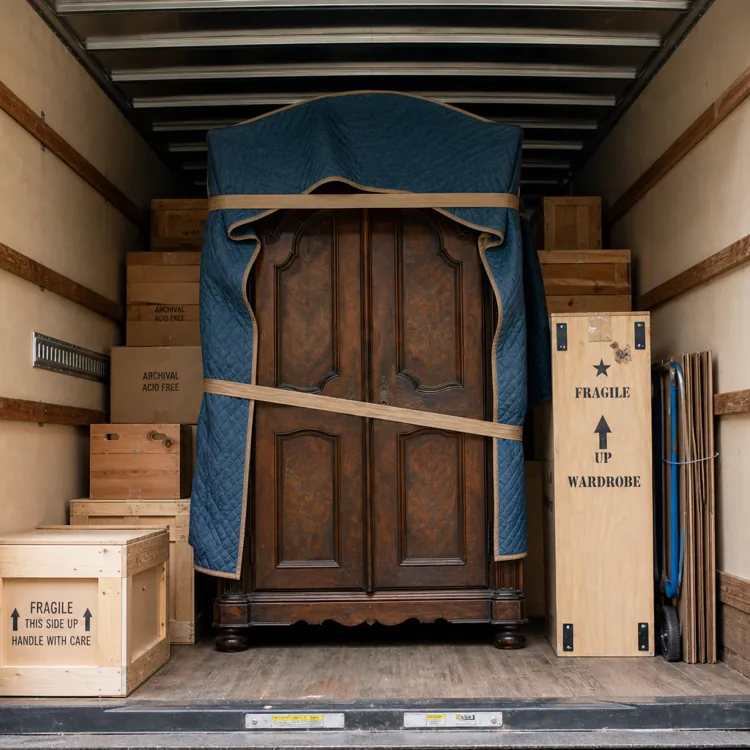
- Museum-grade packing: Archival materials like acid-free tissue, polyethylene foam and moisture barrier films protect finishes that standard moving blankets can’t. “We treat the process more like conservation handling than moving,” added Roskow.
- Climate-controlled transport and storage: Wood, canvas and mixed-media pieces are sensitive to environmental changes. “Temperature and humidity fluctuations can cause warping, cracking or mold growth,” Roskow explained.
- Air-ride suspension trucks: These vehicles absorb road vibrations, reducing the risk of damage to irregularly shaped or fragile pieces in transit.
- White-glove handling: Trained crews use specialized techniques to move fragile items like grandfather clocks, chandeliers and marble safely.
- Professional disassembly and reassembly: Some pieces are too bulky or fragile to move intact. Specialized movers take them apart, transport them safely and put them back together at the other end.
- Condition reporting and documentation: A dependable mover photographs and documents everything before the truck pulls away. If something looks different when it arrives, you have documentation to back up your claim.
Antique moving costs and estimates
What you pay depends on how far you’re going, what you’re moving and how much protection it needs. For jobs within about 40 miles, movers typically bill by the hour. Beyond that, Roskow said costs increase by roughly $250 to $350 per additional 100 miles to account for fuel, crew time and equipment.
Expect to pay $80 to $100 per hour for a team of two local movers.
“Pricing is less about distance alone and more about risk, protection level and complexity of execution,” Roskow said. Custom crating, museum-grade packing and climate-controlled transport are the biggest cost drivers.
Valuation coverage is another expense many people overlook. Standard moving insurance reimburses based on weight, so it may barely reimburse you for a 10-pound antique worth $5,000. “Antique valuation is often based on appraised value rather than weight,” explained Roskow. That means coverage tied to what an appraiser says the piece is worth, not to its weight on a scale.
Access challenges add up, too. “We once had to remove a large antique sculpture from a location with limited access,” Roskow recalled. “That move demanded more labor, rigging equipment and precise coordination, which factored into the final cost.”
Common antique moving costs
Here’s a breakdown of common antique moving costs, based on ranges Roskow shared with ConsumerAffairs:
| Typical range | Why it varies | When it applies | |
|---|---|---|---|
| Custom crating | $100 to $7,500+ per item | Small antiques sit on the lower end; large, fragile or high-value items hit $2,000 to $7,500+ | Fragile, irregularly shaped or high-value items |
| Packing labor | $300 to $15,000+ | Time is the biggest driver (fine art packing is slow and methodical; full residences take much longer than single items) | Targeted packing for one to five items versus a full antique residence |
| Valuation coverage | 1% to 3%+ of the declared value | Higher for residential collectors; may exceed 3% for international or multi-stop moves | High-value antiques and collections |
| Stair carries | $100 to $300 per flight | Risk, crew size and time (a marble-top dresser can require four handlers and specialized equipment) | Multi-story homes or buildings without elevators |
| Long carries (50+ feet) | $150 to $500+ per occurrence | Surface type, number of trips and floor protection measures required | When a truck can’t park close to the entrance |
| Climate-controlled transport | $250 to $5,000+ added to the base rate | Short-haul add-ons run lower; dedicated fine art vehicles or exclusive-use transport run highest | Wood, canvas, textiles and mixed-media pieces |
| Storage | $200 to $2,000+ per month | Fine art storage with environmental monitoring and private rooms runs higher; standard climate-controlled runs lower | Moves with gaps between pickup and delivery |
» RELATED: How much does a storage unit cost?
How to choose antique movers
Choosing the right antique mover takes more than a quick “antique movers near me” online search. An unqualified mover can put irreplaceable pieces at risk, and standard insurance rarely covers the full loss.
Here’s what to nail down before you book:
1. Check licensing and credentials
Not all movers are equal — and some aren’t even legal. Interstate movers must carry an active USDOT (United States Department of Transportation) number and Operating Authority (MC number) with the Federal Motor Carrier Safety Administration (FMCSA). If you’re staying in-state, look up the licensing rules in your state.
2. Assess experience with high-value items
A long track record in moving doesn’t automatically mean experience with antiques. “You need demonstrated experience with high-value, fragile items,” emphasized Roskow. Ask for specific examples, such as projects involving fine art, antiques or estate relocations. Then, expect a mover to walk you through their process in detail.
3. Require an on-site or virtual survey
A reputable antique mover won’t quote over the phone. “A thorough on-site or virtual survey is a must,” Roskow said.
Look for the mover to do the following:
- Document each item and its condition before the move
- Flag pre-existing damage to prevent disputes down the road
- Build a tailored handling plan based on what they see
4. Review the contract carefully
Before signing anything, watch out for “Released Value Protection,” which reimburses only $0.60 per pound — far too little for most antiques.
Your contract should spell out the following:
- Valuation coverage tied to what an appraiser says the piece is worth, not the number on a scale
- What packing materials the crew will use, and how they’ll crate fragile items
- A flat-rate quote with no surprises at the door on moving day
- Concrete dates for pickup and delivery, not a window that spans several days
5. Screen reviews and references
Star ratings only tell part of the story. Look for reviewers who describe the actual job — what got moved, how the crew handled it, whether anything went wrong and how the company responded. A glowing five-star review that says “great service!” is less useful than a detailed account of a successful estate move.
FAQ
Do antique movers offer storage services?
Yes, most antique movers offer storage services. Options range from standard units to climate-controlled and fine art-grade facilities, depending on your needs.
What packing materials protect antiques best?
Acid-free tissue paper, custom-molded foam and double-walled boxes are among the best materials for protecting antiques.Avoid newspaper or plastic wrap on wood. Both can cause staining or chemical damage.
How far in advance should I book antique movers?
Aim to book antique movers eight to 12 weeks out. Specialized crews and custom crating fill up fast, especially during peak moving season.
Are antique moving companies licensed differently from regular movers?
No, antique movers hold the same USDOT or state-issued licenses as standard movers. But they often have specialized training and credentials for handling fragile, high-value items.
Methodology: How we chose the best antique movers
The ConsumerAffairs Research Team evaluated antique moving companies using a weighted scoring model that combined verified customer reviews with company offerings and capabilities.
1. Customer satisfaction: We analyzed verified reviews from ConsumerAffairs customers between March 1, 2023, and Feb. 28, 2026, to identify the factors that matter most when moving antiques, collectibles and other valuable items. We then calculated satisfaction scores for:
- Movers
- Customer service
- Punctuality
- Packing quality
- Pricing
- Quote accuracy
- Damage prevention and claims handling
2. Antique moving services and protections: Because antiques often require specialized care, we evaluated each company's services and protections, including:
- Storage options
- Professional packing services
- Available discounts
- Types of moves offered (local, long-distance and international)
- Quote process
- Website quality and transparency
3. Cost and value: Moving valuable antiques can be expensive, so we also considered overall affordability. This included:
- Pricing satisfaction from customers
- Quotes for a sample two-bedroom move from Chicago to Kansas City
- Available discounts
- Overall value compared with services offered
How we chose the winners
Each award category used its own weighted formula based on the needs of that type of customer. For example, our "Best for packing satisfaction" category placed extra emphasis on packing quality and damage prevention, while "Best for budget antique moves" prioritized affordability and moving costs.
Article sources
ConsumerAffairs writers primarily rely on government data, industry experts and original research from other reputable publications to inform their work. Specific sources for this article include:
- Federal Motor Carrier Safety Administration, "Select a Mover." Accessed June 4, 2026.
- Move.org, "How to Pack Your Antiques, Collectibles and Delicates." Accessed June 4, 2026.