


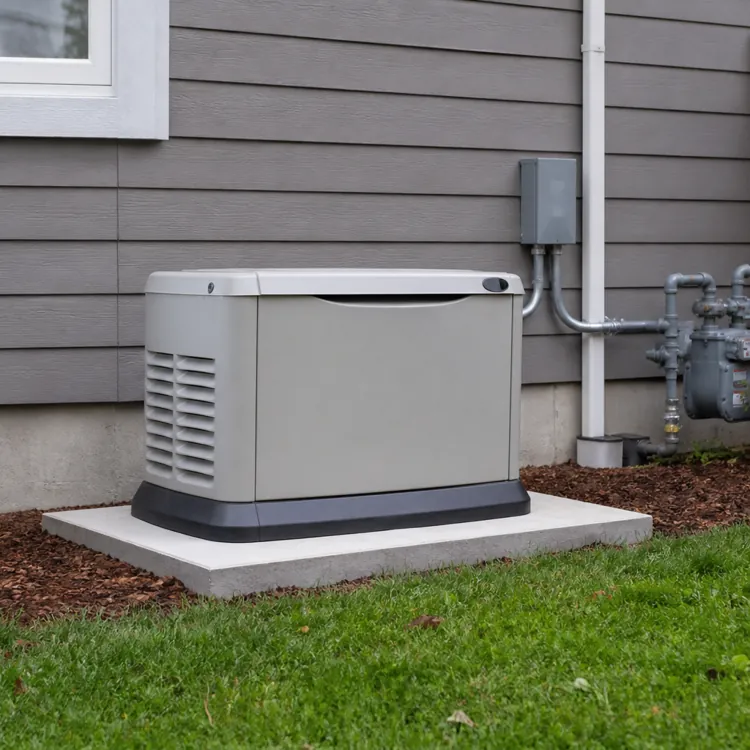
Generator sizes for a 1,500 sq. ft. house
A 1,500-square-foot house usually needs a generator between 5 kilowatts (kW) and 15 kW. However, these are just general guidelines. Size your generator based on your actual power demands, not your square footage.
A 5-kW generator at the lower end of that range may provide enough emergency backup power for:
- Well pumps
- Refrigerator
- Lighting
- Minimal outlet use
As you move toward 15 kW, you can power more of your home, and a 15-kW generator is often enough for whole-home backup, including your heating and cooling system for comfort during outages. However, you may need a larger generator if you want whole-home backup plus power for pool pumps, electric water heaters and electric vehicle (EV) chargers.
Don’t buy based on square footage alone
Size your generator based on the appliances and devices you need to power, then choose a unit with extra capacity for startup surges.
Calculating your wattage helps you determine how much power you’d need to run all your necessary devices and appliances, but you should upsize your unit to account for startup surges. This is especially important for appliances with compressors, which require extra power to start and can temporarily push your power needs beyond your generator’s capacity.
Generator size and cost by power needs
You can use the table below to estimate what size generator you’ll need and compare whole-house generator costs.
| Backup level | What it can power | Wattage requirements | Average cost |
|---|---|---|---|
| Essentials only | Well pump, refrigerator, lights, minimal outlet use | 5,000 to 8,000 | $4,500 to $5,000 |
| Essentials and comfort | Well pump, refrigerator, lights, outlets, fans and one or two window AC units | 8,000 to 12,000 | $4,500 to $10,600 |
| Whole-home backup | Entire home, including heating and AC systems | 12,000 to 15,000 | $5,000 to $12,500 |
| High-demand, whole-home backup | Entire home, including electric water heaters, EV chargers and other items demanding large amounts of power | 15,000 to 20,000 or more | $12,500 to $19,700 or more |
Calculating wattage for a 1,500 sq. ft. house
You can estimate your generator wattage needs by adding the running and starting loads of the appliances and devices you want to use during an outage. If you’re buying a standby generator, ask a professional installer to verify your calculation before choosing a unit. Follow these steps to get started:
Leave a buffer
Choose a generator with 20% to 30% more capacity than your estimated wattage needs to accommodate unexpected demand and avoid running the unit at maximum capacity.
- Make a list of the items you want to run during outages. Start by listing everything you’ll want power for during an outage, including appliances, lighting, devices and essentials, like well pumps. Make sure to include items even if you’ll only use them temporarily during emergencies.
- Figure out what you’ll need to run simultaneously. Think about which items may operate at the same time. For example, your refrigerator and lights may already be running when your well pump turns on, so your generator must be able to power all three.
- Use the running load of those items as a baseline. Find out the running load of each of the items you want to power simultaneously, and write them down. For appliances and HVAC equipment, you can usually find the running load on the unit’s nameplate or in the owner’s manual. For things like light fixtures and outlets, you can safely use average numbers if you know the voltage.
- Make sure to account for starting loads. Next, figure out which items require significantly more electricity during startup than during normal operation. High starting loads are particularly common with items that use compressors, motors or pumps, like refrigerators, freezers, well pumps, sump pumps and air conditioning (AC) units.
- Determine your maximum and running loads. With all of these loads listed, add up the simultaneous running loads and the highest surge loads that your home may call for on top of the running loads. Ideally, this will be the peak power you’ll need your generator to provide.
- Add at least 20% to your estimate as a buffer. Since running a generator at maximum capacity can damage the unit, you should add 20% to 30% to your wattage calculation. This gives you a buffer in case you ever need more power at once.
» FIND OUT: How to size a whole-house generator
Running watts vs. starting watts
Running watts, also called rated watts, is the continuous power a device or appliance uses during normal operation, after it has gone through its startup phase. Starting watts, also called surge watts or peak watts, is the momentary spike a device or appliance uses to start.
Resistive loads, like lights, TVs, microwaves and electric baseboards, usually require just a small amount of additional wattage to start up, and sometimes none at all. Inductive loads, like refrigerators, freezers, AC units and water pumps, have much higher power draws to start before they dip down to their rated watt consumption.
If you can’t find starting watts for inductive loads, you can estimate by multiplying running watts by two to four.
Common appliance wattage ranges
Use the table below to estimate your power needs based on the typical running and starting wattages of common household appliances and devices:
| Device or appliance | Average running watts | Average starting watts |
|---|---|---|
| Central AC | 3,000 to 5,000 | 9,000 to 15,000 |
| Coffee maker | 500 to 1,500 | 500 to 1,500 |
| Ductless mini-split | 2,000 to 4,000 | 6,000 to 12,000 |
| Electric baseboards | 500 to 2,000 | 500 to 2,000 |
| Electric furnace | 5,000 to 20,000 | 5,000 to 20,000 |
| Heat pump | 2,000 to 4,000 | 6,000 to 12,000 |
| Incandescent bulb | 60 to 100 | 60 to 100 |
| LED bulb | 4 to 18 | 4 to 18 |
| Microwave | 600 to 1,700 | 600 to 1,700 |
| Propane, natural gas and oil heating systems | Under 500 | Under 500 |
| Phone charger | 5 to 100 | 5 to 100 |
| Pool pump | 350 to 2,250 | 1,200 to 2,500 |
| Sump pump | 800 to 1,000 | 1,300 to 4,100 |
| Tank-style electric water heater | 4,000 to 6,100 | 4,000 to 6,100 |
| Tankless electric water heater | 3,000 to 36,000 | 3,000 to 36,000 |
| TV | 20 to 270 | 20 to 270 |
| Well pump | About 1,000 | About 3,000 |
| Window AC | 400 to 1,000 | 800 to 3,000 |
Note that running and starting wattages are sometimes the same and sometimes not. Appliances with motors, pumps or compressors generally require more power during startup, while other items use roughly the same wattage when starting and running.
How AC startup affects generator size
AC compressors are often responsible for the biggest surges in power demand, drawing three to five times their running wattage for a few seconds when they start. Starting the compressor motor requires much more electricity than keeping it running.
You can sometimes install a soft-start kit, which lengthens the startup time for your AC components, allowing the motor and compressor to overcome inertia gradually rather than all at once. These can reduce your startup surge by 50% to 70%, meaning you might be able to reduce your generator size and still have backup power for your AC.
Otherwise, you should consider increasing the size of your generator to ensure you have plenty of room for the startup power, plus a buffer to avoid maxing out your generator’s capacity.
Which generator type is best for a 1,500 sq. ft. house?
There are three main types of generators you can consider for backup power:
Portable generators
Portable generators require manual fueling and starting, so they’re less convenient than standby generators. They’re significantly less expensive and don’t require permanent installation, but most won’t be able to provide whole-home backup power for a 1,500-square-foot house.
Instead, they’re better for powering individual appliances and devices that you need to plug into the unit. Because of this, a portable generator may be best if outages in your area are infrequent and you only need to power essential items.
Inverter generators
Inverter generators are a type of portable generator that convert energy back and forth between AC and DC energy. The result is a more stable electricity flow that’s better suited for sensitive devices, like laptops, phones and other electronics. These are more expensive than equivalent portable generators, but they come with most of the same downsides. They also typically have lower output capabilities, meaning they’re only suitable for true emergency backup power.
Standby generators
Standby generators must be permanently connected to your home’s electrical system by a professional installer, resulting in significantly higher generator installation costs. Most automatically detect outages and switch to backup power, making them more convenient than portable models.
Because standby generators integrate with your electrical system, they can power standard outlets and built-in fixtures. For a 1,500-square-foot house, a standby generator is generally the best option if you want whole-home backup.
» COMPARE: Top-ranked home generators
Portable, inverter and standby generators compared
Here’s a quick breakdown of how these three types of generators compare to help you choose the right one for your home:
| Portable generator | Inverter generator | Standby generator | |
|---|---|---|---|
| Typical output (watts) | 5,000 to 12,000 watts | 1,000 to 4,000 watts | 12,000 to 30,000 watts |
| Fuel options | Gasoline or diesel | Gasoline or diesel | Natural gas or propane |
| Noise level | High | Low | Moderate |
| Best for | Essential power during infrequent outages | Sensitive electronics during infrequent outages | Whole-home power during frequent outages |
| Average cost | $300 to $3,000 | $300 to $3,000 or more | $10,000 to $25,000 |
Generator connection options
A transfer switch allows you to alternate between utility power and generator power. You don’t have to worry about these for portable generators, but they’re mandatory for standby generators that connect to your home’s electrical system since they prevent the dangerous backflow of energy from your generator to the power lines.
There are two types of transfer switches, as well as another option for safely connecting a generator:
- Manual transfer switch: A manual transfer switch lets a portable generator power selected household circuits, including hardwired lights and appliances. An electrician installs it near your electrical panel. During an outage, you must fuel and start the generator, then manually switch the selected circuits from utility power to generator power.
- Automatic transfer switch: An automatic transfer switch (ATS) is a device that’s standard for standby generators. These detect outages automatically and switch you to backup power, usually in under 30 seconds, without any input from you. An ATS costs an average of $600 to $1,200, but it’s often worth the convenience.
- Interlock switch: An interlock switch works similarly to a manual transfer switch but is installed on your existing electrical panel, while a manual transfer switch uses a separate subpanel.
With portable generators, you can also opt to plug appliances and devices directly into the unit to power them without the need for a transfer switch, but it’s less convenient than having power come through your home.



FAQ
What can you run on a 14,000-watt generator?
A 14,000-watt generator can serve as a whole-home backup source for smaller homes with relatively low power needs. It can also provide partial backup for midsize and larger homes. The exact list of what you can run on this size unit depends on each item's running and starting watts, as well as what you want to run simultaneously.
What should you not plug into a generator?
Always follow the manufacturer’s instructions when connecting appliances and devices. Avoid anything with a starting wattage near or above your generator’s rated capacity.
Unless you’re using an inverter generator, don’t connect phones, laptops, TVs or other sensitive electronics directly to the unit.
What size Generac do I need for a 1,500 sq. ft. house?
Most 1,500-square-foot homes need generators between 5,000 and 15,000 watts. However, you should never base your generator output solely on home size. Instead, have a professional installer size your system based on the appliances and devices you actually need to power.
Can I run my whole house on a 12,000-watt generator?
A 12,000-watt generator may power most or all of a 1,500-square-foot house if you manage which appliances and systems run simultaneously. However, a home with central AC, electric heat, an electric water heater or an EV charger may require more capacity.
Article sources
ConsumerAffairs writers primarily rely on government data, industry experts and original research from other reputable publications to inform their work. Specific sources for this article include:
- UDPOWER, "How Many Watts Does a Light Bulb Use?" Accessed Aug. 21, 2026.
- UDPOWER, "Common Microwave Wattages: What 700W, 1000W, 1200W, and Input Watts Actually Mean." Accessed Aug. 21, 2026.
- Fantasia Trading LLC, "How Many Watts Is a Phone Charger? 5W, 20W, or 100W?" Accessed Aug. 21, 2026.
- UDPOWER, "How Many Watts Does a TV Use: 24, 32, 50, 55, 65 Inch TV and More [With a Data Table]." Accessed Aug. 21, 2026.
- UDPOWER, "How Many Watts Does a Window Air Conditioner Use? (2026)." Accessed Aug. 21, 2026.