


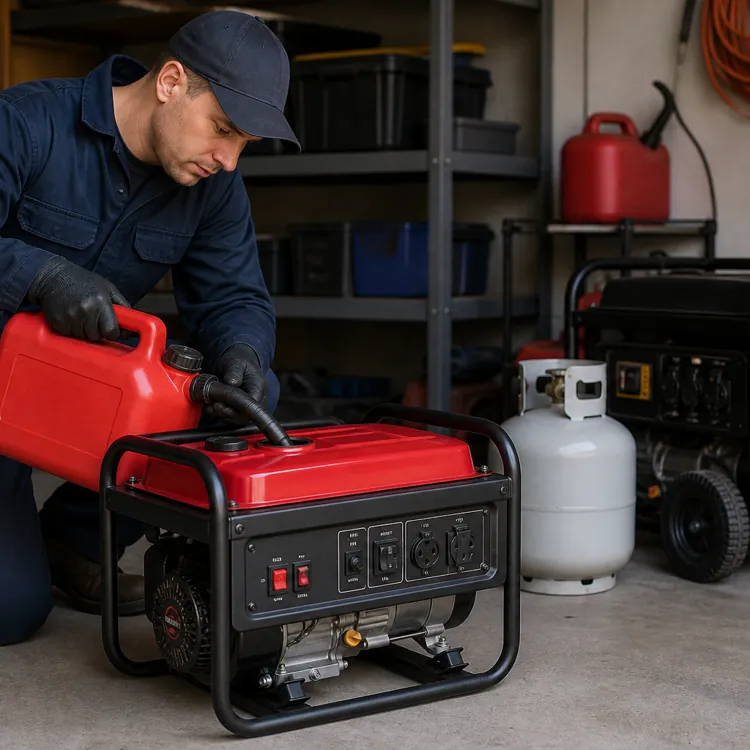
Propane vs. gas generator differences
The main differences between propane and gasoline generators are in their startup method and the scale of power they provide.
Propane generators are usually standby generators. They kick on automatically and can often power your entire home during an outage. A gasoline generator is a portable generator that you have to fill and start manually. It powers individual devices or appliances you plug into it.
Key differences at a glance
Other key differences are outlined in the table below.
| Propane generator | Gasoline generator | |
|---|---|---|
| Type of generator | Standby | Portable |
| Provides power for | Whole home | Individual appliances or devices |
| Runtime (without refueling) | Varies by output, but often multiple days | Varies by output, but usually several hours |
| Availability during emergencies | Limited | Limited |
| Fuel storage timeline | Indefinite | 6 months |
| Filling | Delivered by pros | Manual |
| Initiating backup power | Automatic | Requires manual start |
| Maintenance requirements | Routine maintenance once per year | Manual emptying |
| Safety | Generally safer to store | Generally more prone to explosions and fire |
| Emissions | Lower carbon content means fewer emissions | Higher carbon content means more emissions |
| Noise | Moderate | Loud |
| Fuel cost (per gallon)* | $3.17 | $4.18 |
| Power output per gallon | 91,500 Btu | 120,000 Btu |
| Btu per dollar | 28,900 Btu | 28,700 Btu |
Functional differences
Both propane and gasoline generators can provide backup power, but they work differently in an outage. The biggest differences come down to convenience, runtime, power capacity and fuel availability.
Propane generators
Most propane generators are standby generators, which means they turn on automatically during an outage and provide a seamless transition to backup power. They can usually power your entire home and, depending on your storage capacity, provide backup power for multiple days. However, getting propane deliveries during an outage may not always be possible.
A standby unit that runs on propane is the best generator option for homeowners who want total home backup and comfort during outages.
Gas generators
Gasoline generators are always portable generators, meaning they require manual fueling and starting during an outage. They’re much less convenient, especially because they only power the appliances or devices you plug into them — and they usually provide power for just a few hours before you need to refuel. Access to gas stations during emergencies can be limited.
A gasoline-powered portable generator is better for essentials-only backup, especially if you’re on a tight budget.
Differences in convenience
Fuel type can make a noticeable difference in how easy a generator is to use and maintain. Propane offers some advantages for hands-off preparedness, while gasoline requires more hands-on management.
Propane generators
Propane generators are more convenient because they turn on automatically and don’t require manual refueling. Instead, professionals deliver propane and fill your tanks for you. You can store propane indefinitely, meaning you can always have it on hand to stay prepared. Additionally, propane generators:
- Require less maintenance; they run automatic maintenance once a week
- Produce fewer carbon emissions
- Make less noise during operation
Gas generators
Gasoline generators require manual fueling and starting during outages, and you’ll experience an interruption to power. So, they aren’t as convenient as propane generators. Since you can only safely store a few gallons of gasoline for around six months, preparedness is also limited.
Propane vs. gasoline generator runtime
Both propane and gasoline generators require you to store fuel on-site, so your available fuel supply affects how long your generator can run. However, propane generally allows you to store much more fuel than gasoline.
Propane offers more fuel storage
It’s not uncommon for homes with propane generators to have multiple 100-gallon tanks, while larger homes may use a 500-gallon tank. Propane contains about 91,500 Btu per gallon, giving you:
- 100-gallon tank: 9,150,000 Btu
- 500-gallon tank: 45,750,000 Btu
Gasoline has limited fuel storage
Most portable gasoline generators use tanks that hold up to about 20 gallons. Gasoline contains roughly 120,000 Btu per gallon, so a full 20-gallon tank provides about 2,400,000 Btu — roughly one-quarter of the fuel energy in a 100-gallon propane tank.
What does that mean for runtime?
Actual runtime depends on your electricity usage and how efficiently the generator converts fuel into power. Propane generators can provide whole-home backup for a day or two, while gasoline generators typically power select appliances for a few hours before refueling.
Runtime for propane and gas generators under different loads
The table below estimates runtime for 100-gallon propane tanks compared to 20-gallon gasoline tanks.
Note that average electricity consumption in the U.S. is around 30 kWh per day, so most of the consumption comparisons are based on small generator loads.
| Electricity consumption (watts) | Tank size (gallons) | Estimated runtime |
|---|---|---|
| Propane | 100 | 1,340 hours |
| Gasoline | 20 | 351 hours |
| Propane | 100 | 670 hours |
| Gasoline | 20 | 175 hours |
| Propane | 100 | 446 hours |
| Gasoline | 20 | 117 hours |
| Propane | 100 | 297 hours |
| Gasoline | 20 | 78 hours |
| Propane | 100 | 22 hours |
| Gasoline | 20 | 23 hours |
Runtime based on demands
Your generator’s runtime will vary depending on what you’re powering. The table below shows estimated runtime for common household appliances based on their typical energy demands.
| Item | Typical running watts* | Runtime on 1 gallon of propane (hours) | Runtime on 1 gallon of gasoline (hours) |
|---|---|---|---|
| Central AC | 3,000 to 5,000 | 5.3 to 8.9 | 7 to 11.3 |
| Ductless mini-split | 2,000 to 4,000 | 6.7 to 13.4 | 8.8 to 17.6 |
| Electric baseboards | 500 to 2,000 | 13.4 to 53.6 | 1.7 to 70.3 |
| Electric furnace | 5,000 to 20,000 | 1.3 to 5.3 | 5.7 to 7 |
| Electric water heater (tank-style) | 4,000 to 6,100 | 4.4 to 6.7 | 1 to 8.8 |
| Electric water heater (tankless) | 3,000 to 36,000 | 0.75 to 8.9 | 8.8 to 11.72 |
| Heat pump | 2,000 to 4,000 | 6.7 to 13.4 | 70.3 to 17.6 |
| Pool pump | 350 to 2,250 | 11.9 to 76.6 | 15.6 to 100.5 |
| Sump pump | 800 to 1,000 | 26.8 to 33.5 | 35 to 44 |
| Well pump | ~1,000 | 26.8 | 35 |
Propane vs. gasoline generator cost
The average upfront cost of a portable generator that uses gasoline is between $300 and $3,000. A standby generator that uses propane is likely to cost between $10,000 and $25,000.
Propane generators are considerably more expensive than gasoline generators for a few reasons, including:
Capacity
Propane generators are usually meant to power your entire home, which means they tend to have a greater capacity than portable generators. Larger units have more capability, but much higher costs.
Added features
Propane generators are standby generators. To turn on automatically, they require an automatic transfer switch. This can add between $500 and $2,000 to your total costs.
Unit installation
Standby generators that use propane as a fuel source require a concrete pad and connection to your home’s electrical system. Installation alone can cost between $1,500 and $5,000 for a standby generator.
Portable generators that use gasoline require no connection or installation, so you’ll pay for the unit itself.
Tank installation
Propane generators require on-site tank storage, and you’ll need a professional to install tanks — often on a permanent foundation. Gasoline generators let you use a portable gas tank, which you can fill yourself and requires no installation.
Permits
You don’t need permits to use a portable generator, but you should expect to pay between $80 and $500 for permits to install a standby generator.
Propane is less expensive per gallon than gasoline, although actual costs vary based on your location and availability. While you’ll pay less per gallon for propane, you’ll only get slightly more Btu per dollar since propane has a lower Btu output per gallon. Actual running costs are about equal.
Additional costs to consider
There are other costs you might run into with both propane and gasoline generators.
- Fuel stabilizers: Gasoline is an unstable form of fuel because it’s in liquid form, so you should consider the cost of fuel stabilizers for long-term storage. Even with stabilizers, you’ll very likely face fuel waste at some point, which increases your long-term costs.
- Propane tank certification: You’ll need to get propane tanks recertified every five to 12 years, depending on condition and age. Recertification comes with added costs, and you may need to replace your tanks if they fail.
- Refilling: Refilling gasoline tanks takes some time on your part, but refilling propane tanks for a whole-home generator requires professional delivery. Delivery costs can get unusually high if you live in a remote area or if access to your property is limited.
Maintenance is the other main cost to consider.
You should schedule maintenance annually for standby generators that use propane, which costs between $200 and $500. You may not need ongoing maintenance for portable generators that use gasoline, but you will have to spend more time yourself filling and emptying the unit.
Propane vs. gasoline generator for outages
Upfront and ongoing costs notwithstanding, propane is the better fuel source for generators in most cases for a few key reasons.
- They have much bigger storage options: Propane tanks come in 100-gallon capacities for homes, and sometimes up to 500 gallons, which equals longer runtimes for your generator.
- They turn on automatically: Standby generators that use propane turn on automatically during an outage, so you won’t have any interruption to electrical service.
- They provide power for your entire home: Standby generators have bigger capacities and can often run everything in your home, including HVAC systems, well pumps and appliances.
- Storage is indefinite: Propane doesn’t degrade, so once you fill your tanks, you’ll have guaranteed power during the next outage.
- They’re quieter during operation: Propane generators don’t make as much noise when they’re on, so they’re less likely to interrupt your daily routine.
Gasoline generators also have their uses and come with several upsides.
- They’re good for emergency power: Portable generators that use gasoline are great for quick emergency power for your electronic devices or individual appliances.
- They’re much more affordable: Portable generators can cost as little as $300, while a standby generator that uses propane can cost up to $25,000 or more.
- They take up limited space: You can store empty portable generators in your garage or shed, so they won’t take up yard space like a permanently installed standby generator might.
- They don’t run weekly maintenance cycles: Portable generators only turn on when you need them; standby generators run maintenance cycles every week, which can create unwanted noise.



FAQ
Is it cheaper to run your generator on propane or gas?
It’s generally cheaper to run your generator on propane, but it depends on the cost per gallon for both fuel types in your area and how long you want to run your generator. Propane is less expensive per gallon, but has a lower fuel density. So the output per gallon between the two fuels is close. However, long runtimes are possible on propane without refueling.
How long will a 20-pound propane tank last on a generator?
A 20-pound propane tank will last about five to 12 hours if you’re powering your entire home with your generator. The actual amount of time you get from a 20-pound propane tank depends on how much power you need.
What is the disadvantage of a propane generator?
The biggest disadvantage of a propane generator is the upfront cost, which averages between $10,000 and $25,000 for the unit and professional installation. Propane generators also require fuel delivery to keep your tanks full, and the unit and the tanks will take up space in your yard.
Is it better to run a generator on propane or gasoline?
Neither propane nor gasoline is strictly better than the other for generators, so you should compare generators based on your needs.
For emergency power only on specific devices or appliances, a gasoline-powered portable generator is a better fit and will cost a fraction of what a propane generator would. If you want backup for your entire home or for long periods during emergencies, a standby generator that uses propane is a better option.
Bottom line
Propane standby generators cost between $10,000 and $25,000, on average. They usually kick on automatically during an outage and can power your entire home for multiple days. Gasoline-powered portable generators cost $300 to $3,000, but they’re less convenient to use, come with limited gas storage timelines and are better for essentials-only backup.
Ultimately, if you want seamless, whole-home backup and are willing to invest more upfront, a propane standby generator is worth it. For basic or occasional emergency use, a portable gasoline generator is a budget-friendly solution.
Article sources
ConsumerAffairs writers primarily rely on government data, industry experts and original research from other reputable publications to inform their work. Specific sources for this article include:
- Bluetti Power, "How Long Will a Generator Run on Propane?" Accessed Aug. 20, 2026.
- U.S. Department of Energy, Transportation Technologies Office, "Propane Vehicle Emissions." Accessed Aug. 20, 2026.
- New York State Energy Research and Development Authority, "Monthly Average Propane Prices." Accessed Aug. 20, 2026.
- New York State Energy Research and Development Authority, "Monthly Average Motor Gasoline Prices." Accessed Aug. 20, 2026.
- AmeriGas Propane, "BTUs: What They Are and Why You Should Care." Accessed Aug. 20, 2026.
- U.S. Energy Information Administration, "Energy conversion calculators." Accessed Aug. 20, 2026.
- Kauffman Gas, "Common Residential Propane Tank Sizes for Your Home." Accessed Aug. 20, 2026.
- U.S. Energy Information Administration, "Energy conversion calculators." Accessed Aug. 20, 2026.
- U.S. Energy Information Administration, "How much electricity does an American home use?" Accessed Aug. 20, 2026.