


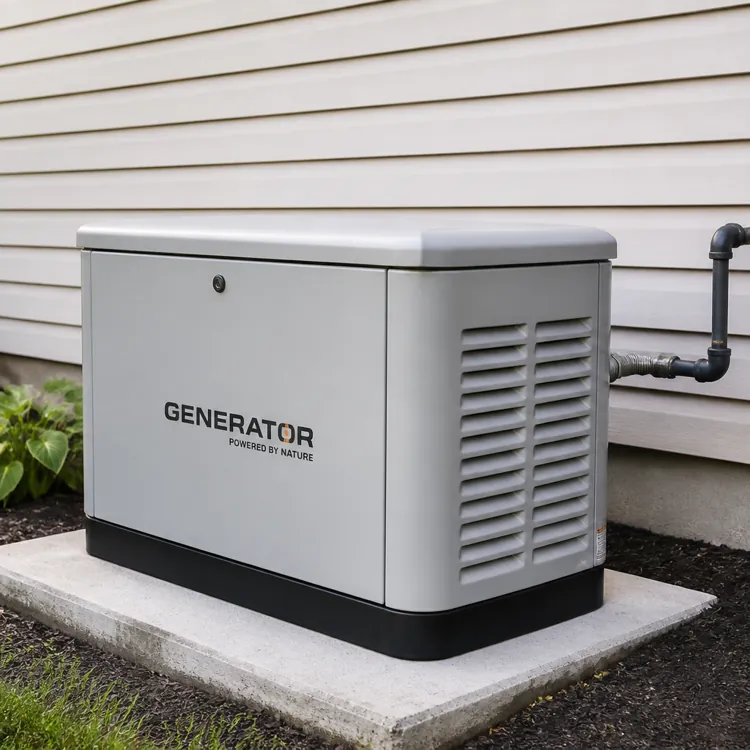
Comparing natural gas and diesel generators
The biggest difference is how these generators are typically used: Natural gas generators are usually installed as standby systems, while diesel generators are more often portable.
Natural gas standby generators cost more, costing between $10,000 and $25,000. Portable generators cost between $300 and $3,000. Standby generators require professional installation, permits and utility connections, while portable generators can be used without permanent installation or connections.
However, standby generators are more convenient. They turn on automatically during an outage and can power your entire home. Portable generators require a manual start and only power individual appliances or devices.
Natural gas vs. diesel: Key generator differences
The table below compares natural gas and diesel units to help you decide which generator is best for you.
| Natural gas generator | Diesel generator | |
|---|---|---|
| Best for | Whole-home backup | Single-appliance or device backup or portable use |
| Fuel source | Natural gas | Liquid diesel fuel |
| Fuel efficiency | 20,160 BTUs per lb | 20,725 BTUs per lb |
| Fuel requirements | Receives constant supply of fuel from gas line | Requires manual fueling during an outage |
| Fuel storage | No fuel stored on site | Requires stored fuel, which can last for six months to one year |
| Startup process | Automatically during an outage | Requires manual starting |
| Possible run time | Indefinite | Usually <24 hours, depending on fuel tank size and power demands |
| Average installation cost | $10,000 to $25,000 | $300 to $3,000 |
| Capability | Whole-home backup or dedicated circuit backup | Only powers appliances or devices you plug in |
| Installation space/storage needs | Permanently takes up yard space | Storage is possible in shed or garage once empty |
| Lifespan | 15 to 25 years | 20 to 25 years |
| Safety concerns | Gas leaks | Explosions |
Natural gas vs. diesel: Energy efficiency
Comparing the efficiency of natural gas and diesel generators is challenging because diesel is a liquid fuel and natural gas is a gaseous fuel. We measure diesel in gallons, but we measure natural gas in pounds under a certain pressure, or in volume, usually by cubic feet under a certain pressure.
However, we can compare these two generator fuels based on BTU and CO2 production. Natural gas can produce 1,036 BTUs per cubic foot, which comes out to 20,160 BTUs per pound. Diesel can produce 137,400 BTUs per gallon, and at 6.2 pounds per gallon, the output per pound of fuel is 20,725.
Natural gas vs. diesel emissions
CO2 emissions refer to how “clean” a fuel burns.
Natural gas produces 116.65 pounds of CO2 per 1,000,000 BTUs produced, while diesel produces 163.45 pounds of CO2 per 1,000,000 BTUs produced. Natural gas also generates close to 30% less carbon dioxide, making it a cleaner and more efficient fuel source.
Natural gas vs. diesel consumption per kWh
You may want to know how much fuel is necessary to meet your energy demands before choosing a generator. Start by estimating your daily electricity consumption and then using the table below to get an idea of how much fuel you’d use to maintain power during an outage.
| Natural gas | Diesel fuel | |
|---|---|---|
| kWh per pound | 5.91 | 6.07 |
| Average run time per pound | 4.7 hours | 4.86 hours |
Note that run time for natural gas generators is indefinite unless there’s an issue with your utility connection or gas supply. The total run time for diesel generators is limited by the tank size and the fuel you have stored on your property. Run time also varies by energy demands, load capacities, surge demand and more.
Pros and cons of diesel generators
The main appeal of a diesel generator is its much lower upfront cost, usually between $300 and $3,000. Diesel generators are portable, so you can purchase one and store it in your shed or garage until you need it. You’ll also need to buy a gas tank and store fuel on your property, but there are no installation or utility connection costs.
The main downside is that portable diesel generators demand manual fueling and starting, so they won’t kick on automatically during an outage. Portable generators also won’t back up your entire home; instead, they provide power to individual appliances or devices you plug into them.
Consider the pros and cons of diesel generators below before committing to this fuel type.
Advantages of diesel generators
- Low upfront cost: Portable generators require no professional installation or utility connections, so they cost a fraction of what you’d pay for a standby generator.
- Portable: Portable generators come on wheels, so you can move them around your property or to remote areas as needed.
- Doesn’t take up yard space: Since portable generators don’t require permanent installation, they don’t take up yard space when not in use.
- Longer lifespan: Portable generators don’t run weekly maintenance cycles and generally see less use than whole-home generators, so they tend to last a bit longer.
- Fewer maintenance costs: Portable generators need minimal maintenance as long as you don’t store them with fuel inside. This saves you an average of between $200 and $500 per year.
- No risk of continuous gas leak: Since there’s no constant supply of fuel, there’s no risk of a continuous gas leak like there is with natural gas.
Disadvantages of diesel generators
- Manual fueling: Portable generators require you to refuel them whenever you need backup power, which is much less convenient than having a constant fuel supply.
- Manual starting: You’ll also have to start your portable generator manually whenever you need power, which is less convenient than an automatic start.
- Fuel storage limitations: Your diesel generator run time will always be limited by how much liquid fuel you store on your property, and you can only store fuel for 6 months to a year before you’ll need to replace it.
- Louder operation: Diesel generators are louder when running than natural gas generators.
- High fuel cost: Diesel fuel costs are more volatile than natural gas prices, and you’ll pay more per kWh due to the higher average cost.
- More emissions: Diesel creates more CO2, making diesel generators less environmentally friendly.
Check stored diesel for water and contamination before an outage.
Applications where diesel generators are best
Portable diesel generators are ideal for emergency-only power for medical equipment or individual appliances or devices. They’re also a good option in remote locations, where natural gas lines aren’t available or are prohibitively expensive to extend to your home. However, in remote areas, you can opt for either portable diesel or standby propane generators.
Pros and cons of natural gas generators
Natural gas generators have several upsides. They are always fueled, start automatically to minimize interruptions to electrical service and can provide backup power for your entire home. Overall, they’re more convenient.
The main drawback is the upfront cost, which averages $10,000 to $25,000. Fuel is less expensive per kWh, but you will have annual maintenance costs to consider, and natural gas generators have a shorter lifespan.
Benefits of natural gas generators
- Constant fuel supply: Natural gas delivery is automatic and continuous, so you never have to refuel.
- Automatic start-up: Most natural gas generators have an automatic transfer switch (ATS), which detects when there’s an outage and automatically switches to backup power for convenience.
- No run-time limitations: Since natural gas has automatic delivery, you can run your generator indefinitely without worrying about running out of fuel.
- Quieter during operation: Natural gas generators produce less noise during operation, so they’re less likely to interrupt you in your home.
- Lower fuel cost: Natural gas is more affordable than diesel per BTU and per kWh.
- Fewer emissions: Natural gas is a cleaner-burning fuel, which is better for the environment.
The CDC recommends installing carbon monoxide alarms when using a natural gas generator.
Drawbacks to natural gas generators
- Higher upfront cost: Natural gas standby generators require professional installation and cost more, averaging $10,000 to $25,000.
- Permanent installation: Standby generators require permanent installation on a concrete slab. You can’t move them, and they’ll always take up some yard space.
- Shorter lifespan: Standby generators run more frequently for maintenance and tend to take heavier loads during outages, so they don’t last as long as portable generators.
- Higher maintenance requirements: Expect to pay between $200 and $500 per year for ongoing maintenance for a standby generator, which adds to your long-term costs.
- Risk of gas leaks: Natural gas lines always carry a small risk of leaks, which can lead to explosions.
Applications where natural gas generators are best
Natural gas generators are a good choice if you want reliable, convenient backup power with minimal interruption to your electrical service during outages. Standby models are particularly well suited for whole-home backup.
» Explore: KOHLER reviews from real customers



FAQ
Are diesel generators being phased out?
According to the Environmental Protection Agency (EPA), diesel generators aren’t being phased out, but new regulations apply to non-road diesel engines, including those in diesel generators. The new Tier-4 emissions standards will require diesel generators to use emission-control technology to meet EPA standards.
How long do 100 gallons of diesel last in a generator?
A generator with 100 gallons of diesel will run for about 78 hours. However, run time can vary widely based on your electricity demands.
Is a diesel or natural gas generator better for home backup power?
A standby generator running on natural gas is usually better for home backup power because it can power your entire home continuously without running out of fuel. Portable diesel generators power only individual appliances or devices, have limited run time based on fuel capacity and require manual fueling and starting.
Which generator type has lower maintenance costs?
Diesel generators have lower maintenance costs than natural gas generators, largely because they only run when you need power. Standby generators run a maintenance cycle every week. A portable diesel generator needs next to no maintenance, but you should expect to pay $200 to $500 per year to maintain a natural gas generator.
Bottom line
Diesel generators are best if you want emergency backup only and don’t mind the inconvenience of fueling and starting the unit manually during an outage.
Natural gas standby generators are the better option if you want whole-home backup and more convenient operation that delivers less interruption to your daily routine.
Article sources
ConsumerAffairs writers primarily rely on government data, industry experts and original research from other reputable publications to inform their work. Specific sources for this article include:
- U.S. Department of Energy, "Fuel Properties Comparison." Accessed Aug. 21, 2026.
- United States Census Bureau, "Commodity Weight Conversion Tables." Accessed Aug. 21, 2026.
- General Power Limited, Inc., "How Long Do Generators Last? Our Guide to Generator Lifespan." Accessed Aug. 21, 2026.
- Massachusetts Institute of Technology, "EIA Emissions Coefficients." Accessed Aug. 21, 2026.
- U.S. Energy Information Administration, "Energy conversion calculators." Accessed Aug. 21, 2026.
- United States Environmental Protection Agency, "Regulations for Emissions from Heavy Equipment with Compression-Ignition (Diesel) Engines." Accessed Aug. 21, 2026.