

Key insights
Stair lift installation is usually included in stair lift pricing, starting around $500 and averaging 15% to 35% of total costs.
Jump to insightStraight staircases cost the least. Curved rails with multiple landings and outdoor models cost more.
Jump to insightYou can lower stair lift costs by choosing fewer features, buying used or renting.
Jump to insightCost to install a stair lift
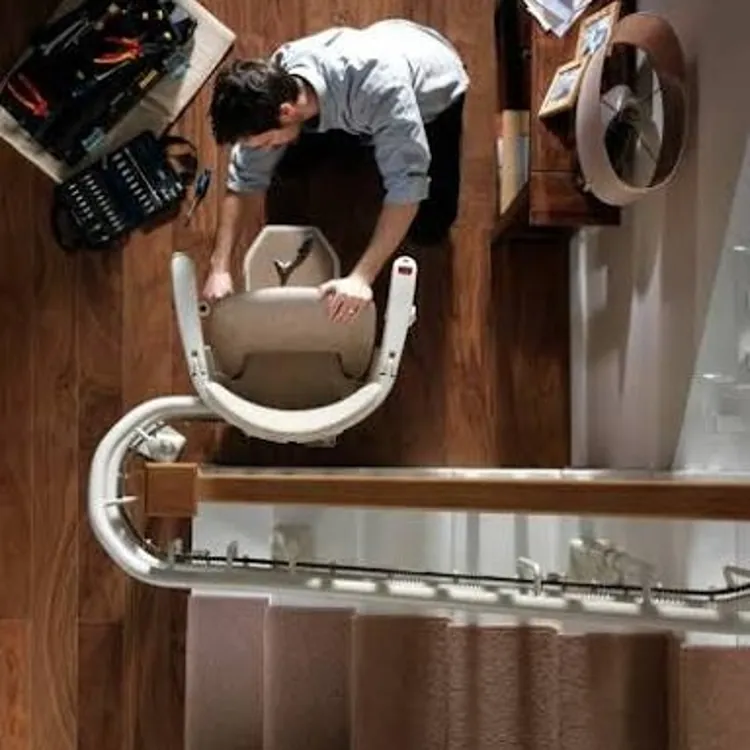
Professional stair lift installation typically ranges from 15% to 35% of the equipment cost and is usually quoted as part of a package price with the lift itself.
Costs to install a stair lift vary based on:
- Stair lift type
- The layout of your stairs
- Whether the lift is indoor or outdoor
- Number of landings
- Custom adjustments
- Any special considerations, such as heavy-duty support or stair width issues
- Dealer
Professional chair lift installers can train you on how to use the lift safely.
However, some manufacturers, such as AmeriGlide, offer equipment-only sales and allow DIY installation.
Stair lift installation typically includes
Stair lift installation typically includes assembling and installing the rails, placing the lift on the rails, making electrical connections and testing. Installation also includes any prior quoted custom adjustments, such as bracing for rails or structural supports needed.
Stair lift installation cost factors
Stair lift installation costs typically rise for anything beyond the ordinary straight rail attachment to rails, stairs or walls.
Because stair lifts are not one-size-fits-all, most top stair lift companies and dealers, such as Lifeway Mobility, Bruno and Harmar, strongly suggest professional installation and a home consultation before purchase. The extra step ensures the lift fits your home and lifestyle — and reduces extra costs.
Factors influencing stair lift installation costs include:
- Type of lift (sitting or standing)
- Staircase measurements (length, width, slope, number of steps)
- Straight or curved rails
- Number of landings
- Tight spaces
- Rail customization/custom fabrication
- Electrical work
- Home layout
- Seat upgrades
- Weight capacities
- Safety features (battery backups, autostop for obstacles, speed governor, mechanical braking)
- Indoor or outdoor installation
- Warranty types
- Service plans
Professional vs. DIY stair lift installation
When deciding how to install a stair lift, it's important to understand the key differences between professional and DIY installation. Here’s a side-by-side comparison to help you and your family choose the best option for you:
| Professional installation | DIY installation | |
|---|---|---|
| Safety | Trained installers handle setup and safety checks | Mistakes can increase the risk of falls or lift failure |
| Modifications | Installer coordinates needed electrical or structural work | You handle or hire help for needed modifications |
| Cost | About $500 to several thousand dollars | May cost little for a simple setup, but tools or hired help add expense |
| Installation time | Usually one to five hours | Often takes longer |
| Warranty | Usually preserves full warranty coverage | May limit or void warranty coverage |
| Delivery | Often included | May cost extra |
Stair lift cost by staircase and lift type
Beyond installation costs, stair lift prices vary widely by staircase type and lift type. For example, straight standardized staircases typically cost less than multiple-landing or curved lifts. Likewise, larger seats, extra safety features and outdoor lifts tend to cost more than base models.
Entry-level straight staircase stair lifts cost around $2,500 to start, which includes installation. Curved stair lifts start around $8,000, including installation.
Stair lift types
Stair lifts typically fall into standing or sitting models. Sitting stair lifts are the most common, but standing lifts are used to accommodate tight spaces and people who have problems standing up/sitting down without assistance.
Stair lift location
Indoor stair lifts tend to be cheaper than outdoor models because they do not have to be weatherproof. Outdoor installations also often require mounting to more difficult surfaces such as stone, brick and metal.
Staircase configuration
When choosing the best stair lift for your home, start by factoring in your staircase configuration.
Spiral staircases are particularly expensive due to their curves and freestanding nature.
Staircase configuration is a major factor in stair lift costs. For example, the farther the chair has to go and the steeper the staircase, the more power it needs, along with more rails and drive chains. Likewise, where the rail needs to attach influences the cost.
Some rails are designed to attach to a wall rather than to a railing, and others attach directly to the stairs themselves. Some stairs, such as freestanding staircases, may require reinforcement when a wall installation is not available.
The number of landings also influences cost, regardless of the number of floors. When a staircase reaches a landing, you have the option of a curve to move to the next set of stairs or another straight set of rails with another chair.
Ways to lower stair lift costs
There are many options for reducing stair lift costs, or spreading out your payments.
Stair lift companies know they are primarily selling to seniors with fixed incomes and have plans in place to help you reduce costs or find financing to make stair lifts more affordable.
Forgo extra features
Opting for a base-model stair lift instead of extra features such as swivel seats and power footrests can dramatically reduce the total cost of the stair lift. But don’t skimp on needed features, such as wider seats and extra weight limits when appropriate.
Buy a used or refurbished model
Dealers often have a good stock of used stair lifts thanks to buy-back programs. Refurbished stair lifts that were repaired under warranty are available, too.
Used and refurbished stair lift savings usually start at $500 to $1,000 for base units and go up from there.
Rent a stair lift
While renting a stair lift isn’t the best option long-term, if you are facing post-surgery recovery or a short-term living situation, it can save money compared to a direct purchase. Stair lift rentals usually offer terms starting around six months and packages that include the stair lift, installation and removal at the end of the rental period.
In addition to reducing costs in the short term, renting stair lifts can keep you up to date with the latest models or allow you to upgrade to more features later if you expect your mobility to decline.
Most reputable manufacturers and dealers, such as Stannah, also offer rent-to-own options.
Finance your purchase
Stair lift financing and monthly payment plans for qualified buyers are available through most stair lift dealers and manufacturers. As with other loan plans, rates and terms vary widely among dealers and depend on your credit rating.
Apply for a bank loan
Local bank loans are another option for managing the cost of stair lifts. The most common loan types usually involve your home. Home equity line of credit (HELOC) loans are popular because they offer a credit line for just about any purpose, and funds can be accessed quickly.
Reverse mortgages that supply monthly funds are another option, but often come with downsides such as excessive upkeep demands and foreclosure. Personal home improvement loans are another option and are often unsecured by your home.
Research senior discounts
Some senior organizations have partnerships with stair lift companies to provide member discounts. Check your member benefit list or call the organization to find out which companies work with your senior organization.
Consult a tax professional
Although stair lifts are not deductible as durable medical equipment (DME), they are sometimes qualified as capital expenses. If the stair lift is medically necessary,you may be able to claim a tax deduction for it.
Tax rules can be complex, so it is worth consulting with your tax professional for details on your personal situation.
Do insurance and VA benefits cover stair lifts?
Getting insurance coverage for stair lifts can be tricky. Private insurance coverage is rare, and Medicare or Medicaid coverage is limited. Medicare typically doesn’t cover stair lifts because they are considered home modifications instead of durable medical equipment.
However, some Medicare Advantage (Part C) plans offer limited coverage for home modifications to prevent falls. This isn’t universal, however, so you’ll need to check with your Medicare Advantage provider to see if your plan includes stair lift coverage.
Medicaid Home and Community-Based Services (HCBS) waivers sometimes offer limited financial assistance for stair lifts if it is vital to prevent a move to a group facility or nursing home. Coverage varies by situation and state. Check with your state Medicaid office for details.
VA benefits often cover stair lifts for veterans. Four main VA programs may offer stair lift coverage:
- Home Improvements/Structural Alterations grants (HISA): HISA VA grants help cover costs for alterations to make your home accessible. Examples include access to your home (such as outdoor stair lifts) and roll-in showers.
- Specially Adapted Housing grant (SAH): SAH grants are available to veterans with specific service-connected injury types, such as loss of a leg or severe burns. Similar to HISA, it helps cover disability access modifications.
- Special Home Adaptation grant (SHA): VA SHA grants work like SAH grants, but cover a different set of service-connected injuries, including some respiratory injuries.
- Temporary Residence Adaptation grant (TRA): A VA TRA grant provides assistance similar to other grants, except that it applies to temporary housing. For example, if your injury and disability require you to stay with family members for a time.
FAQ
Can stair lifts be installed on narrow staircases?
Some stair lifts can be installed on narrow staircases. The required width varies by local fire code and by whether the stair lift is a sitting or standing model.
What can seniors do instead of getting a stair lift?
Instead of stair lifts, many seniors move their bedrooms downstairs. Other options include home elevators and moving to a single-floor residence.
What is the weight limit for stair lifts?
Standard stair lifts typically support up to 350 pounds, although exact numbers vary. Bariatric stair lift models can support up to 600 pounds.
Do home lifts (home elevators) cost more than stair lifts?
Yes, most home lifts (home elevators) are more expensive, starting around $15,000, while entry-level stair lifts start around $2,500.
Is the cost to install a stair lift worth it?
Professional stair lift installation is usually worth the investment. While the cost can be significant — ranging from $2,500 to over $25,000 — the benefits often outweigh the expense. Professional installation ensures safety, proper fit and reliable operation, all of which are critical if you have mobility challenges. It also protects your warranty and reduces the risk of costly mistakes or repairs.
Article sources
ConsumerAffairs writers primarily rely on government data, industry experts and original research from other reputable publications to inform their work. Specific sources for this article include:
- U.S. Department of Veterans Affairs, "Home Improvements/Structural Alterations (HISA)." Accessed July 7, 2026.
- U.S. Department of Veterans Affairs, "Disability housing grants for Veterans." Accessed July 7, 2026.
- Internal Revenue Service, "Publication 502 (2025), Medical and Dental Expenses." Accessed July 6, 2026.