

OTC vs. prescription hearing aids: What’s the difference?
Over-the-counter (OTC) hearing aids, available for sale in stores or online without a prescription or hearing test, work well for mild and self-diagnosed hearing loss.
With a more generalized sound-amplification process, these devices tend to be much more cost-effective than prescription aids, offering a significantly lower price floor. Many private companies and brands make OTC hearing aids.
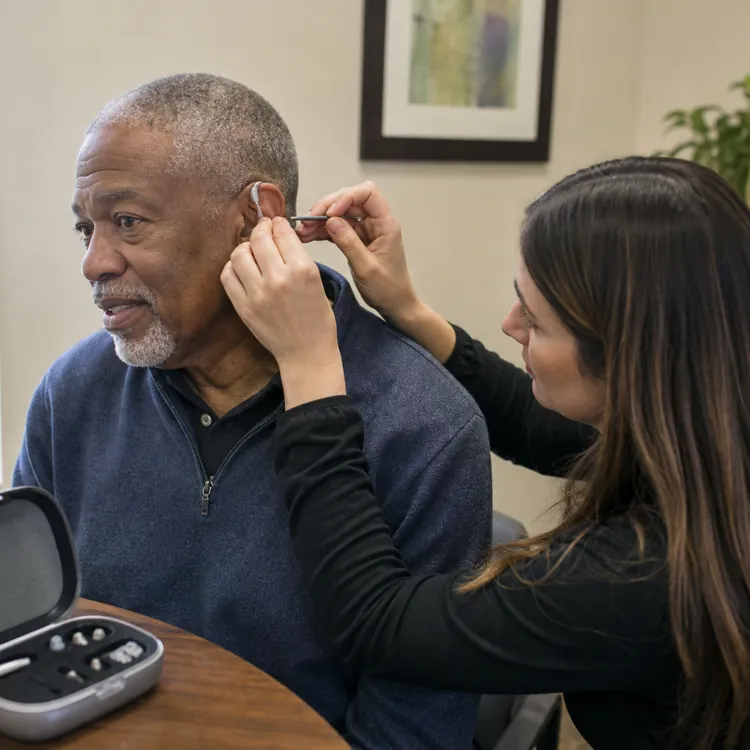
Prescription hearing aids, on the other hand, require diagnosed hearing loss measured by a test, usually given by an audiologist. Your audiologist or ear, nose and throat (ENT) specialist also tailors the aids’ fit and sound amplification to your hearing loss, including the specific frequencies you have the most trouble hearing.
While costlier, prescription aids also include more advanced audio-enhancing features, such as directional microphones and background noise reduction.
OTC and prescription hearing aids compared
Here’s how the two options compare when you’re choosing your hearing aids:
| OTC hearing aids | Prescription hearing aids | |
|---|---|---|
| Hearing loss range | Self-perceived mild to moderate (26 to 55 decibels) | Any level, from mild to severe |
| Hearing test required | No | Yes |
| Fitting method | Self-fitted using included sleeve sizes | Professional measurements and fitting |
| Professional support | Self-managed | Ongoing from an audiologist or ENT |
| Features | Some Bluetooth and noise cancellation | Bluetooth connection, background noise reduction, speech clarification, directional microphones |
| Cost range per pair | Preset: $100 to $500 per pair; self-fitting: $300 to $2,500 | $1,000 to $5,000 |
| Return policy | Sellers aren’t required to accept returns, but many have a 30-day trial | Typically longer (60 days) |
| Best for | Adults with mild to moderate hearing loss | Complex or severe hearing issues requiring personalized support |
OTC hearing aids pros and cons
Compared to prescription options, OTC hearing aids are generally much more accessible, with a significantly lower upfront cost and no required testing or customization. However, this lack of customization is also a detriment, as it means your OTC aids may not cater to your specific hearing needs or ear shape, leading to less effective auditory support.
Here’s a deeper breakdown of the pros and cons of OTC hearing aids:
OTC hearing aid pros
- Lower cost: OTC hearing aids can start as low as $100 for a pair, offering a low price floor. However, more advanced features can bump the cost of OTC aids over $1,000. Still, the median price for OTC aids is significantly lower than for prescription aids, which often cost several thousand dollars.
- Easier access: OTC aids are available at stores like Walmart or Walgreens and don’t require a hearing test, making them much easier to buy than prescription aids.
- Simpler setup: Prescription hearing aids require a hearing test, professional fitting and customized sound settings. OTC aids don’t require any appointments, so you can get started sooner.
- Useful features: Some OTC hearing aids offer Bluetooth connectivity for compatible devices, rechargeable batteries or both.
- Support for mild to moderate hearing loss: If you believe yourself to have mild to moderate hearing loss, OTC aids can be an effective way to hear better without requiring as much investment of time or money.
OTC hearing aid cons
- Fewer connectivity options: While higher-level OTC aids offer Bluetooth and mobile phone audio syncing, they generally lack the breadth of connectivity features that link smoothly with all sorts of devices, such as smartphones, tablets, televisions, streaming apps and your car’s audio.
- Limited sound customization: Preset OTC hearing aids offer limited sound settings, while self-fitting models let you adjust amplification to your hearing needs.
- Limited ongoing support: Professional fitting and follow-up care may not be included in the purchase price.
- Limits on hearing loss severity: OTC hearing aids lack the amplification and sound customization to assist with severe hearing loss, which requires prescription hearing aids.
- Potential fit issues: Since OTC hearing aids rely on general, standard designs and shapes, they may not offer a fit as snug or comfortable as prescription aids do.
Prescription hearing aids pros and cons
Prescription hearing aids boast superior amplification, paired with cutting-edge sound technology, like noise reduction and spatial audio, which leads to a more detailed hearing experience. However, the process to get started takes longer and involves more hassle, and these aids usually cost significantly more than OTC alternatives.
Here are the positives and downsides to choosing prescription hearing aids:
Prescription hearing aid pros
- Personalized sound settings and fit: ENTs or audiologists measure your hearing and ear size with detailed tests and molding, ensuring personalized fit and frequency amplification.
- Better speech clarity: Prescription hearing aids can be professionally adjusted to emphasize the speech sounds you have trouble hearing.
- Spatial hearing features: Premium prescription aids include advanced spatial hearing technology, which allows you to better recognize where sounds originate, improving your awareness within your environment.
- Background noise reduction: Prescription aids often include noise-reduction technology that can minimize unwanted background noise or nonspeech sounds, preserving a peaceful environment for your ears.
- Ongoing professional support: Your hearing care provider offers ongoing support and testing to check that your hearing aids are working properly. They can also adjust the settings and arrange repairs as needed.
- Support for a wider range of hearing loss: While OTC aids are designed for mild-to-moderate hearing loss, prescription aids can cover a wider frequency range and boost volume levels more, making them suitable for all hearing loss severities.
Prescription hearing aid cons
- Required appointments and testing: While the prerequisite testing ensures a more personalized fit and audio response, it also means that you have to attend appointments through a healthcare provider before getting started, which can be a hassle.
- Higher cost: Prescription hearing aids often start around $1,000 per pair and can cost up to $5,000 or more, depending on the brand and features you choose.
- Longer wait times: Since prescription hearing aids require medical appointments, testing and custom fitting, patients often have to wait several weeks or longer to finally begin using their aids.
- Limited insurance coverage: While health insurance plans in general are trending toward better hearing aid coverage, many plans still don’t cover hearing aids, requiring you to pay the full cost out of pocket. Before committing to a prescription aid, check your coverage to get an estimate.
FAQ
Do OTC hearing aids require a hearing test?
No, adults with self-perceived mild to moderate hearing loss can buy OTC hearing aids without a hearing test or prescription. A hearing test can show how severe your hearing loss is and whether OTC aids are a suitable option.
Are OTC hearing aids as good as prescription ones?
Usually, no. OTC aids offer some connectivity and amplification features that can compete with prescription aids, but prescription hearing aids generally offer a better fit and more complex sound amplification.
What are the disadvantages of OTC hearing aids?
Some OTC hearing aids offer fewer ways to adjust sound to your hearing needs and fewer features that can help you tell where sounds come from. Professional support varies by brand, and finding a comfortable fit may take some trial and error.
Is it worth going to an audiologist for hearing aids?
Depending on the degree of hearing loss you have, it can be worth it to go to an audiologist. An audiologist can test your hearing and adjust your hearing aids to the sounds you have trouble hearing. Professional care can be especially valuable if your hearing loss is severe or complex.
OTC vs. prescription: Which should you choose?
When choosing hearing aids, the most important factor to consider is the degree and complexity of your hearing loss. If your hearing loss is significant, asymmetrical or nuanced, you’ll probably benefit from the ongoing, personalized, professional support that accompanies prescription aids.
However, you also must consider factors like your budget and the features you want. OTC aids are becoming increasingly feature-rich, often costing significantly less than prescription options. If you have minor hearing loss and are on a budget, OTC hearing aids may be best.
Your hearing needs, budget and preferences all play a role in choosing between OTC and prescription hearing aids.
Hearing tests
If you’re under the age of 50 and don’t experience any difficulty with your hearing during daily life, you should generally get a hearing test every five to 10 years.
However, if you’ve noticed that you need to increase the volume on your TV or audio system or if you struggle to hear the details of regular conversation, you should get tested regardless of your age. It’s also a good idea to consider testing if you experience tinnitus (a ringing in your ears) or if you’ve recently been exposed to excessively loud noises.
If you have health insurance, your plan will likely cover an audiologist visit and testing. If your insurance won’t cover a hearing test, you may be able to get a free hearing screening at a retailer like Costco or a hearing aid center.
Hearing loss severity
If you have tested your hearing and found moderate-to-severe hearing loss, prescription aids are a better choice. Prescription hearing aids can be adjusted to amplify the sounds you have trouble hearing. Features like background noise reduction can also make everyday listening easier.
On the other hand, OTC hearing aids are designed for mild-to-moderate hearing loss. If you’ve tested and found mild or moderate hearing loss (up to 55 decibels), you may be able to maintain sufficient daily hearing with an OTC aid.
Professional support
If you want ongoing professional support, prescription hearing aids typically include help with fitting, adjustments and follow-up care.
Your hearing care provider can adjust your hearing aids’ fit and frequency settings, ensuring your aids are tailored to your hearing needs on an ongoing basis.
Cost and insurance
Prices vary among hearing aid companies, but OTC devices generally cost less than prescription options.
If your hearing loss is mild and you’re paying out of pocket, OTC hearing aids may be a more affordable option. Some cost around $200, while models with more features start around $300 per pair.
By comparison, prescription aids often start in the thousands, with a median cost around $2,000 with insurance.
» FIND OUT: Ways to pay for hearing aids
Features and connectivity
Top-tier OTC and prescription hearing aids both offer basic Bluetooth connectivity with your phone and streaming apps. However, prescription hearing aids tend to incorporate more advanced cutting-edge technology as it becomes available.
Article sources
ConsumerAffairs writers primarily rely on government data, industry experts and original research from other reputable publications to inform their work. Specific sources for this article include:
- American Academy of Otolaryngology–Head and Neck Surgery, "AAO-HNS Summary: FDA Over-the-Counter Hearing Aids Final Rule." Accessed Sept. 10, 2026.
- Audien Hearing, "Costco Hearing Aids vs Audiologist." Accessed Sept. 10, 2026.
- Audio Hearing Aid Service, "What Is the Difference Between Otc and Prescription Hearing Aids." Accessed Sept. 10, 2026.
- Boulder Medical Center, "Prescription vs. Over-the-Counter Hearing Aids." Accessed Sept. 10, 2026.
- National Council on Aging, Inc., "Common Types of Hearing Loss." Accessed Sept. 10, 2026.
- U.S. Food and Drug Administration, "OTC Hearing Aids: What You Should Know." Accessed Sept. 10, 2026.
- UCHealth, "Worried about hearing loss? Answers to your top hearing aid questions." Accessed Sept. 10, 2026.