

How to pay for hearing aids
Following these steps in order can help you find as much coverage and financial assistance as possible. Then, you can decide how to pay for any remaining costs.
1. Estimate total hearing aid costs
A written estimate from your audiologist should give a breakdown of everything required to fit and operate your hearing aids. Salespeople call this the out-the-door price. It should include the cost of your hearing aids, exams, fittings, any necessary follow-up visits, repairs and warranties.
2. Check insurance and employer benefits
Call the number on your health insurance card and ask whether your plan pays anything toward hearing aids, how often benefits renew and which providers you must use. Then, review your employer or union benefits for any hearing or wellness add-ons that can offset costs.
3. Compare Medicare and Medicaid options
Unfortunately, original Medicare won’t cover hearing aids, though if you’ve purchased a Medicare Advantage plan, you may have coverage. Some plans provide an allowance or discount for hearing aids. Medicaid covers hearing aids for children nationwide, while coverage for adults varies by state.
4. Apply for VA or vocational rehab
Veterans with hearing loss may be eligible for benefits through the U.S. Department of Veterans Affairs (VA). To access hearing aid coverage through the VA, they must enroll at a VA medical center. Adults whose hearing loss affects their work can ask their state vocational rehabilitation agency about help paying for hearing aids tied to employment.
5. Use HSA, FSA or payment plans
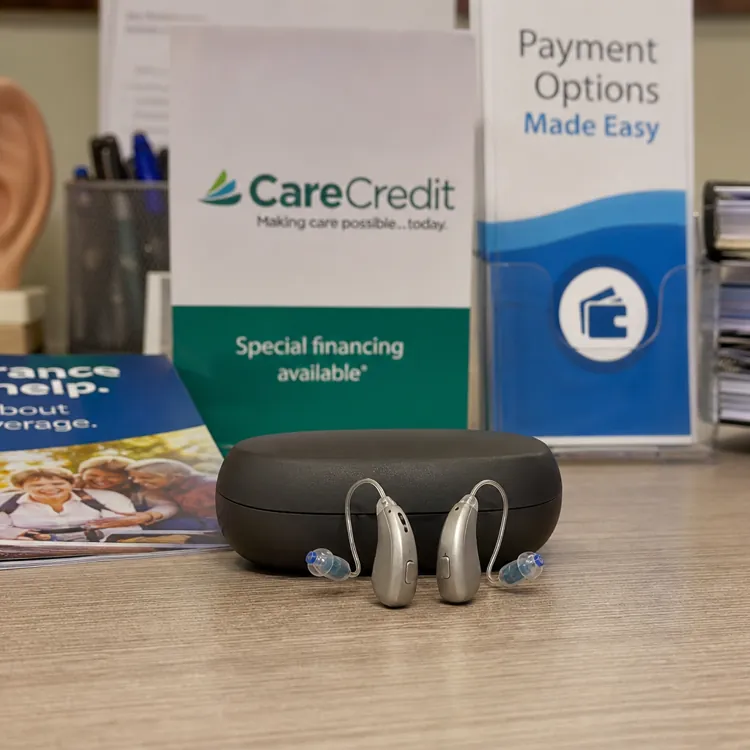
Once you know which public programs and insurance will cover hearing aids, you can start figuring out how to pay the remaining balance. If you have a health savings account (HSA) or flexible spending account (FSA), you can use those pretax funds to pay for hearing aids. You can also ask whether your provider offers payment plans or accepts medical credit cards such as CareCredit, which let you pay the balance over time.
6. Layer in nonprofit or discount programs if needed
If you still face a gap, look for nonprofit programs and community groups that help with medical devices like hearing aids. Then compare those offers against your quote to decide whether to pay cash, finance or wait for assistance to come through.
Hearing aid insurance and government coverage
Most people pay for hearing aids through a mix of private insurance, public programs and out-of-pocket costs, each with its own rules. The table below explains who qualifies, what each program may cover and what limitations to expect:
| Program | Who qualifies | What it may cover | Common limits | How to apply |
|---|---|---|---|---|
| Private insurance | People with individual or employer-sponsored health plans | Partial allowance for hearing aids, hearing exams or discounts on devices | Dollar caps per ear, narrow provider networks, and limits on how often hearing aids are covered | Call the number on your ID card or check your benefits portal; some plans require preauthorization |
| Original Medicare | Adults enrolled in parts A and B | Diagnostic hearing and balance tests ordered by a doctor | No coverage for hearing aids or fitting exams | Enroll through Social Security or Medicare.gov; coverage is automatic once you have parts A and B |
| Medicare Advantage | Medicare enrollees who choose a Part C plan from a private insurer | Hearing exams, fittings, batteries, an allowance toward hearing aids or discounted devices, depending on the plan | Benefits vary by plan, often with spending caps, brand restrictions or set replacement cycles | Shop plans on Medicare’s Plan Finder or insurer sites, then enroll during open enrollment or special periods |
| Medicaid | Low-income adults and children who meet state eligibility rules | Hearing aids and related services for children nationwide, with adult hearing aid coverage available in some states | Income eligibility rules, medical-necessity requirements, state-specific device caps and limits on how often repairs or replacements are covered | Apply through your state Medicaid agency or online portal; providers must verify eligibility at each visit |
| Children's Health Insurance Program (CHIP) | Children in low-income families who don’t qualify for Medicaid | Low-cost health coverage for kids, including hearing aids in some states | Benefits vary by state and may exclude hearing aids or include dollar or frequency caps | Apply via your state’s CHIP website or marketplace; often paired with Medicaid offices |
| Department of Veterans Affairs | Veterans enrolled in VA health care, especially those with service-related hearing loss | Hearing exams, prescription hearing aids, repairs, future batteries and follow-up care at VA facilities | Must maintain VA eligibility, with device choices and services handled through VA audiology clinics | Register at a VA medical center or online with form 10-10EZ, then schedule an audiology evaluation |
Hearing aid assistance programs
If you’re still left with a balance after your insurance pays, there may be assistance programs that can help lower your hearing aid costs. Explore these options before buying, since some programs have eligibility requirements or require you to use certain providers or devices.
Nonprofits and community organizations
Several nonprofit programs help people with low incomes get hearing aids at little or no cost, though you usually have to document your finances and hearing loss.
The Hearing Aid Project collects donated devices, refurbishes them and distributes them to eligible applicants, while programs like Miracle-Ear Foundation and Help America Hear focus on people whose household income falls around or below 200% of the federal poverty level.
Local service clubs, such as Lions Clubs International, Kiwanis and Sertoma, sometimes chip in for hearing aids or fitting fees, especially when a community member’s job or schooling is affected.
Manufacturer and state assistance programs
Some manufacturers and clinics offer discounted hearing aids to people who meet certain income requirements. Starkey Cares, Oticon Hearing Foundation and similar programs work through audiologists who submit applications on behalf of patients and verify that they meet the financial requirements. Approved patients may then receive donated or discounted hearing aids.
Start researching assistance programs before you buy hearing aids. Requirements vary, and some programs require you to establish eligibility or receive approval before your purchase.
State programs like the Ohio Hearing Aid Assistance Program or the Georgia Hearing Aid Distribution Program also require proof of income and a formal application before approving devices.
CareCredit and installment plans
Some clinics may offer in-house installment plans, while others partner with CareCredit, which helps you spread the cost of the hearing aids over time. With an in-house installment plan, there’s usually no credit check, though you typically must put some money down.
CareCredit offers several financing options. Some charge no interest if you pay the full balance within the promotional period, while longer-term plans charge a fixed annual percentage rate.
Refurbished and donated hearing aids
Organizations such as Lions Clubs International and the Miracle-Ear Foundation may offer donated or refurbished hearing aids through programs in your area. Refurbished hearing aids are a great way to save on costs, though they tend to come with much shorter warranties and fewer customizations than you’d find in new devices. Check with your audiologist to see if they’ll program and fit refurbished devices.
Hearing aid costs and ways to save
Even if your insurance won’t pay for hearing aids, you may be able to lower your costs.
Prescription vs. OTC hearing aids
Prescription hearing aids generally cost around $1,000 to $4,000 per ear, especially when you buy them through a traditional clinic that bundles testing and follow-up care. Over-the-counter (OTC) devices sold directly to consumers usually run from about $99 to $1,000 per pair, with many models falling in the $300 to $600 range per device.
Bundled vs. unbundled pricing
Think of unbundled pricing like buying every piece of the hearing aid process a la carte. This is helpful if you don’t have extensive needs or you plan on moving out of the clinic’s service area.
Bundled pricing takes testing, fitting, follow-ups and sometimes even repairs and puts them into one plan. A bundle may be worthwhile if you expect to need ongoing adjustments or support. However, unbundled pricing could save you money if the package includes services you’re unlikely to use.
Costco and retail clinic options
Costco often bundles its hearing aids so you get initial testing, fitting, adjustments, follow-up visits and your hearing aids for a set price, which usually runs between $1,600 and $1,700 per pair. These big-box stores tend to charge less than a private retail clinic, though your brand choices and additional services may differ as a result.
» COMPARE: Top-rated hearing aid brands
Tax deductions and medical expenses
The IRS lets you count hearing aids, batteries, repairs and maintenance as qualifying medical expenses. If you itemize, you may be able to claim a tax deduction for hearing aids and other qualifying expenses that exceed 7.5% of your adjusted gross income.
Hearing aids are also eligible expenses for HSAs and FSAs, allowing you to pay with pretax dollars.
FAQ
How do you get hearing aids when you can't afford them?
You can get hearing aids when you can’t afford them by combining insurance or Medicaid benefits with nonprofit programs, state assistance and low-cost retail options, starting with local audiology clinics that know which funds and charities are active in your area.
Some patients who can document their medical needs and provide proof of low income may qualify for donated or deeply discounted devices through programs like the Hearing Aid Project or local Lions clubs.
How much will Medicare pay for hearing aids?
Original Medicare doesn’t cover hearing aids. However, some Medicare Advantage plans include hearing aid benefits, such as a set allowance or a discount on devices. Check your Summary of Benefits to see what your plan covers.
Are hearing aids tax deductible?
Hearing aids are tax-deductible as medical expenses because the IRS treats them as qualified medical equipment. Batteries, repairs and necessary fittings also qualify for deductions.
You can only claim a deduction if your total unreimbursed medical spending for the year exceeds 7.5% of your adjusted gross income and you itemize deductions on your tax return.
Does insurance cover hearing aids?
Insurance covers hearing aids only on some plans, usually by offering a fixed dollar allowance, discounted devices or limited hearing benefits instead of paying the full price. Many employer and individual policies still exclude hearing aids outright, so you have to check your specific plan documents or call your insurer to see what, if anything, is offered.
Article sources
ConsumerAffairs writers primarily rely on government data, industry experts and original research from other reputable publications to inform their work. Specific sources for this article include:
- U.S. Centers for Medicare and Medicaid Services, "Hearing aids." Accessed July 26, 2026.
- U.S. Department of Veterans Affairs, "Hearing Aids." Accessed July 26, 2026.
- Internal Revenue Service, "Publication 502 (2025), Medical and Dental Expenses." Accessed July 26, 2026.
- Hearing Loss Association of America, "Financial Assistance." Accessed July 26, 2026.
- CareCredit, "Hearing Health and Hearing Aid Financing." Accessed July 26, 2026.
- New Jersey Department of Human Services Division of the Deaf and Hard of Hearing, "Hearing Aid Assistance to the Aged and Disabled (HAAAD)." Accessed Aug. 14, 2026.