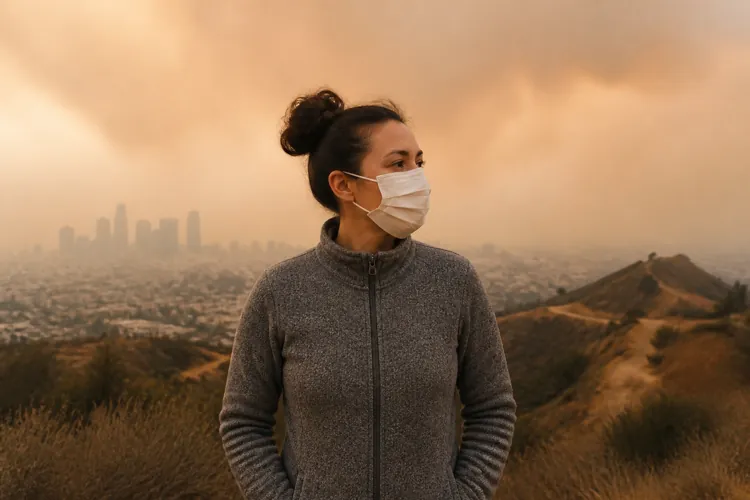

Wildfire smoke was linked to higher hospitalization risks for several heart and lung conditions.
Among older adults with lung cancer, greater wildfire smoke exposure was associated with a higher risk of death.
Researchers found that wildfire-related pollution appeared to be more harmful, at the same concentration, than non-wildfire pollution.
When wildfire smoke drifts into an area, the hazy skies and smoky smell can be hard to miss. But new research suggests there may be more to the health effects than simply breathing in “bad air.”
Researchers from the Icahn School of Medicine at Mount Sinai and other institutions conducted two large studies looking at fine particles from wildfire smoke, known as PM2.5. These are extremely small particles that can travel deep into the lungs and enter the bloodstream.
The researchers wanted to know whether wildfire-related PM2.5 was associated with different health risks than PM2.5 from other sources.
“Wildfire smoke is no longer a regional environmental issue. It is becoming a nationwide public health challenge,” Yaguang Wei, Ph.D., Assistant Professor, Environmental Medicine, Icahn School of Medicine at Mount Sinai, and senior author of both studies, said in a news release.
“Our research shows that wildfire-related PM2.5 appears to be more harmful than equivalent levels of pollution from other sources. As wildfire activity increases, public health and environmental policies must account for both the quantity and the source of air pollution.”
How researchers studied wildfire pollution
The first study looked at 414,016 adults ages 65 and older who had been diagnosed with lung cancer. Researchers used data from the SEER-Medicare database covering 2006 through 2019 and estimated wildfire-related and non-wildfire PM2.5 exposure based on participants’ residential ZIP codes. They then followed participants over time and examined the relationship between long-term pollution exposure and survival.
The second study took a broader look at hospitalizations. Researchers analyzed more than 57 million cardiovascular hospitalizations and nearly 33 million pulmonary disease hospitalizations among residents of 20 states between 2006 and 2019. They compared long-term exposure to wildfire-related and non-wildfire PM2.5 using pollution models.
What the findings mean for consumers
Both studies found a similar pattern: wildfire-related PM2.5 was associated with greater health risks than non-wildfire PM2.5 at equivalent concentrations.
In the hospitalization study, a 1-microgram-per-cubic-meter increase in wildfire-related PM2.5 was associated with higher hospitalization risks across all cardiopulmonary diseases studied. The increases ranged from 10% for heart failure to 16% for asthma.
The lung cancer study found that both types of PM2.5 were associated with increased mortality among older adults with lung cancer, but wildfire-related pollution showed greater toxicity per unit of exposure. Researchers estimated that wildfire-related PM2.5 accounted for about 4% of total PM2.5 but about 17% of mortality related to PM2.5 exposure in the study population.
The researchers say the findings highlight the importance of paying attention to wildfire smoke exposure, particularly for people with lung cancer or chronic heart and lung conditions. They also say more research is needed to understand which components of wildfire smoke may make it particularly harmful.