
That locksmith at the top of Google isn't necessarily legit: Scammers and questionable operators can use online advertising to get in front of people searching for emergency help.
Watch for the bait-and-switch: An unusually cheap quote over the phone can turn into a bill for hundreds of dollars once someone arrives.
Do this now: The Better Business Bureau recommends finding a reputable locksmith before you have an emergency and keeping the number in your phone or wallet.
You're locked out of your house. It's late, you're frustrated, and you need someone there ASAP.
So you grab your phone, Google "locksmith near me," and call one of the first businesses you see. Turns out this is exactly what scammers are counting on you doing.
The Better Business Bureau (BBB) has warned that locksmith scams are on the rise and can begin with a simple online search. Some operators advertise using names and logos that resemble legitimate locksmith companies, then lure desperate customers with extremely low prices.
Once someone shows up at your house, the price can suddenly skyrocket.
And the part that’s particularly concerning is that these scammers are simply paying for prominent placement in Google search results to lure you in.
Google actually restricts locksmith ads
Google knows the industry presents enough risk that locksmiths can't simply start running ads like most businesses.
Locksmith advertisers in the U.S. must complete Google's "Advanced Verification" process before they're eligible to advertise. Google says the process can include reviewing business registrations, professional licenses where applicable, publicly available information, and even conducting video interviews.
Google says businesses can be disqualified if there's evidence of deceptive or misleading practices.
Still, consumers shouldn't assume that appearing prominently in search results (sponsored or otherwise) means they can skip doing their own homework. This goes for any service company you’re looking to hire, not just locksmiths.
The $29 quote can become a $400 bill
Interestingly, one of the biggest red flags is an incredibly cheap quote.
BBB says a scammer might quote a price as low as $15 over the phone, only to discover “complications” after arriving. Then they’ll conveniently jack up the price of your bill or estimate by hundreds of dollars.
Recent consumer complaints show the problem hasn't disappeared.
In one December 2025 report submitted to BBB Scam Tracker, a Seattle-area consumer said a locksmith quoted $80 to $120 over the phone, with $170 described as a worst-case scenario. The consumer reported ultimately being charged $473 and being pressured to pay through Cash App. The complaint represents the consumer's account and isn't an independent finding by BBB.
That makes getting the price nailed down before the work starts all the more important.
Things to ask include:
What the service call costs
Whether there are mileage or after-hours fees
Approximately what the actual lockout service will cost
At that point, ask for a written estimate before allowing any work to begin.
Be suspicious if they immediately want to drill your lock
Another big red flag is when the locksmith arrives and quickly tells you your lock can't be picked and instead needs to be drilled out. That conveniently creates another problem you'll have to pay them to fix, which of course is replacing the lock.
BBB says drilling shouldn't routinely be necessary and that skilled locksmiths can open most locks without destroying them.
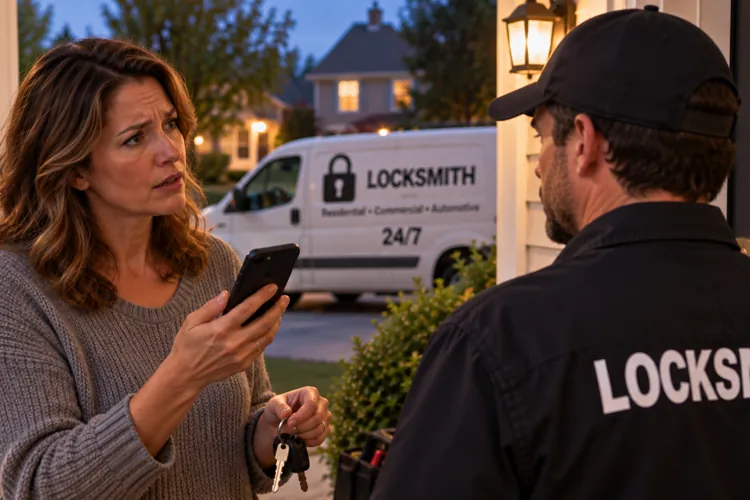
Also look at who actually shows up. Does the person have identification? Did they arrive in a clearly marked company vehicle? Does the company name match the business you thought you called?
If something doesn't add up, don't be afraid to send them away before any work begins.
The smartest locksmith hack takes about 5 minutes
Here's probably the best advice of all: Don't wait until you're locked out to find a locksmith.
BBB recommends finding a reputable locksmith before you have an emergency and keeping the company's number in your wallet or phone.
I'd take that advice even one step further: Find two legitimate local locksmiths today. Check their history and reviews, verify any licensing required in your state, and save both numbers in your contacts. You could even label them "LOCKSMITH — VERIFIED."
Then forget about them. Hopefully you'll never need either number.
But if you eventually find yourself standing on the wrong side of a locked door, you'll have something far more useful than the first sponsored search result Google happens to show you: a locksmith you've already checked out when you weren't desperate.