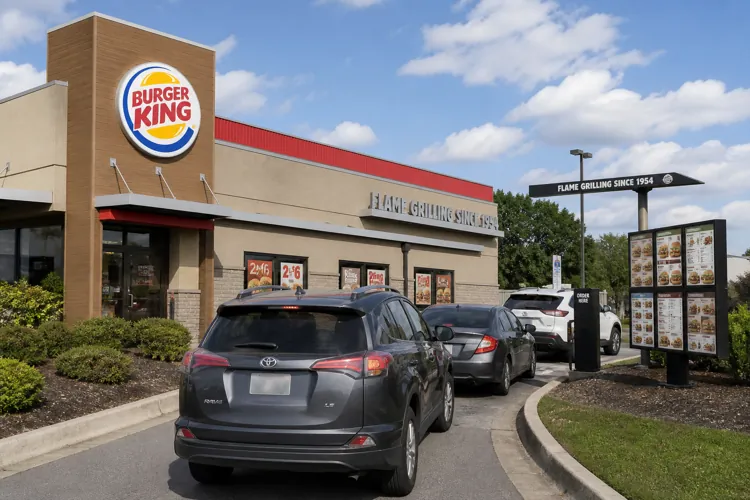

Burger King is the clearest winner in the current burger wars. The chain paired an 8.5% surge in U.S. comparable sales with a multiyear effort to improve restaurants, operations, and the Whopper.
Wendy’s is the clearest loser. U.S. same-restaurant sales fell 7%, traffic deteriorated, and its new CEO acknowledged that the chain had allowed food quality and execution to decline.
McDonald’s remains the dominant player, while Shake Shack is outperforming from the premium end of the market.Both illustrate how sharply the sector has split between brands with compelling value or a distinctive product and those caught in the middle.
For years, the hierarchy of the fast-food burger business appeared settled. McDonald’s towered over the category, Wendy’s occupied the second-place position in U.S. sales, and Burger King struggled to turn its famous brand into consistent growth.
That order is changing.
Burger King has regained momentum while Wendy’s has fallen into a full-scale turnaround.
McDonald’s remains comfortably ahead of both, but its recent U.S. performance has been subdued. Meanwhile, premium chains such as Shake Shack are showing that consumers will still pay more for burgers when the experience feels distinctive enough to justify the price.
The result is an increasingly polarized market. Consumers are rewarding brands that offer either unmistakable value or unmistakable quality. The chains stuck between those two promises are losing traffic.
Winner: Burger King
Burger King is producing the strongest growth among the three traditional burger giants. Its U.S. comparable sales rose 8.5% in the second quarter of 2026, versus only 1.5% a year earlier. Systemwide sales for the broader Burger King segment increased 8.2%.
That performance is the product of a turnaround that began years ago rather than a single successful promotion. Under its “Reclaim the Flame” plan, Burger King committed as much as $700 million through 2028 to restaurant remodeling, equipment, technology, and other improvements. The company has also placed renewed emphasis on the Whopper, giving the brand a clearer center of gravity.
Burger King’s advantage today is coherence. Its signature product is recognizable, its flame-grilled positioning differentiates it from competitors, and its restaurant investments address a longstanding weakness in the customer experience.
The resurgence has also enabled Burger King to displace Wendy’s as the second-largest U.S. burger chain by sales, according to the competitive picture described by Restaurant Business. That is an important symbolic victory, but the more consequential achievement is that customers appear to be returning.
Losing: Wendy’s
Wendy’s second-quarter numbers show a brand losing relevance and operational control at the same time. U.S. same-restaurant sales declined 7%, while U.S. systemwide sales fell 8.2%. Company-operated restaurant margin dropped from 16.2% to 13.8%, and net income declined nearly 41%.
The figures are damaging, but the diagnosis offered by new CEO Bob Wright may be even more revealing. As reported by Restaurant Business, Wright said Wendy’s had allowed “quality degradation” to creep into its food while overcomplicating its menu, promotions, and operations.
That cuts directly against the promise on which Wendy’s built its reputation. “Fresh, never frozen” was not merely a slogan; it positioned Wendy’s as a modest step up from conventional fast food. If customers no longer perceive a meaningful quality difference, the chain is left competing primarily on price against McDonald’s enormous scale and Burger King’s revitalized value platform.
Wendy’s has identified sensible priorities: rebuild the menu, sharpen value, improve marketing and operations, strengthen digital engagement, and restore franchisee economics. But turnarounds become much harder when weak traffic and declining margins reduce the money available for improvements. Closing underperforming restaurants may strengthen the remaining system, but it also confirms the depth of the problem.
Wendy’s is not beyond repair. It still has valuable assets, including the Baconator, Frosty, spicy chicken sandwich, and a broadly recognized brand. The immediate challenge is to make those assets part of a simple, credible reason to visit.
Winning on Scale, but Not Momentum: McDonald’s
McDonald’s remains the category’s unquestioned leader. Its global systemwide sales reached $37 billion in the second quarter, and sales tied to loyalty members totaled $40 billion over the preceding 12 months. Few restaurant companies can match its purchasing power, advertising reach, digital infrastructure, or real-estate network.
Yet the company’s U.S. comparable-sales growth slowed to just 0.8%. Management attributed the result partly to inconsistent restaurant execution, weaker marketing, and a reduction in digital offers.
McDonald’s therefore occupies an unusual position: it is winning the war but underperforming its own capabilities. Its scale gives it more room for error than any competitor, and even modest percentage growth represents a large amount of spending. But price-sensitive diners are scrutinizing the affordability of fast food, making dependable value — not just occasional promotions — essential.
The company’s loyalty ecosystem remains a formidable advantage. It can personalize offers, generate repeat visits, and measure customer behavior at a scale smaller rivals cannot approach. If it restores sharper U.S. execution, McDonald’s should remain nearly impossible to dislodge.
Quality can trump price
Shake Shack competes at a higher price point and operates a much smaller restaurant base, so it is not a direct substitute for every McDonald’s or Burger King visit. Nevertheless, its results demonstrate that customers have not rejected expensive burgers outright.
Second-quarter revenue rose 17.2%, systemwide sales increased 13.8%, and same-Shack sales grew 3.5%. Restaurant-level profit margin reached 23%.
According to Restaurant Business, Shake Shack is winning because its premium is legible. Customers understand what they are paying for: a focused menu, distinctive burgers, contemporary restaurants, and a brand positioned closer to casual dining than conventional fast food. Its growth suggests that value is not synonymous with cheapness. Value can also mean an experience that feels worth the price.