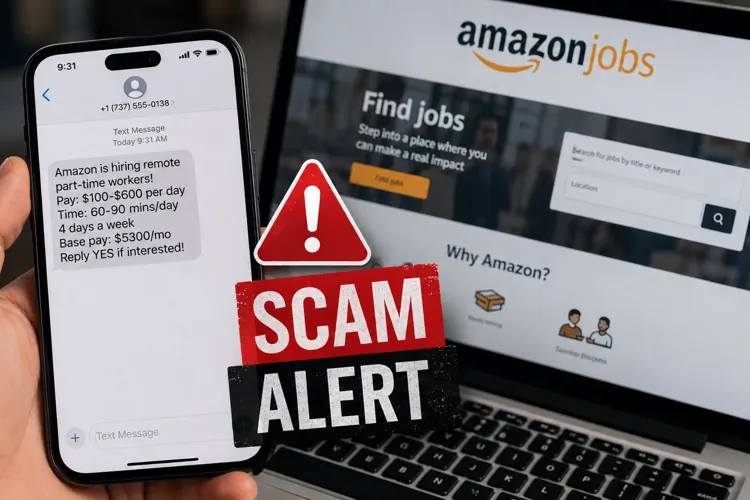

Scammers are impersonating Amazon recruiters. Consumers receive texts promising $100 to $600 a day for as little as 60 to 90 minutes of remote work.
Do the reality check before responding. Ask whether you actually applied, calculate the supposed hourly wage, and verify openings directly through Amazon’s official jobs site.
Never pay to get paid. Don’t send money, crypto, gift cards, or sensitive financial information to a supposed employer.
Have you received a text saying Amazon wants to hire you for a remote job paying hundreds of dollars a day? It might sound like an incredible opportunity, but unfortunately, it’s almost certainly fake.
Kurt Knutsson of CyberGuy, reporting for Fox News, recently flagged a new wave of scam texts impersonating Amazon recruiters. The messages promise $100 to $600 per day for as little as 60 to 90 minutes of work, along with perks like paid time off and free training.
The pitch is tempting, but it contains several red flags that can help you spot the scam before you respond.
Ask yourself: Did I apply?
This might be the easiest red flag.
The scam message claims a recruiter reviewed your "background," but there's no mention of an application, previous conversation, or specific position you supposedly applied for.
An unsolicited recruiting message isn't automatically fraudulent, but an amazing job opportunity appearing out of nowhere does deserve a closer look.
First off, don't click a link in the text to investigate. Instead, go independently to Amazon's official jobs website and search for the position yourself.
Do the hourly-pay math
The scam promises up to $600 for about 90 minutes of work. That's $400 an hour.
Yet the message doesn't explain what specialized skills could possibly justify that compensation.
Scammers may be pairing “easy work” with high pay because they want you focused on the money instead of asking whether the offer makes any sense.
Pro tip: Whenever you see a daily earnings claim, be sure to calculate the hourly wage. If an easy, entry-level side hustle suddenly pays like a highly specialized profession, that's a giant red flag.
Don't reply just to see what happens
Some of these texts don't initially contain a suspicious link, which for some, can make them look less dangerous. Instead, the sender simply asks you to reply "YES" or "INTERESTED."
That may seem harmless, but the Federal Trade Commission (FTC) warns that unexpected job texts can lead to "task scams."
Victims may be asked to complete simple online activities while watching supposed earnings accumulate in an account. Eventually, they're told they need to deposit their own money to continue working or withdraw their earnings.
The balance on the screen may be fake, but the money you send isn't, so be careful.
Never pay to get paid
This is the rule worth remembering even when scammers change their tactics. A legitimate employer shouldn't require you to send money to receive your wages.
Be suspicious if a supposed employer asks you to deposit money, send cryptocurrency, buy gift cards, pay a fee, or purchase equipment through a specific vendor.
The FTC's advice is simple: Never pay anyone to get paid.
Ignore the countdown clock
The Amazon impersonation text reportedly claims only 18 positions remain. That's classic scam psychology.
Phrases like "limited positions," "respond immediately," or "spots filling fast" create urgency so you'll act before investigating.
The more urgent an unsolicited job opportunity sounds, the more slowly you should proceed.
What if you already replied?
Simply responding doesn't mean you've automatically lost money.
Be sure to stop communicating and don't provide your Social Security number, banking information, passwords, or any other sensitive information.
If you've already sent money or provided any financial information, contact your bank or card issuer immediately and report the incident to the FTC at ReportFraud.ftc.gov.