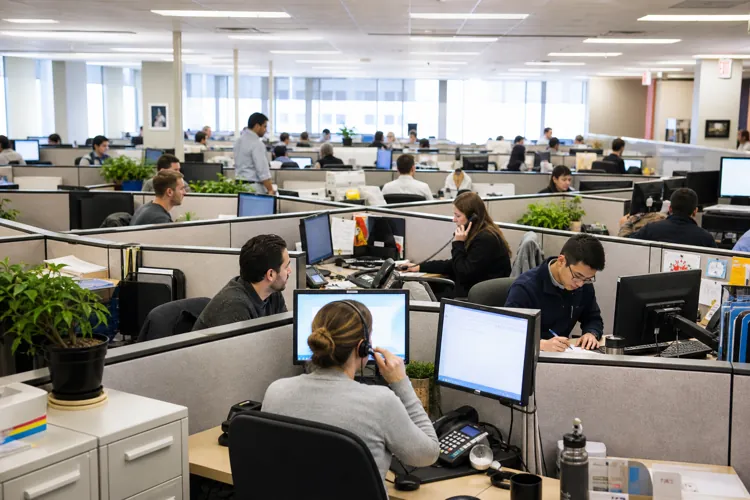

Employers can monitor emails, web browsing, keystrokes, locations, conversations, and even physical movements, often using artificial intelligence to evaluate the data.
Workplace surveillance has expanded with remote work and increasingly sophisticated software, but research raises questions about its accuracy and effects on morale.
Monitoring is generally legal on company-owned systems, although state laws vary and employers may face limits involving discrimination, labor organizing, and protected communications.
Employers have always kept an eye on workers, but the digital workplace has given them far more ways to do it.
Companies can now track when employees sign in, which websites they visit, how often they move their mouse, and how quickly they complete individual tasks. Monitoring may also extend beyond the computer to include vehicle locations, recorded conversations, wearable sensors, and artificial intelligence that analyzes worker behavior.
The trend accelerated as millions of employees began working remotely during the COVID-19 pandemic. Employers wanted a way to determine whether people outside the office were working, creating a growing market for employee-monitoring software sometimes called “bossware.”
A 2024 Government Accountability Office (GAO) report concluded that employers across a range of industries were increasingly using digital surveillance. The most frequently mentioned tools included cameras and microphones, computer-monitoring software, location tracking, mobile apps, and wearable devices.
Computer software can record keystrokes and mouse movements, take screenshots, review browser histories, and measure how long a user remains active. Some programs periodically photograph employees through their webcams or use artificial intelligence to flag behavior considered unusual.
Monitoring is not limited to office workers. Delivery companies may use GPS to measure routes, speed, and stops. Warehouses can track how quickly employees select or package products.
Call centers routinely record conversations and measure the time representatives spend on each call. Trucking companies may use inward-facing cameras to check whether drivers are distracted.
Wearable devices can monitor body movements, and in some cases, collect biometric information such as heart rate or blood pressure, according to the GAO report.
Why companies monitor workers
Employers say monitoring can serve legitimate purposes. It can help protect customer information, detect cyberattacks, investigate theft, and document harassment or other misconduct. GPS systems can improve delivery routes, while cameras and wearable sensors may help prevent accidents.
Recorded customer-service calls can be used for training, and access logs can alert a company when an unauthorized person attempts to view sensitive files.
Problems arise when monitoring intended for security or safety is also used to generate productivity scores or make decisions about discipline, promotions, and dismissals.
A worker may appear inactive while reading printed documents, talking with a customer, or thinking through a difficult problem. Software that primarily counts keystrokes or mouse movements may not recognize those activities as productive work.
That can encourage “productivity theater,” in which workers focus on looking busy instead of completing meaningful work. Some employees use automated mouse-moving devices or keep unnecessary documents open to prevent monitoring programs from labeling them inactive.
The effects on workers
The American Psychological Association (APA) found that employees who knew they were being monitored were more likely to report stress and concerns about their psychological safety at work. Monitored employees were also more likely to feel tense during the workday and to say their workplace harmed their mental health.
“Data suggests that electronic monitoring is associated with psychological distress,” the APA said in reporting its survey results.
The GAO found sharply divided opinions about surveillance’s effect on productivity. Some employers and technology providers said it improved performance by identifying areas where workers needed coaching. Workers, unions, and researchers said it could lower morale, increase stress, and produce misleading performance measurements.
Privacy was the most frequently raised concern in the GAO’s review. Stakeholders also warned that automated scoring systems could discriminate against pregnant employees, workers with disabilities, and people who need additional or more frequent breaks.
Surveillance can also create labor law issues if it is used to identify or discourage employees discussing working conditions or organizing a union.
Is workplace monitoring legal?
In the United States, employees generally have limited expectations of privacy when using a company’s computer, phone, email account, or network. Employers usually have broad authority to monitor company equipment when there is a legitimate business reason.
However, the rules are not unlimited. Some states, including New York, Connecticut, and Delaware, require certain employers to notify workers about electronic monitoring. State laws may also restrict audio recording, biometric-data collection, and GPS tracking.
Monitoring that captures private health information, interferes with protected union activity, or is applied in a discriminatory manner may violate other laws. Recording audio can be especially complicated because consent requirements differ by state.
Workers should assume activity on a company-owned device or network may be visible to the employer. Personal email, banking, medical searches, and other sensitive activities are best kept off workplace equipment.
Employees can also review their company’s technology and privacy policies and ask what information is collected, how long it is stored, and whether it is used in employment decisions.
Workplace monitoring is likely to keep growing as AI makes it easier to analyze enormous amounts of employee data. The concern is not simply whether employers are watching, but whether the information they collect accurately measures performance — and whether workers know how it will be used.