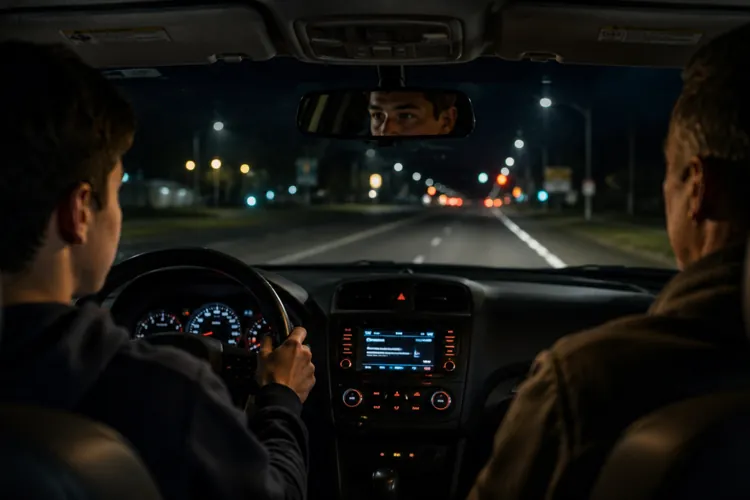

Night driving stands out: 56.8% of fatal crashes involving young drivers occurred at night, according to a recent analysis.
Experience matters: Crash risk rises sharply during the first few hundred miles, so parents can gradually introduce nighttime, bad-weather, and unfamiliar-road driving.
Give teens an escape hatch: Set firm rules around speed and alcohol, but make sure they know they can always call for a ride home without getting in trouble that night.
When your teenager gets their driver's license, you probably have a few rules ready to go: Don't speed. Don't text. Never drink and drive.
You might want to add another: Taking it easy on nighttime driving until they've built some experience.
A new Bagen Law analysis of five years of National Highway Traffic Safety Administration (NHTSA) data found 56.8% of fatal crashes involving young drivers occurred at night.
That's higher than accidents involving speeding, not wearing seat belts, or alcohol.
Night driving obviously isn't a bad behavior like speeding or drinking and driving. But reduced visibility combined with inexperience can leave new drivers with less time to recognize and recover from mistakes.
Here are four ways that parents can help.
1. Don't make their first night drive a difficult one
A newly-licensed driver probably shouldn't get their first real nighttime experience driving home from a concert at midnight on unfamiliar roads.
Start with familiar routes after dark with a parent in the passenger seat. Practice judging distances, handling headlight glare, and spotting pedestrians on poorly lit roads.
Then gradually increase the difficulty.
2. Treat the first few hundred miles like driver's ed
Getting a license means you've demonstrated that you can drive. It doesn't mean you've experienced everything the road can throw at you.
Steve Bagen, from Bagen Law, points to research showing crash rates increase dramatically during the first 250 miles after a driver receives their license.
For those first few hundred miles, consider limiting unnecessary nighttime trips, bad-weather driving, and those complicated, unfamiliar routes. The goal isn't to avoid those situations forever. It's more about building behind the wheel experience before stacking risks on top of each other.
3. Speed deserves special attention
Speeding showed the largest disparity in fatal crashes between young drivers and drivers overall in the analysis. It was involved in 38.5% of young-driver fatal crashes compared with 28.2% among drivers overall.
New drivers haven't had years to develop the judgment and vehicle-control skills experienced motorists rely on when something suddenly goes wrong.
One useful family rule could be having the posted speed limit be the ceiling, not the target. Darkness, rain, or heavy traffic may mean the safest speed is well below what's posted.
4. Create a no-questions-asked ride home
Alcohol was involved in 28.6% of young-driver fatal crashes, nearly identical to the 29% figure for drivers overall.
Give your teen an escape hatch before they need it. Promise to pick them up without a lecture, interrogation, or argument that night. The goal is to make calling you feel safer than taking a chance behind the wheel.
Whatever else needs to be discussed can wait until tomorrow.
The bottom line
Passing the driving test isn't the end of learning to drive. In many ways, it's actually when the most important practice begins.
Think of the first few months behind the wheel as an extension of driver's ed — without the instructor. Start with familiar roads and good conditions, then gradually add nighttime driving, highways, unfamiliar routes, and bad weather as your teen gains experience and confidence.