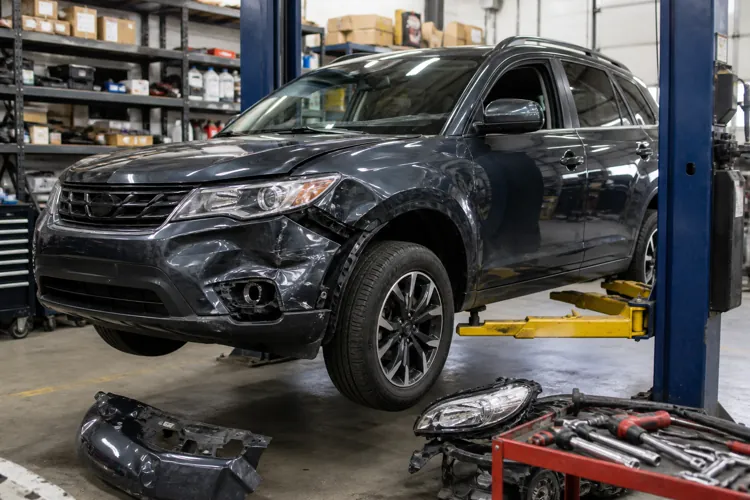

Vehicle repair prices have risen more than 40% since 2020, but crash-avoidance sensors are only part of the reason.
Cars with advanced safety systems can cost more to repair after a collision, yet they generate significantly fewer insurance claims.
IIHS data suggest the technology reduces total insurance losses while helping drivers avoid deductibles, injuries, and other costs.
Today’s cars are packed with technology designed to prevent crashes, but when a collision does occur, that equipment can make the repair bill more expensive.
That apparent contradiction has contributed to criticism of advanced driver assistance systems, including automatic emergency braking, blind spot monitoring, and lane departure warning. These features rely on cameras, radar units, and other sensors that may be damaged in a crash and often require careful calibration after repairs.
However, a new analysis from the Insurance Institute for Highway Safety (IIHS) argues that focusing only on the cost of individual repairs misses much of the financial benefit. Although equipped vehicles can be more expensive to fix, they are also involved in fewer crashes.
“If you got in a crash, you were probably shocked at the size of the bill. But if you made it through the week without hitting anything — and without anybody hitting you — you paid nothing,” said Matt Moore, chief insurance operations officer, in the IIHS-HLDI blog. “That, in a nutshell, is how crash avoidance systems are saving consumers money even as they also contribute to higher average repair costs: Though they’re expensive to fix, they’re remarkably good at preventing crashes.”
According to the IIHS analysis, vehicle repair prices have risen more than 40% since 2020, far outpacing overall inflation. But the institute says advanced safety technology is only one factor behind that increase.
New vehicles are generally larger, more powerful, and more complex than they were in the past. SUVs and pickup trucks dominate the market, while nearly two-thirds of new vehicles have all-wheel or four-wheel drive. More than half have turbocharged or hybrid engines or are fully electric.
Even components that once were relatively simple, such as headlights and power seats, have become more sophisticated and expensive to replace. Newer powertrains may also require specialized parts, tools, and training.
Higher costs when crashes occur
The Highway Loss Data Institute compared otherwise similar vehicles from model years 2017 through 2022, some equipped with a package of crash-avoidance features and others without it.
Collision claim severity — the average amount insurers paid to settle a claim — was about 10% higher for vehicles with the safety technology. That difference is consistent with the higher cost of replacing and calibrating cameras and sensors.
But the analysis uncovered a more complicated pattern.
Property damage liability claim severity, which reflects damage to another vehicle caused by the policyholder, was 15% higher for vehicles equipped with crash-avoidance systems. Because that coverage pays to repair the other vehicle, the higher figure cannot be explained by the cost of fixing sensors on the insured vehicle.
IIHS says the explanation lies in the types of crashes that remain.
Automatic emergency braking and similar systems prevent many minor, low-speed collisions. With a large number of fender benders eliminated, more serious and expensive crashes make up a larger share of the remaining claims. That pushes up the average cost per claim even though the total number of claims declines.
Fewer claims lower total losses
Claim frequency was about 10% lower for collision coverage among vehicles with the safety package. For property damage liability coverage, claim frequency was nearly 40% lower.
When claim frequency and claim severity were considered together, total insurance losses were about 5% lower under collision coverage and almost 30% lower under property damage liability coverage for vehicles equipped with the technology.
For consumers, fewer crashes can mean avoiding a deductible, rental-car expenses, lost time, and the possibility of higher insurance premiums. Crash-avoidance features have also been linked to substantial reductions in injury claims, providing benefits that go well beyond repair costs.
The findings do not mean every driver will save money or that every advanced safety feature performs equally well. Insurance premiums, repair costs, and system effectiveness vary by vehicle and insurer.
But Moore says the broader data show why an expensive sensor replacement does not tell the whole story. Crash-avoidance systems can make a repair more costly when a collision happens — but their greater value may be in keeping many of those collisions from happening at all.