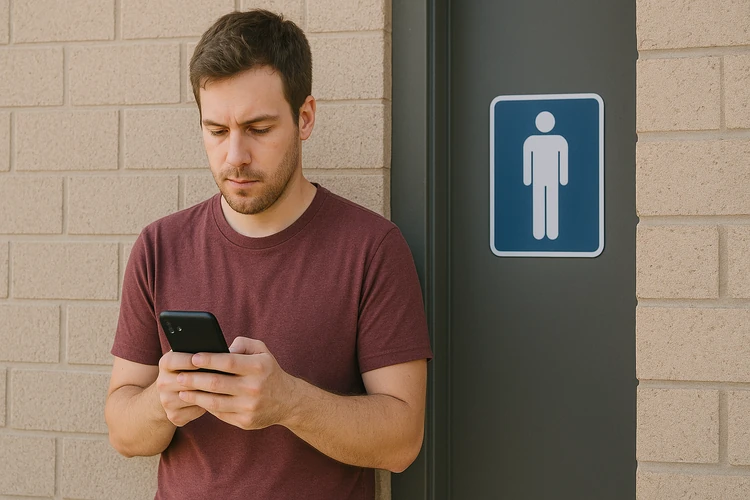

About two-thirds of people in the study used their smartphones while sitting on the toilet, and those users were much more likely to stay there for over five minutes.
After adjusting for age, sex, BMI, fiber intake, exercise, and straining, smartphone toilet-use was associated with a ~46% higher chance of having hemorrhoids.
There were no major differences in constipation or frequency of straining between phone-users and non-users, suggesting that the extra sitting time (not straining) may be the link.
If you find yourself scrolling, checking social media, or catching up on news while sitting on the toilet, you’re far from alone. But could that habit be doing more than just eating up your time?
A recent study conducted at Beth Israel Deaconess Medical Center raises the possibility that using a smartphone during bathroom visits may increase the risk of developing hemorrhoids.
Hemorrhoids are common, uncomfortable, and costly in terms of health care. While things like constipation, low-fiber diets, and pregnancy are established risk factors, researchers wanted to explore whether this modern habit of “toilet scrolling” also plays a role.
“I was struck by this fantastic old study from 1989 in The Lancet on hemorrhoids and reading the newspaper on the toilet,” researcher Dr. Trisha Pasricha said in a news release. “They looked at how many patients read the newspaper on the toilet and then doctors had a look to see how many of them had hemorrhoids.
“But that study did find that there was this association. More hemorrhoids were found amongst people who spent time reading on the toilet. Now in 2025, I don't think anyone's reading the newspaper, but we know everybody's on their phones in the bathroom. So I thought we needed to update this literature for the modern TikTok era.”
The study
The study recruited 125 adults who were undergoing routine screening colonoscopies. Before their procedures, participants filled out detailed surveys about their demographics (age, sex, BMI), lifestyle (diet, physical activity), and specific bathroom behaviors: how often they used a phone while on the toilet, how long they stayed, and what they did with their phones (e.g. read news or use social media).
Doctors then checked for hemorrhoids during the colonoscopies. To ensure fairness and reduce bias, two independent endoscopists reviewed a subset of high-quality images to confirm internal hemorrhoids.
The analysis included adjusting for known risk factors like fiber intake, straining, exercise, etc., so the researchers could assess whether phone use was associated with hemorrhoids independent of those factors.
The results
Here’s what they found:
Prevalence of phone use: Roughly 66% of the participants reported using smartphones while on the toilet.
Longer sit times: Among phone users, 37.3% stayed more than five minutes per toilet visit, compared with only 7.1% of non-users.
Increased risk: After controlling for other factors, use of a smartphone on the toilet was associated with a 46% increased odds of having hemorrhoids.
No difference in straining or constipation: The groups did not differ significantly in their reports of straining, constipation, or related gastrointestinal symptoms, suggesting that the extra sitting time may be the key factor.
Demographics: Smartphone-users were younger on average (≈ 55 years) than non-users (≈ 62 years). Also, phone users had lower weekly physical activity.
What we can take away
The study doesn’t prove cause and effect — it can't show that phones cause hemorrhoids – but it does suggest a strong association. If nothing else, it raises a simple habit-change possibility.
“My colleagues and I in GI, we all tell our patients not to spend longer than a couple minutes on the toilet,” Dr. Pasricha said.
“I think what’s happening is that time sort of slows down when you’re scrolling, and people don’t realize just how much longer they’re sitting there.”