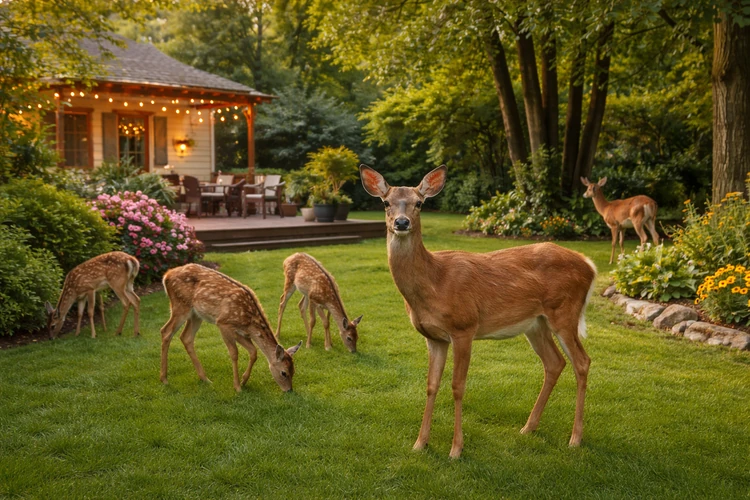

Researchers tested a birth-control vaccine designed to prevent deer from reproducing for multiple years.
The vaccine is delivered by dart and works by blocking fertilization rather than altering hormones.
In a long-term field study, many treated deer remained unable to reproduce for several years.
In many U.S. suburbs, deer sightings have become part of everyday life. While the animals may look peaceful grazing on lawns, large deer populations can create real challenges for communities. They can damage gardens and crops, increase the risk of vehicle collisions, and play a role in the spread of Lyme disease by hosting the ticks that carry the bacteria.
Traditionally, wildlife managers have relied on hunting to control deer numbers. But that approach can be difficult in suburban areas where safety concerns and declining numbers of hunters make it less practical.
Researchers at Tufts University and collaborators have been exploring another possibility: birth control for deer.
In a study published in Human–Wildlife Interactions, the team examined whether a contraceptive vaccine could provide a longer-lasting, nonlethal way to limit reproduction in suburban deer populations.
How the researchers tested a deer birth-control vaccine
To study the idea in real-world conditions, the researchers worked in Hastings-on-Hudson, a suburb north of New York City where deer had been linked to frequent car crashes and extensive landscape damage.
The team used a contraceptive vaccine called porcine zona pellucida-22 (PZP-22). Instead of changing hormone levels, the vaccine prompts the animal’s immune system to produce antibodies that block sperm from fertilizing eggs.
Researchers administered the vaccine by firing a small dart from a CO₂-powered air rifle into the deer’s rump. After the initial injection, some animals later received booster shots.
The study followed vaccinated deer from 2014 through 2021. During that time, scientists returned to observe the animals and track whether they showed signs of recent pregnancies, such as swollen udders or the presence of fawns.
The goal was to determine whether the newer PZP-22 formulation could last longer than earlier versions, which typically prevented pregnancy for only about a year and required frequent re-darting.
What the study found
The researchers reported encouraging results. A single initial injection appeared to remain effective for at least two years in many deer.
Among animals that received a booster shot, about 80% were still not producing fawns three years later.
However, researchers say the approach may work best in suburbs with dense deer populations where animals are easy to locate and dart safely in parks, yards, or other residential areas.
“We depend on having a lot of accessible deer to make this work,” Allen Rutberg, Ph.D., said in a news release. “In Hastings, we’ll often see five deer in someone’s front yard. In rural areas, the deer are much harder to find.”
In the meantime, the study suggests that long-lasting contraceptive vaccines could become another tool communities consider when looking for ways to manage deer populations in crowded suburban environments.