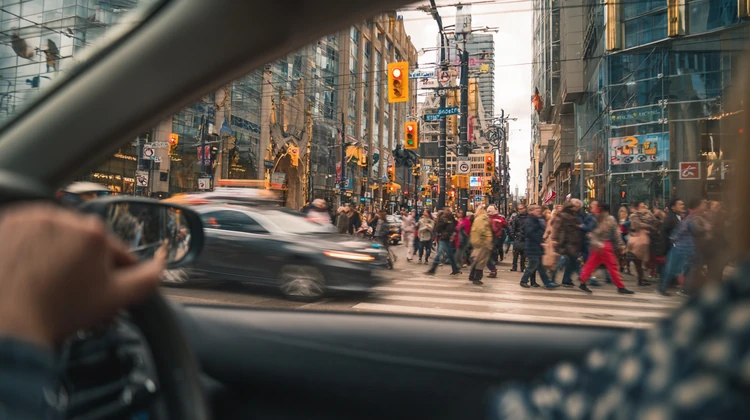

Vehicles with big driver-side blind zones are far more likely to hit pedestrians while turning left
IIHS researchers say large blind zones raise left-turn crash risk by 70% compared with small ones
Findings highlight visibility problems tied to modern vehicle design, especially SUVs and pickups
Vehicles with large blind zones on the driver’s side are dramatically more likely to strike crossing pedestrians during left turns, according to a new study from the Insurance Institute for Highway Safety (IIHS). The research found that a large blind zone increases the odds of a left-turn pedestrian crash by 70%, while a medium blind zone raises the risk by 59% compared with small ones.
IIHS says thick A-pillars, bulky mirrors, long hoods and windshield geometry all play a role in blocking a driver’s view — and that these design elements are becoming more common as vehicles grow taller and heavier. “These results clearly identify problematic aspects of vehicle design,” IIHS President David Harkey said. “The challenge for automakers will be to find ways to address them that don’t diminish the protection vehicles provide to their occupants in a crash.”
Rising pedestrian deaths add urgency to the findings
The study arrives amid a troubling spike in pedestrian fatalities. Since 2009, deaths have increased 78%, reaching more than 7,300 a year. Higher speeds, roadway design and the rise of larger, taller vehicles — particularly SUVs and pickups — are all contributing factors. These vehicles not only cause more severe injuries but are also more likely to hit pedestrians while turning.
To better understand how design affects visibility, IIHS measured blind zones on 168 vehicles using a camera-based method developed by its engineers. Measurements were taken from the eye level of two driver heights — 5 feet 9 inches and 4 feet 11 inches — to reflect a wide portion of the driving population.
The results showed significant variations. For average-height drivers, cars had the largest blind zones overall, but SUVs and pickups offered narrower windshield views and pushed the nearest visible point on the road farther away. For shorter drivers, SUVs and pickups created the largest blind zones and the most restricted fields of view.
Across all vehicle types, the average driver-side blind zone blocked 27% of the area in front-left of the vehicle for a 5'9" driver — and 33% for a 4'11" driver.
Crash data confirms the link between design and danger
Researchers analyzed nearly 4,500 police-reported pedestrian crashes across seven states. Vehicles with large driver-side blind zones were vastly overrepresented in left-turn crashes compared with straight-driving pedestrian collisions. A narrow front field of view — 85 degrees or less — increased left-turn crash risk by 51%, and having the nearest visible point more than 30 feet ahead increased risk by 37%.
Passenger-side blind zones, by contrast, did not significantly affect right-turn crashes.
“When a driver’s view is partially blocked, it’s easy for a person in the crosswalk to disappear from sight,” said Wen Hu, the study’s lead author. “That’s exactly the kind of situation that leads to turning crashes.”
Balancing visibility and crash protection poses design challenges
Some features that worsen blind zones play important safety roles. Thick A-pillars help strengthen roofs in rollovers, and long hoods support larger crumple zones. But IIHS says improvements are possible without undermining occupant protection.
Potential solutions include side-view cameras, hood airbags, and better-tuned pedestrian automatic emergency braking systems designed to work during turning maneuvers. Roadway changes — such as giving pedestrians a head start at crosswalks or extending curbs into intersections — could also reduce risk by placing pedestrians more clearly in view.
“The driver’s ability to see is a fundamental element of safety that hasn’t received enough attention,” Harkey said. “That should change with our new ability to easily measure vehicle blind zones and assess their effects on crash risk.”