

If you receive a document from an unknown law firm—like [info@rigsbylawgroup.com]—requesting your electronic signature, it is a scam, even though the message and document may look very convincing.
The scam email urges recipients to sign an “important” e-document and claims to be from Rigsby Law Group in Lexington, Ky., but that domain is inactive, and official representatives have confirmed the messages are fraudulent.
Red flags include a lack of personalized greeting, the absence of your name on the document, and the sender’s link leading to a suspicious Google Doc rather than a legitimate e-signature service, potentially exposing users to malware or phishing.
There’s a new scam making the rounds, and this one is dangerous because it, at first glance, appears real.
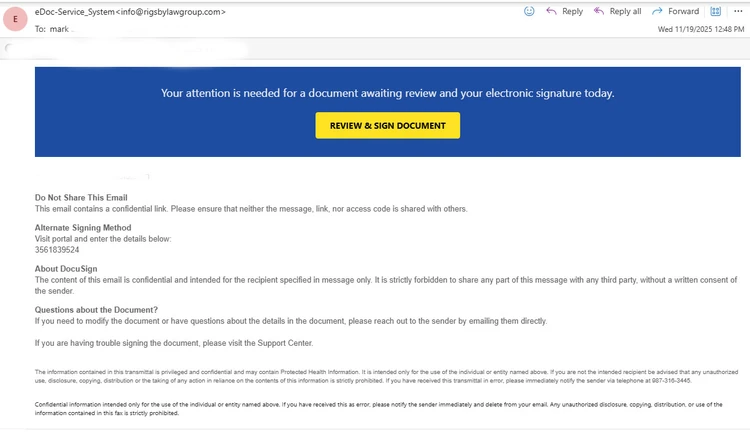
It comes in the form of an emailed E-Doc with the message, “Important – Your attention is needed for a document awaiting review and your electronic signature today.” The sending address is info@rigsbylawgroup.com.
The Rigsby Law Group is a firm in Lexington, Ky., specializing in probate cases, perhaps leading the recipient to think they may have inherited some money from a long-lost relative. But RigsbyLawGroup.com is not a working domain. A spokesperson for the law firm confirmed to ConsumerAffairs that the emailed document is a scam.
By hovering the cursor over the link, ConsumerAffairs found the link was not to an E-Doc company, but rather to a Google document. Clicking it would likely have downloaded malware or led to a page that asked for personal information.
It would be understandable that a curious recipient would click on the link in the email to start the process. But the first thing the recipient of such an email should do is ask – “Why is this law firm I’ve never heard of and done no business with asking for my signature?”
Other red flags
While this email is cleverly designed to appear real, there are a couple of obvious red flags. First, a name does not appear anywhere on the document, only an email address. The email should have been addressed to the individual by name. Scammers can obtain email addresses from the dark web but it is much harder to match the email address to a name.
Second, a quick check of the URL, by typing it into a browser, shows it is inactive, resulting in a “The site cannot be reached” message.
If you receive one of these emails, just delete it. Or, if you think it might be legitimate, contact the law firm to confirm.