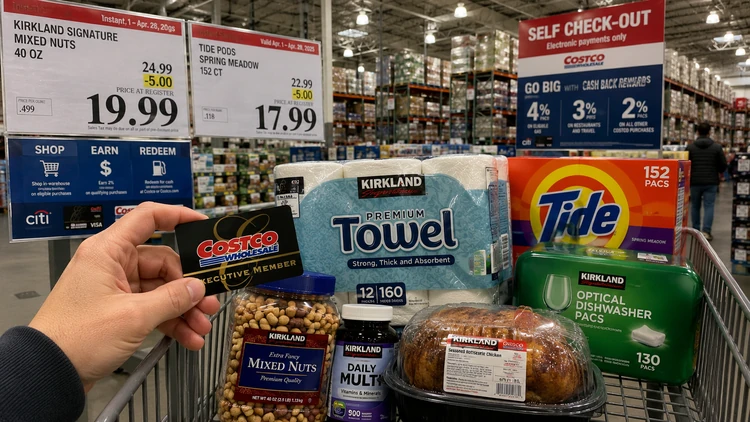

Learn Costco’s sale cycles, and then combine with the monthly savings book. Otherwise, if you miss it, you’re paying full price for no reason.
Read the price tags or you’re guessing what kind of a deal you’re getting. $0.97 means clearance, $0.00 can be a killer deal, and the asterisk means it’s about to disappear.
Stack what Costco does allow, which includes instant rebates, 2% rewards, credit card cash back, and then grab a price adjustment if it drops in price within 30 days.
When you think about shopping at Costco, the word “coupon” doesn’t immediately come to mind.
After all, you won’t ever find Costco coupons in the Sunday paper, or promo codes, or an app with digital coupons ready to be clipped.
Because at Costco, the game isn’t about clipping coupons, but rather about timing your purchases, decoding the price tags, and stacking hidden savings layers most people never notice.
Here’s a full breakdown of how it all works at Costco.
The 'coupon book' isn’t optional reading — it’s your roadmap
Most shoppers treat the monthly Costco Savings Book like junk mail. Flip. Toss. Forget.
But if you actually study it, you’ll start to see some interesting patterns, and those patterns are where the real savings live at Costco.
These “coupons” are:
- Preloaded into the system.
- Automatically applied at checkout.
- Often the lowest price that item will hit for months.
Costco negotiates these savings book discounts directly with brands. That means when something shows up in the book, it’s not a random markdown. It’s actually a planned price drop tied to inventory cycles.
Why that matters: If your household regularly buys things like paper goods, vitamins, coffee, or protein shakes, the difference between buying on-cycle vs. off-cycle can easily be 20–30% per item.
Multiply that across a year, and now you’re talking about some real savings.
Costco runs on a cycle — and once you see it, you can’t unsee it
Any seasoned Costco shopper knows they don’t do constant discounts, but instead, they rotate them throughout the year.
And once you start tracking that rotation, you’ll stop overpaying immediately.
Here’s what you need to know to make it happen:
- Household staples rotate every eight to 12 weeks.
- Seasonal items get aggressive markdowns at the end of the current season.
- Big-ticket items (think appliances, computers, TVs) often align with holiday sale cycles.
So, when you start paying attention, instead of asking, “Do I need this today?” You start asking yourself, “Where is this in the cycle?”
Here’s an example:
- Laundry detergent not on sale → wait
- Two weeks later → shows up in the book at $6 off
- Same exact item, completely different price
In a nutshell, that’s how couponing at Costco works.
Pro tip: Keep a running note in your phone of the items you buy regularly and the last time you saw them on sale. Within a few months, you’ll start predicting deals before they happen.
Price tags tell a story — and most don’t know the language
Costco employees won’t walk up to you and tell you something is about to disappear or get cheaper.
But the price tag will, and over the years, I’ve had several Costco employees tell me how to read their shelf tags to figure out what kind of a deal you’re getting.
Here’s how to read the tag like an insider:
- Price ends in $0.97 → Markdown clearance price (typically corporate-driven)
- Price ends in $0.99 → This is the regular price
- Ends in $0.00 or $0.88 (varies by store) → Manager markdown (store-specific, often an excellent price)
- Asterisk (*) in the corner → Item is being discontinued. Some call it the Costco death star…once it’s gone, it’s gone forever.
That asterisk in the corner of the shelf tag is the big one to pay attention to.
It means:
- No restock
- No future sale cycle
- What you see is all that’s left
Combine an asterisk with a $0.97 price and you’ve found what many shoppers call a “Costco unicorn deal.” The next time you see this combination, I dare you to try and find a cheaper price anywhere else. I doubt you can.
Where real couponing happens: stacking outside the store
You’ve never seen a shopper with a stack of manufacturer coupons checking out at Costco. That’s because they do not accept them.
Because of this, most people assume stacking discounts at Costco is impossible.
It’s not impossible, you just have to do it a little differently.
Here’s the workaround:
- Use a rebate app like Ibotta, Fetch, or Shopmium.
- Scan your receipt after purchase.
- Earn points, cashback, or gift cards.
Now layer that savings with these:
- Costco instant savings (the monthly savings book)
- An Executive Membership (2% back)
- A rewards credit card (1–5% back)
Congrats, you’ve just creatively recreated “coupon stacking” at Costco, and the savings is significant — especially when you can take advantage of a deal in the monthly savings book.
A real-world example:
- $20 item → $5 instant Costco discount
- $2 rebate app
- 2% Executive reward
- 2% credit card
You’ve just saved about 30% when you combine all of these. That’s how a “no coupon” store can still leave you with significant savings.
Costco’s 30-day price adjustment policy is retroactive couponing
This is one of the most underused Costco hacks out there today.
If something you bought goes on sale within 30 days, you can request a price adjustment.
The best part is you don’t have to bring back the item, or your receipt, as Costco keeps track of all your purchases via your membership. Just walk up to the membership counter, tell them about the lower price, and they’ll refund you the difference.
This policy allows you to do the following:
- Buy when inventory is available
- Watch upcoming sales cycles
- Get refunded the difference if the price drops
Why this matters right now: With supply chain issues and rising prices (especially in tech), waiting can sometimes mean missing out entirely or paying more down the road.
Their price adjustment policy basically lets you shop smart now and still hedge your bet if the price drops later.
Where Costco 'couponing' goes wrong
Even the smartest Costco shoppers can slip up from time to time.
After all, the biggest danger at Costco isn’t high prices, it’s when they trick you into “false value.”
For example, watch out for these common mistakes:
- Bulk produce that spoils before you use it.
- “Deals” on items you wouldn’t normally buy.
- Name brands that are cheaper at grocery stores with coupons.
Remember, Costco’s pricing psychology is a real thing and quite powerful. They realize that the bigger the package, the more it feels like a better deal in the minds of consumers.
For this reason, always pay attention to the unit price. That’s the price that still wins and always will.
Rule to live by: A discount only saves you money if you were going to buy it anyway and actually use the entire thing before it goes bad.