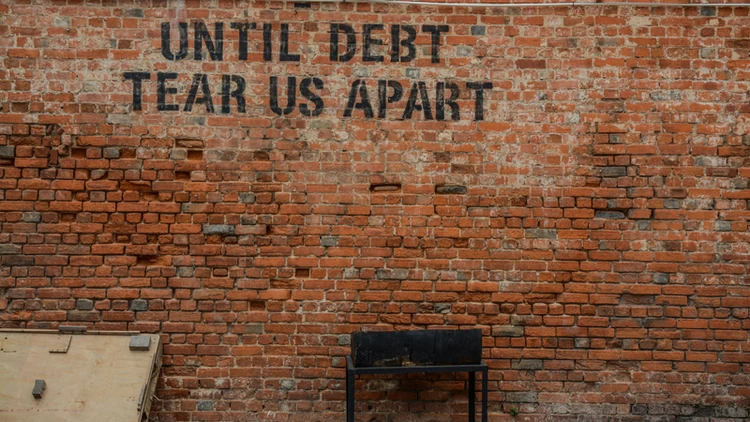

Since the end of 2023, concerns about growing U.S. debt have become more pronounced. Not the debt taken on by U.S. consumers – which is significant – but the debt run up by the U.S. government.
As of April 2024, the U.S. national debt was above $34.6 trillion. Given the total population of the U.S., that means the average citizen’s share of the national debt is more than $100,000.
But the U.S. is not the only nation to push its deficit to a record high. Last September, economist Arthur Laffer warned that the world is facing a debt crisis that will last for a decade because of rising budget deficits. In the wake of the COVID-19 pandemic, countries rich and poor have seen their budget deficits swell.
“I predict that the next 10 years will be the Decade of Debt,” Laffer said in an interview with CNBC. “Debt globally is coming to a head. It will not end well.”
Could the U.S. face a credit crisis and how would it affect the average consumer? We put the question to a panel of economic experts who recognize the potential danger but don’t think a crisis is imminent.
Economists weigh in
Dr. Dennis Nsafoah, professor of economics at Niagara University, sees a big warning sign – government debt that is 121% of the nation’s gross domestic product (GDP). But he thinks the U.S. is in better shape than many other countries.
“Despite these historically high figures, the probability of a traditional debt crisis, common in countries with limited borrowing capacity and those that do not borrow in their own currency, remains low for the U.S.,” Nsafoah told ConsumerAffairs.
“Instead of an abrupt default or collapse, a U.S. debt crisis would likely emerge slowly through rising debt servicing costs, which could curb government spending and slow economic growth. Rising interest rates on new government debt could increase borrowing costs and necessitate fiscal adjustments that might hinder economic expansion.”
In such a scenario, U.S. consumers would pay higher interest rates on any money they borrow, including mortgages, auto loans and credit cards. That would dampen consumer spending and likely slow economic growth.
Slowing growth could make things worse for a country with a lot of debt. Carl Schramm, a professor of economics at Syracuse University, says an expanding economy makes it easier to handle rising debt. But, he too sees a warning sign.
“The critical issue is innovation and our level of innovation has been falling, and with it eventually, the growth capacity of the economy,” Schramm said.
A return of ‘stagflation?’
When debt rises but innovation and productivity fall, the result is almost always more inflation, or in the case of the 1970s, “stagflation” – higher prices but little to no economic growth.
“We’re going to have inflation because the historical record across many nations is clear,” Schramm said. “If a government’s debt, its obligation to its bond-holders continues to grow, the government generally has no choice but to devalue the currency.”
A devalued dollar means it won’t buy as much as it used to. In other words, rising debt, combined with slower growth, leads to more inflation and higher prices of assets.
Eric Kelley, chief investment officer at UMB Bank, sees the risk of a U.S. debt crisis but doesn’t expect it would occur under current circumstances for at least another five to seven years.
“The U.S. net-debt-to GDP is elevated by all historical measures, but can likely continue to expand for quite a while longer,” he told us.
That is due, in part to the fact that the U.S. dollar is the world’s “reserve currency,” which is held in significant quantities by the world’s central banks and used for trade. That gives the U.S. government some extra wiggle room other nations don’t have.
“Other major players on the world stage cannot fulfill the role of the U.S. dollar for global trade, at least in the near term, so there isn’t likely to be any serious pressure on our borrowing capacity if the deficit and debt burden continue to expand for several more years,” Kelley said.
Kelley said there is not a high degree of certainty around a precise “trigger point” for a debt crisis but notes that many economists estimate that U.S. net debt to GDP could expand to 150%, from its current level today, before it would start to cause serious issues for the country.
'Tipping point?'
“The tipping point would be highly dependent on inflation and interest rates over the next five to ten years. Any serious disruption is likely quite a few years into the future,” he said.
But history shows that things can change. Thomas Brock, an expert contributor at Annunity.org, doesn’t take the dollar’s status as the world’s reserve currency for granted.
“While U.S. economic growth is relatively strong, our geopolitical status is weakening and global reliance on the U.S. dollar is declining, Brock said. “For these reasons, we need to immediately begin behaving in a more fiscally responsible manner.”
The U.S. debt has been steadily growing for decades, but it got a huge boost during the COVID-19 pandemic, when the government sent out massive support payments, whether the individual recipients needed them or not.
“The thing I worry most about is the level of debt the government has taken on and it’s not clear to me why,” Schramm said, referring to pandemic spending. “We kept spending, even after it was very clear that COVID had ended.”
The Fed has complicated things
The Federal Reserve’s battle with inflation has complicated America’s debt situation. It has raised interest rates to dampen inflation.
But, the increase in interest rates has contributed to the rise in interest rates on Treasury bonds. That has increased the government’s cost of servicing its debt.
“Should the status quo hold, the United States will experience some sort of debt crisis because the government is not collecting as much as it is spending,” American Staffing Association Chief Economist Noah Yosif told ConsumerAffairs.
And at some point, he says things could get ugly.
“If the government were to default on its debt, an ensuing debt crisis would see excruciating cuts in federal spending or [higher] taxes, which would force households to curtail their consumption of goods and services,” he said.
That could result in an “effective standstill in economic activity” and would almost certainly induce a recession, trigger a massive increase in unemployment, support debt-deflation as the real value of the U.S. dollar rises, and spook creditors into raising interest rates.
“Any debt crisis would place the average consumer between a rock and a hard place," he said. On one hand, their financial security would suffer under any corrective measures instituted by the government, and on the other hand, backlash from creditors would only inflict more economic pain.”
But our panel doesn’t expect it to get that far. A default on America’s obligations would likely create a situation similar to what Yosif describes.
A more likely scenario would be the continued increase in the money supply. For consumers, that could mean inflation will not end anytime soon, with interest rates remaining higher for longer.