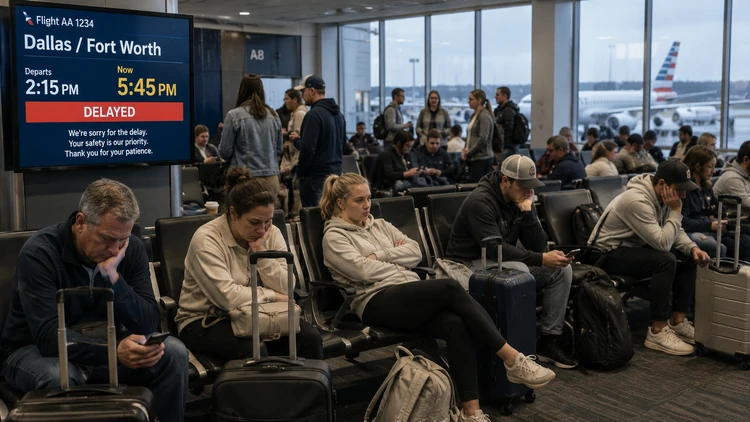

A new report found U.S. flights in 2025 had the worst on-time arrival rates since 2014.
More than 118,000 flights were canceled last year among major airlines and regional partners.
Experts say staffing shortages, crowded airspace, and operational issues continue to affect travelers.
Air travel frustrations continued to pile up in 2025, according to a new report from the U.S. PIRG Education Fund.
The report, called “The Plane Truth 2026,” found that flight delays and cancellations reached some of their highest levels in years, making travel more unpredictable for millions of passengers.
“Air travel has been increasingly erratic and stressful, even before the Spirit Airlines collapse, which will affect flyers on other airlines, too. In addition, the big four airlines are raising prices or cutting flights or both,” Teresa Murray, Consumer Watchdog director for U.S. PIRG Education Fund, said in a news release.
“A lot of issues are converging: a shortage of air traffic controllers, the economy, bad weather, more cancellations and delays, government shutdowns that affect security lines, higher airfares and baggage fees that are $10 to $15 more per bag than a year ago.”
The main findings
Researchers found that overall on-time performance fell to 76.34% in 2025, the lowest level recorded since 2014. That translated to nearly one in four flights being delayed, canceled, or diverted. In addition, roughly one in 12 flights arrived at least an hour late.
The report also noted that airlines canceled more than 118,000 flights across the nation’s 10 largest carriers and their regional partners.
Lengthy tarmac delays increased sharply in 2025, with domestic delays lasting more than three hours reaching their highest level since federal tarmac rules were introduced in 2010.
When it came to specific airlines, some had better results than others. Hawaiian Airlines ranked among the strongest carriers for on-time arrivals and low cancellation rates. Frontier, JetBlue, and American Airlines were on the other end of the spectrum, leading the charge for the airlines with the weakest delays and cancellations.
What led to the delays?
According to the U.S. PIRG Education Fund, there are several reasons for the worsening performance.
Among the biggest challenges were shortages of air traffic controllers, increasingly crowded airspace, and airline scheduling practices that leave little room for disruptions. Researchers also highlighted operational problems that can create a ripple effect across entire flight networks once delays begin.
What this means for travelers
For consumers, the findings are another reminder that air travel can still be unpredictable – even years after pandemic-era disruptions eased.
Travelers may want to build extra time into itineraries, especially for tight connections or important events. The report also emphasized the importance of understanding airline passenger rights, particularly when flights are canceled or significantly delayed. Congress approved new consumer protections in 2024 that guarantee refunds in certain situations if passengers choose not to accept rebooking offers.
Researchers warned that travel disruptions are unlikely to disappear anytime soon, meaning passengers may continue facing long waits, schedule changes, and added stress when flying.
“Travelers still have many, many rights and it’s more important than ever for passengers to know what those are,” said Andre Delattre, The Public Interest Network’s senior vice president and COO. “You can’t just show up and expect everything to go smoothly. Air travel is a participation sport.”