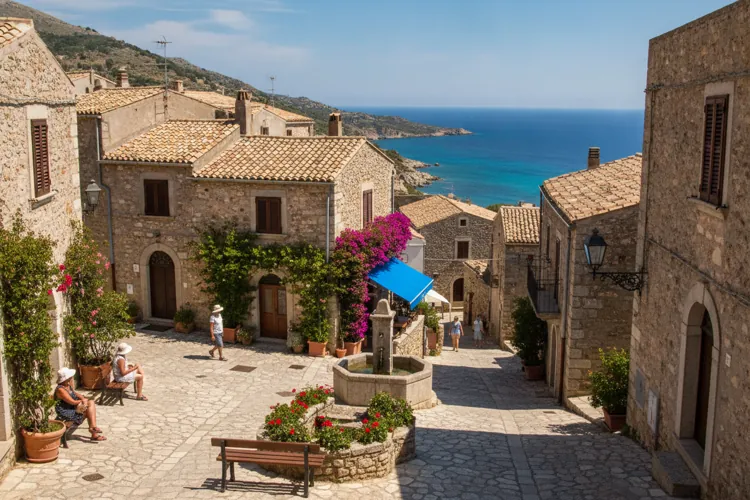

Women in Bolotana, Sardinia, were more likely to reach 100 than women in Italy or the United States.
Researchers verified residents’ ages using historical civil records and church archives.
Walking, locally grown food, and strong family connections could offer clues, but more research is needed to explain the village’s longevity.
What if the secrets to a longer life could be hiding in a small Italian village?
Researchers studying Bolotana, a mountain community on the island of Sardinia, have found an unusual pattern of longevity that could make it a new destination for researchers exploring why some people live longer than others.
The study, published in Frontiers in Aging, found that women in Bolotana who reached age 70 had an estimated 13.8% chance of living to 100. That compares with approximately 3.5% for women across Italy and 3.6% for women in the United States.
The findings suggest Bolotana could be a new “blue zone,” a term used to describe places where residents experience unusually long lives. However, researchers caution that more evidence is needed before the village can officially be considered an established longevity hotspot.
“What makes Bolotana extraordinary is that it has an incredible historical record that allows us to definitively evaluate ages at birth and death,” researcher S. Jay Olshansky said in a news release. “The municipal and baptismal records date back centuries and allowed us to independently verify ages.”
How researchers investigated longevity
To determine whether Bolotana's reputation for long life was supported by the numbers, researchers examined demographic data covering 2021 through 2025. They focused on two measures: how many additional years people could expect to live after turning 70 and the likelihood of surviving from age 70 to age 100.
The team compared its findings with data from Sardinia's surrounding Nuoro province, the island as a whole and Italy nationally. Researchers also compared Bolotana with established longevity benchmarks, including Sardinia's original blue zone.
Accurate age records were especially important. Researchers cross-checked municipal birth and death records against historical church documents, including baptismal and burial records. They verified the ages of all identified centenarians, helping address concerns that unusually old ages can sometimes result from inaccurate documentation.
The researchers also examined alternative time periods to see whether their findings held up under different assumptions.
What the findings could mean for consumers
Women in Bolotana stood out in the results. Those who reached age 70 had an estimated 20.85 additional years of life expectancy, while their chances of reaching 100 were more than three times those of women in the United States.
So, what might explain this pattern? The study did not establish a cause, but the village offers several possibilities worth investigating. Residents live in a walkable community with steep streets and hills, many foods are grown locally, and family members often live near one another. Social isolation also appears to be uncommon.
Researchers believe physical activity, diet, family support, social connections, and genetics may all play a role. Still, the results varied depending on the years examined, and the team says further observation is necessary.
For consumers, the findings offer a reminder that longevity may involve more than any single food, supplement, or fitness routine. Everyday movement and meaningful social connections are potential areas for further study, but this research does not prove that adopting any one habit will help someone live to 100.
“If we can identify the characteristics behind this longevity and help people adopt them, the rest of the world can benefit from understanding the values practiced by these communities,” Olshanksky said.