
Four in 10 adults reported unsafe sleepiness: 41% said they had felt so tired while driving that it affected their ability to drive safely.
Men reported the experience more often: Half of male respondents said they had experienced this level of drowsiness, compared with 33% of female respondents.
Middle-aged adults reported the highest rates: Adults ages 35 to 44 were the most likely to report driving while dangerously sleepy.
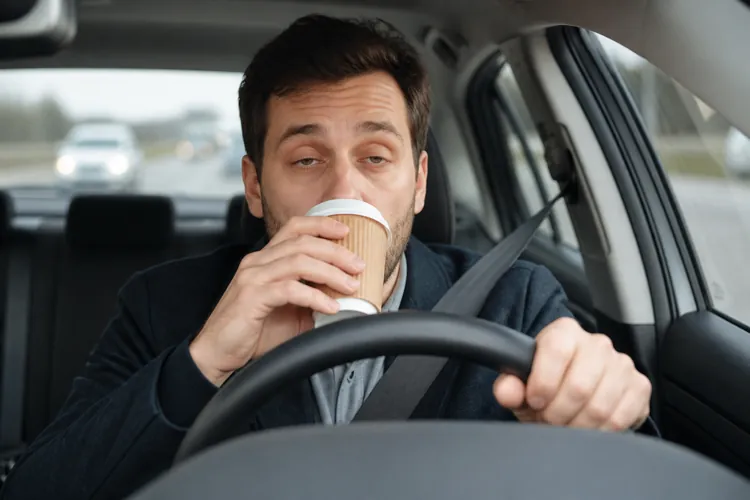
Grabbing a cup of coffee before getting behind the wheel might seem like a simple way to stay alert. But caffeine isn't a replacement for getting enough sleep, and driving while exhausted can put both drivers and others on the road at risk.
A new survey from the American Academy of Sleep Medicine (AASM) highlights just how common this experience is. According to the organization's findings, 41% of U.S. adults have felt so sleepy while driving that it affected their ability to drive safely.
The results serve as a reminder that fatigue deserves the same serious attention as other factors that can interfere with safe driving. Rather than relying on coffee to push through tiredness, drivers should recognize when they aren't alert enough to be on the road.
“Drowsy driving puts everyone on the road at risk,” AASM President Dr. Fariha Abbasi-Feinberg, said in a news release. “It’s important to recognize the warning signs that you are too tired to drive. If you are yawning, drifting into other lanes, or nodding off, it’s time to pull over to get some sleep.”
How the survey was conducted
The AASM commissioned an online survey of 2,007 adults across the United States. Independent market research agency Atomik Research conducted the survey between June 5 and June 13, 2025.
Participants were asked a straightforward question: Had they ever felt so sleepy while driving that it affected their ability to drive safely?
Researchers collected responses from different age groups and genders to examine how experiences with drowsy driving varied among participants.
The survey's reported margin of error was plus or minus two percentage points, with a 95% confidence level. That means the overall findings have a degree of statistical uncertainty, and the results represent respondents' reported experiences rather than a direct measurement of driving behavior.
What the results mean for drivers
The survey found that 41% of respondents had experienced unsafe sleepiness while driving, while 59% said they had not. The results also showed differences across demographic groups.
Men were more likely than women to report the experience, at 50% versus 33%. Adults ages 35 to 44 reported the highest rate, at 47%, followed by those ages 45 to 54 at 46%. Among adults 65 and older, 28% reported having experienced it.
These findings don't establish why the groups differed, but they underscore that drowsy driving is not limited to one age group or type of driver.
For consumers, the practical takeaway is simple: Don't assume coffee can make you safe to drive when you're exhausted. If you're struggling to stay awake, the safer choice is to avoid driving until you're rested enough to do so safely.
A caffeine boost may make you feel more alert temporarily, but it shouldn't be treated as a substitute for sleep. Recognizing your limits before starting a trip can help you make safer decisions for yourself and everyone sharing the road.
“Drowsy driving isn’t limited to nodding off behind the wheel,” said Jake Nelson, director of Traffic Safety Advocacy and Research at AAA. “Research from the AAA Foundation for Traffic Safety has found that driving after getting only four hours of sleep is associated with a crash risk comparable to driving with a blood alcohol concentration of 0.08.
“Coffee, fresh air, or a loud radio may make you feel more alert temporarily, but they cannot replace sleep. If you become drowsy on the road, a 20- to 30-minute nap can help restore alertness for up to two hours. Before getting behind the wheel, ask yourself whether you’re truly rested enough to drive safely.”