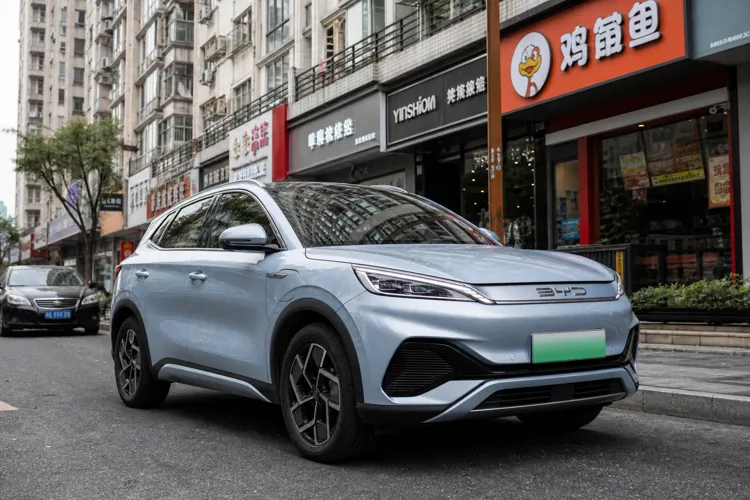

Major automakers are urging Congress to permanently ban Chinese connected vehicles, software, and hardware from the U.S. market.
The industry says government-subsidized Chinese vehicles threaten American manufacturing and could expose drivers’ personal and location data.
A ban could protect U.S. auto jobs but also prevent consumers from gaining access to lower-priced Chinese electric vehicles.
Major automakers are asking Congress to permanently close the U.S. market to Chinese connected vehicles, arguing that allowing them into the country would threaten American jobs, domestic manufacturing, and consumers’ personal information.
It’s not a request they have made concerning other vehicles imported from Japan, Korea, or Europe.
The Alliance for Automotive Innovation, which represents General Motors, Ford, Toyota, Volkswagen, Hyundai, Honda, Stellantis, and other manufacturers, urged congressional leaders to pass a ban before the current session ends.
In a Sept. 3 letter, the group called for a permanent prohibition on the sale, importation. and manufacture of Chinese connected vehicles, as well as restrictions on Chinese-made vehicle hardware and software.
“Right now, Chinese automakers are dumping subsidized vehicles with connected software and hardware around the world,” Alliance President and CEO John Bozzella wrote. The group said Chinese brands have already captured market share in Europe, Australia, Southeast Asia, Mexico, and South America.
Chinese automakers have not yet established a significant presence in the United States, partly because of tariffs and existing technology restrictions. The industry wants Congress to act before companies such as BYD, Chery, and SAIC Motor can gain a foothold.
More than an economic argument
Automakers describe Chinese vehicles as both an economic and national security threat.
Modern vehicles may contain cellular connections, cameras, microphones, navigation systems, and sensors capable of collecting information about drivers and their surroundings. U.S. officials have warned that technology supplied by companies under Chinese control could transmit sensitive information or potentially allow outsiders to interfere with vehicle systems.
A Commerce Department rule already restricts connected-vehicle technology linked to China and Russia. The legislation under consideration would put many of those protections into federal law, making them more difficult for a future administration to reverse.
The bipartisan Connected Vehicle Security Act of 2026 was approved by the Senate Commerce Committee in July. A similar bill has been introduced in the House. Another proposal, the Motor Vehicle Modernization Act, would prohibit companies linked to designated foreign adversaries from manufacturing, importing, or selling vehicles in the United States.
The Alliance says the restrictions are necessary to protect an American auto industry that supports about 11 million jobs and contributes nearly $1.5 trillion annually to the economy, according to its letter to congressional leaders.
Proposed ban raises complications
Writing an effective ban may be more difficult than simply excluding vehicles shipped directly from China.
Some global automakers have Chinese investors, components, or business partners. Mercedes-Benz, for example, has significant passive Chinese ownership. Senate Commerce Committee Chairman Ted Cruz has warned that a proposal barring companies with more than 15% Chinese ownership could unintentionally prevent Mercedes-Benz from selling vehicles in the United States.
Polestar presents another complication. The electric-vehicle company is headquartered in Sweden but is majority-owned by China’s Geely Holding. Polestar has said federal restrictions would prevent it from selling certain future models in the U.S.
Waymo also plans to use vehicles produced by Zeekr, another Geely-owned company, as platforms for its next generation of robotaxis. Although Waymo supplies its own autonomous-driving technology, a broadly written ban could disrupt that arrangement.
Those examples help explain why lawmakers are still debating how to distinguish a Chinese automaker from a multinational company that has Chinese investors, suppliers, or manufacturing operations.
What it could mean for consumers
Consumers are unlikely to notice an immediate change because few Chinese-branded passenger vehicles are currently sold in the United States.
The longer-term impact could be more significant. Chinese manufacturers have developed electric vehicles that often cost much less than comparable models sold by U.S., European, Japanese, and South Korean brands. Keeping those vehicles out of the country would reduce the possibility of aggressive price competition that could make EVs more affordable.
Supporters contend that low prices are possible because Chinese manufacturers receive extensive government support, making it difficult for companies operating under market conditions to compete. They also argue that slightly lower vehicle prices would not justify risks involving data privacy, cybersecurity, and the loss of American manufacturing jobs.
The Alliance is not simply asking Congress to ban every car containing a Chinese-made part. Its request focuses on vehicles and connected technology associated with Chinese automakers or entities controlled or influenced by China. Exactly where Congress draws that line will determine whether the legislation affects only Chinese brands or reaches established automakers with Chinese investors and suppliers.
For now, the proposed ban remains unfinished legislation. But its bipartisan support suggests that Chinese automakers will continue to face formidable barriers to entering one of the world’s largest and most profitable vehicle markets.