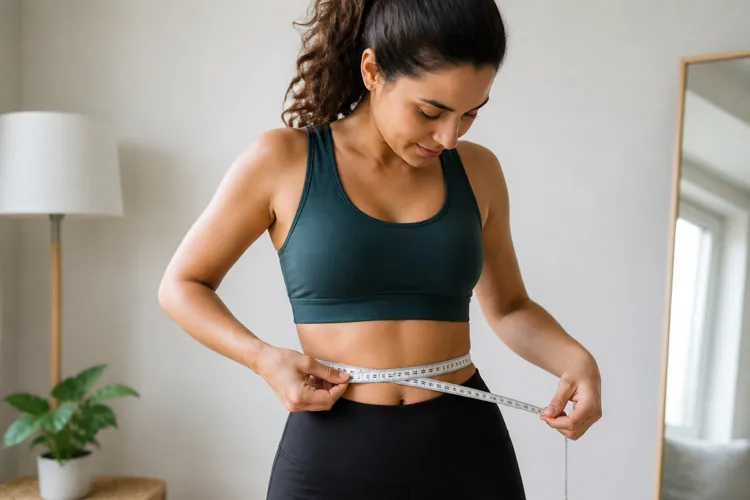

A Rutgers study found that waist circumference performed nearly as well as more complicated methods for identifying excess body fat.
BMI alone missed a substantial number of people who met the study’s criteria for obesity based on body-fat measurements.
Researchers say measuring waist circumference could offer a practical way to identify potential health risks in routine care.
For years, body mass index (BMI) has been one of the main tools used to identify obesity. But BMI has a notable limitation: It doesn’t fully account for differences in body composition or where someone carries their body fat.
New research from Rutgers Health suggests that a much simpler measurement may provide useful information. In a study published in JAMA Network Open, researchers found that waist circumference alone performed nearly as well as a more complicated approach that uses several measurements to identify excess body fat.
That could make the humble measuring tape a surprisingly useful tool in healthcare. Researchers say waist measurements are relatively easy to obtain and could help clinicians and patients identify potential health risks earlier.
“Pay attention to the need to loosen your belt or get bigger pants,” researcher Aayush Visaria said in a news release.
“Although clothing size isn’t the same as a proper waist circumference measurement, it can be an early sign of unhealthy amounts of body fat. Measuring your waist, along with your weight, can help identify health risks earlier and provide an opportunity to reduce your risk of diabetes, heart disease, stroke and some cancers.”
How the study worked
Researchers analyzed data from 1,900 U.S. adults between the ages of 20 and 59 who participated in the 2017-2018 National Health and Nutrition Examination Survey. All participants had undergone whole-body dual-energy X-ray absorptiometry, or DEXA, scans, which researchers used as the reference for measuring body fat.
For the study, obesity based on total body fat was defined as at least 25% body fat in males and 35% in females. The researchers then compared five different ways of identifying obesity: BMI alone, waist circumference alone, BMI or waist circumference, and two versions of a newer framework that incorporates multiple body measurements.
The more complex framework includes measurements such as waist circumference, waist-to-height ratio, and waist-to-hip ratio. Researchers wanted to see whether all those measurements actually provided a meaningful advantage over simpler approaches.
What researchers found
The results favored simplicity. Waist circumference alone had an area under the receiver operating characteristic curve of 0.815, compared with 0.818 for the BMI-or-waist-circumference approach. The researchers said waist circumference captured most of the diagnostic information across the comparisons.
BMI alone, meanwhile, performed substantially worse. Its sensitivity was 51.3%, compared with 71.4% for waist circumference alone. In practical terms, that means BMI alone missed a considerable number of people who met the study’s body-fat criteria for obesity.
The researchers say the findings could help inform future obesity-screening recommendations and support broader use of waist measurements in routine healthcare.
For consumers, the takeaway isn’t that BMI should simply be ignored. Rather, the study suggests that looking at waist circumference alongside other measures may provide a more complete picture than relying on BMI alone.
“Our findings show that you don’t necessarily need multiple complex measurements to identify obesity-related health risks,” said Visaria. “A waist measurement provides much of the information needed and is feasible for clinicians and patients alike.”