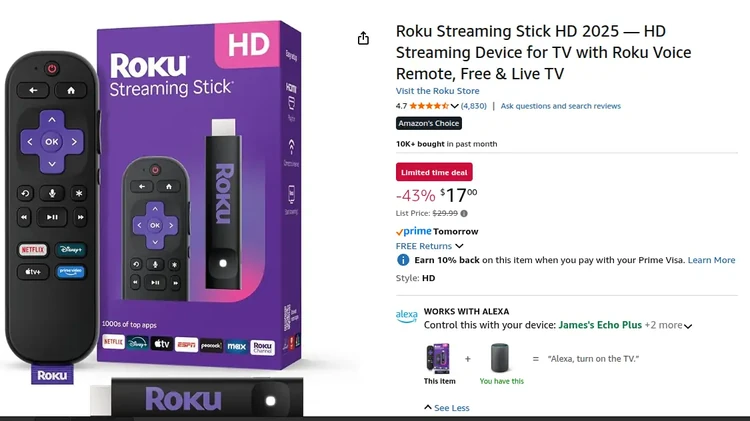

Consumers accuse Amazon of inflating Prime Day discounts with “fictional” list prices.
Lawsuit cites examples where sale prices were no better—or even higher—than regular prices.
Case follows broader scrutiny of Amazon’s sales tactics, including a $2.5 billion FTC settlement.
Amazon is facing a proposed class action lawsuit claiming it misled shoppers with false discounts during its July Prime Day sale.
The complaint, filed in September in federal court in Washington state, was brought by Cathy Armstrong of California and Oluwa Fosudo of Maryland. They allege that Amazon relied on “fictional” list prices to exaggerate percentage-off deals, creating the illusion of bigger savings.
“Amazon uses these fake Prime Day Percentage Discounts, offered under the extreme time pressure of the brief Prime Day window, to lure consumers to purchase products,” the lawsuit states.
Examples of “fake sales”
The filing cites several Prime Day promotions that plaintiffs argue were deceptive:
A pair of headphones promoted as 44% off a list price of $179.95. Plaintiffs allege the product had never been sold above $160, with a typical price between $130 and $160.
An 8-inch Android kids’ tablet marketed as 40% off a list price of $119.99. According to the lawsuit, Amazon had sold the device between $50 and $85 in the 90 days before Prime Day. The “deal” price of $72.18 was actually higher than its $50 price in April and roughly the same as its usual selling price.
The complaint argues that without Amazon’s allegedly inflated discounts, customers might have shopped around for better deals or waited for a lower price.
Quick checklist
✅ Compare across sites – Check the same product on at least two or three other major retailers.
✅ Track price history – Use tools like CamelCamelCamel, Honey, or Keepa to see if the “deal” price is really a bargain.
✅ Watch the fine print – Be cautious when the list price seems unusually high or doesn’t match what you’ve seen before.
✅ Don’t rush – Sales countdowns are designed to pressure shoppers. Take a pause before buying.
✅ Look for “was/now” patterns – If a product’s “deal” price is about the same as its usual selling price, the discount may be exaggerated.
Legal action builds on outside reporting
The lawsuit was filed shortly after Popular Information, a newsletter focused on corporate accountability, published a report highlighting questionable pricing tactics on Amazon’s site during the July 8–11 sale.
Lawyers for the plaintiffs declined to comment, citing the pending litigation. Amazon also declined to comment. On its website, the company described the four-day sale as its biggest Prime event ever, claiming customers “saved billions on deals.”
The case adds to mounting scrutiny of Amazon’s marketing and sales practices. Just last month, the e-commerce giant agreed to pay $2.5 billion to settle Federal Trade Commission allegations that it tricked consumers into signing up for Prime and made cancellations difficult.
That settlement included a record-setting $1 billion civil penalty for violating FTC rules.
Meanwhile, Amazon continues to expand its Prime Day brand, hosting another sales event Oct. 7–8.
Perfect — here’s a sidebar explainer you can run alongside the main story. It follows the recall/scam package style you’ve been using:
Why retailers use “fake discounts”
Anchoring effect: A high strikethrough price makes the actual price look better, even if it isn’t.
Urgency: Limited-time Prime Day or flash-sale events create a fear of missing out.
Volume sales: Even small exaggerations can push thousands of extra purchases.
What to do if you think you overpaid
Contact the seller: Ask for a price adjustment or refund if you can show the price was lower before or after the “sale.”
Report it: File a complaint with the Federal Trade Commission (FTC) or your state attorney general if you believe discounts were deceptive.
Leave a review: Warn other shoppers by leaving a factual review noting the price discrepancy.
Bottom line
A “40% off” or “limited-time deal” may not always mean savings. The safest bet is to research a product’s real price history before clicking Buy Now.