


What size trailer do I need?
Moving trailers come in a variety of styles and sizes, so it’s important to know your needs before reserving one. We asked Paul Kelly, a U-Haul trailer program manager, for tips on finding the right moving trailer.
Kelly’s advice: “If moving equipment, machinery or tools, be sure to look up specific weights for your cargo online and compare that with the weight limits for your trailer.” He said to err on the side of caution when estimating weights — opt for a larger trailer if in doubt, as long as your vehicle is capable of towing it.
Kelly also emphasized the importance of loading the heaviest cargo first. He recommended the 60/40 rule: “(Put) 60% of your cargo weight toward the front to ensure proper tongue weight. This will make for a safer trip and help you avoid dangerous swaying.”
You can follow these six steps to determine the right trailer size for your move:
- List what you’re hauling: Identify what you need to move from your home, particularly large items like couches or bedroom furniture. Completing this step before choosing a trailer will help you accurately estimate the space you need.
- Measure the dimensions of your large items: Measure items such as sectionals, mattresses, dressers and patio furniture. Record the height, width and depth, then calculate the cubic footage.
- Estimate total cargo weight: You can use standard measurements for common items when estimating the weight. For example, a loveseat can weigh up to 150 pounds; a recliner could weigh up to 120 pounds. You can also use basic room estimations of 1,000 to 1,500 pounds per fully furnished room.
- Choose a trailer type: Based on what you need to haul, pick the right trailer type (enclosed or utility) and size. Consider loading access, trip distance and whether you need weather protection.
- Match trailer to tow vehicle: Review the trailer’s towing requirements and assess whether it can be hauled safely by the vehicle you plan to use. You’ll need to know the vehicle's towing and payload capacity. You’ll also need to install the proper trailer hitch.
- Confirm fit and safety margin: Make sure everything fits in the trailer, and plan to tow no more than 80% of your vehicle’s maximum towing capacity. This creates a 20% safety buffer that can help avoid damage to both the towing vehicle and the trailer.
Moving trailer types
You can choose from several types of moving trailers, depending on what you need to haul and how far you're moving. Enclosed cargo trailers have built-in weather protection, making them ideal for moves with household furniture and boxes. They also have lockable doors for extra security.
Open utility trailers are better suited for short, local trips hauling bulky outdoor items that don’t need weather protection, like lawnmowers or outdoor furniture. Keep in mind that neither enclosed cargo nor utility trailers are well suited for long-distance or cross-country moves, as they increase vehicle wear and tear and reduce fuel efficiency. In these cases, renting a small moving truck may be more cost-efficient.
For towing vehicles, you can use either a car dolly or vehicle trailer. A car dolly has a weight limit of around 4,000 pounds, so it can only transport smaller vehicles like sedans or coupes. It’s better suited for short distances because the rear tires stay on the road and wear out during travel. For long-distance moves, consider using a vehicle trailer, which can tow large SUVs and trucks and keep all four tires off the ground.
Trailer types and best uses
Use the comparison below to match the right moving trailer to your move distance and cargo needs.
| Trailer type | Best for | Weather protection | Loading access | Typical trip distance |
|---|---|---|---|---|
| Enclosed cargo | Medium-distance moves with furniture and boxes | Yes | Ramp with access door | 50 to 100 miles |
| Utility | Local moves with bulky outdoor items and equipment | No | Ramp with gate | Under 50 miles |
| Car dolly | Short distances towing smaller vehicles with front-wheel drive | No | Pull-out metal ramps or tilt-bed platform | Under 100 miles |
| Auto transport | Long distances towing larger vehicles | No | Pull-out metal ramps | 100 to 1,000 miles |
Moving trailer capacity by size
Before choosing a trailer size, evaluate both the volume and weight of your belongings rather than relying strictly on room count. For example, a two-bedroom home with lightweight, minimalist furniture may not require as large a trailer as a home with heavy, solid-wood furniture.
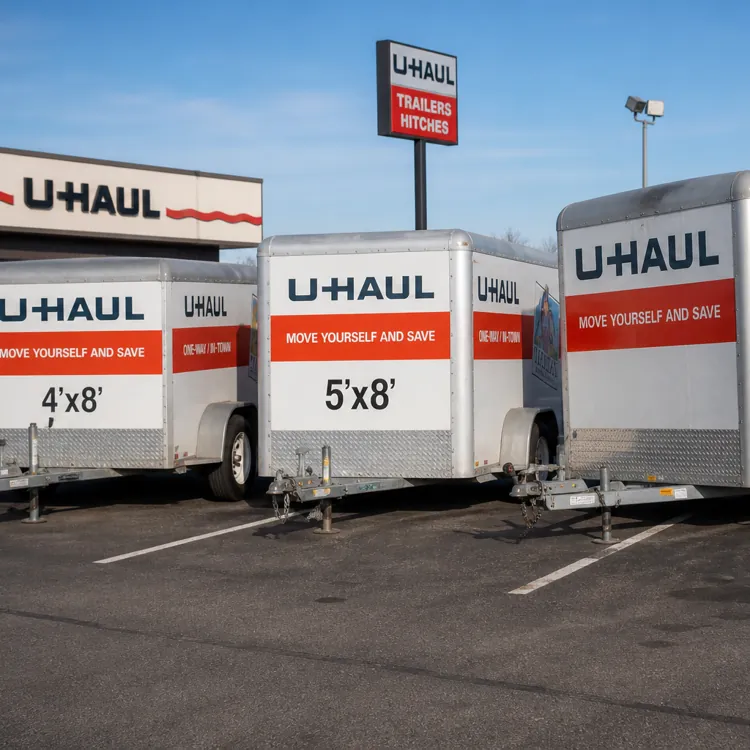
Utility trailer sizes range from 4 by 7 feet to 6 by 12 feet, with weight capacities of 2,400 to 6,000 pounds. Enclosed cargo trailers are typically available in three different sizes: small (4’ x 8’), medium (5’ x 8’) and large (6’ x 12’), with weight capacities ranging from 1,650 to 2,480 pounds.
Small enclosed trailers can fit most items from a dorm room or studio apartment, while a medium trailer can hold items from a one-bedroom home. For two- to three-bedroom homes, you may need to opt for the large trailer because it has the weight capacity and dimensions to hold a dining room table and a king-sized bed, among other items. It’s the largest practical option before upgrading to a full truck for three-bedroom homes.
Trailer sizes by home type and weight
Below, we break down standard cargo trailer sizes by typical home capacities.
| Cargo trailer size | Suggested home size | Weight capacity | Items that typically fit |
|---|---|---|---|
| 4 by 8 feet | Dorm room or studio apartments | 1,650 pounds | Boxes, twin bed, small dresser, sofa or loveseat |
| 5 by 8 feet | One-bedroom home | 1,800 pounds | Full or queen-sized bed, sofa, desk, square dining table |
| 6 by 12 feet | Two- to three-bedroom home | 2,480 pounds | Large sectional, king-sized bed, piano, dining table |
» DO IT RIGHT: How to pack a moving truck
Tow vehicle limits and trailer weight
Checking the tow vehicle’s requirements can help you avoid vehicle strain, brake failure and other safety risks while towing a moving trailer. To maintain control of both the vehicle and the moving trailer, never max out towing capacity, and always build in a 20% (or, at the very least, 10%) safety buffer.
To safely haul a moving trailer, confirm the following specifications:
- Tow rating: Check inside the driver’s door frame or owner’s manual for the Gross Vehicle Weight Rating (GVWR) to calculate the maximum combined weight of passengers, fuel and cargo.
- Payload: This refers to how much cargo weight the vehicle can handle. Payload is a component of the vehicle’s GVWR.
- Hitch class: Class I and II hitches can handle trailers and loads up to 3,500 pounds, while a Class III hitch is necessary for anything over that weight. Check the hitch bar on the vehicle for a label with the rating.
- Tongue weight: This indicates how much downward force can be on the hitch ball, typically 10% to 15% of the fully loaded trailer weight. It reduces available payload in the towing vehicle.
- Trailer GVWR: Locate the trailer’s GVWR on a label fixed on the left side of the trailer’s frame. This is the maximum total weight the trailer can safely weigh, including the trailer and the cargo.
- Brake requirements: Trailers that weigh 3,000 pounds or more must be equipped with brakes. Depending on the weight, check the type of braking system your trailer has.
- Lighting connector: Make sure the wires are in good working order and connected properly to the towing vehicle.
- Tire ratings: Tire ratings on both the towing vehicle and the moving trailer are printed on the tire’s sidewalls. These ratings give you the maximum weight, air pressure and speed limit for safe hauling.
» DON’T WANT TO DIY? Best moving companies
FAQ
How do I know what size trailer I need?
To choose the right trailer size for you, consider how much your cargo weighs and how much space it occupies. The best option also depends on the towing vehicle you plan to use and its tow rating.
What size trailer do I need for a house?
For a studio apartment, a small 4-by-8-foot moving trailer may suffice. However, for larger moves from homes with two or more bedrooms, a 6-by-12-foot trailer may be necessary.
What size trailer do I need to haul a car?
You can rent a designated vehicle trailer, which can tow several thousand pounds. Depending on the car's weight, you could use a car dolly to haul it — but this is only recommended for a short-distance move. Something to keep in mind: You can also hire an auto transporter to ship your car for you.
What size trailer do I need to haul a truck?
Most pickup trucks weigh between 4,000 and 7,000 pounds, so you'll need a vehicle trailer that can handle heavier loads. Check the truck’s weight before reserving a trailer.
Article sources
ConsumerAffairs writers primarily rely on government data, industry experts and original research from other reputable publications to inform their work. Specific sources for this article include:
- Movers.com, "How to Estimate the Weight of a Living Room When Moving." Accessed Aug. 30, 2026.
- National Van Lines, "How Do Long-Distance Movers Calculate Weight and Why Does It Matter for Your Budget?" Accessed Aug. 30, 2026.
- Reese Hitches, "What Is the 80 Rule for Towing Capacity." Accessed Aug. 30, 2026.
- TrailersPlus, "Cargo Trailer vs Moving Truck for a Long-Distance Move: Cost and Convenience." Accessed Aug. 30, 2026.
- U-Haul International, "Tow Dolly Rental." Accessed Aug. 30, 2026.
- U-Haul International, "Auto Transport / Vehicle Trailer Rental." Accessed Aug. 30, 2026.
- U-Haul International, "What Size Cargo Trailer Do I Need?" Accessed Aug. 30, 2026.
- Urgency Trailer, "Trailer Rental Cheaper? Trailer Rental vs. Moving Trucks Cost Comparison." Accessed Aug. 30, 2026.
- U-Haul International, "Toy Hauler - 16ft Flatbed Utility Trailer." Accessed Aug. 30, 2026.
- Extra Space Storage, "Tow Dolly vs. Auto Transport." Accessed Aug. 30, 2026.
- U-Haul International, "Transporting Vehicles with Low Ground Clearance." Accessed Aug. 30, 2026.
- U-Haul International, "Will it fit: Dimensions of U-Haul Trailers." Accessed Aug. 30, 2026.
- U-Haul International, "What Size Utility Trailer Do I Need?" Accessed Aug. 30, 2026.
- U-Haul International, "5x8 Cargo Trailer Rental." Accessed Aug. 30, 2026.
- U-Haul International, "6x12 Cargo Trailer Rental." Accessed Aug. 30, 2026.
- U-Haul International, "What Does GVWR Mean?" Accessed Aug. 30, 2026.
- Extra Space Storage, "What To Know Before Choosing a Moving Trailer Rental." Accessed Aug. 30, 2026.
- U-Haul, "Finding your hitch system rating." Accessed Aug. 30, 2026.
- JTI, "Tongue Weight Explained: What is Tongue Weight and How Do I Weigh It?" Accessed Aug. 30, 2026.
- Utah Trailer Pros, "Understanding Trailer Weight Ratings GVWR, Payload, and Tongue Weight Explained." Accessed Aug. 30, 2026.
- Federal Motor Carrier Safety Administration, "Part 393." Accessed Aug. 30, 2026.
- Felling Trailers, "Trailer Wiring: What to Check Before You Leave." Accessed Aug. 30, 2026.
- Sullivan Tire and Auto Service, Inc., "Find Your Tire Speed Rating." Accessed Aug. 30, 2026.
- North Carolina Department of Environmental Quality, Division of Marine Fisheries, "Choosing Tires for Tow Vehicles & Trailers." Accessed Aug. 30, 2026.
- J.D. Power, "How Much Does a Truck Weigh?" Accessed Aug. 30, 2026.
- Extra Space Storage, "Tow Dolly vs. Auto Transport: Which Option Is Right For You?" Accessed Aug. 30, 2026.