


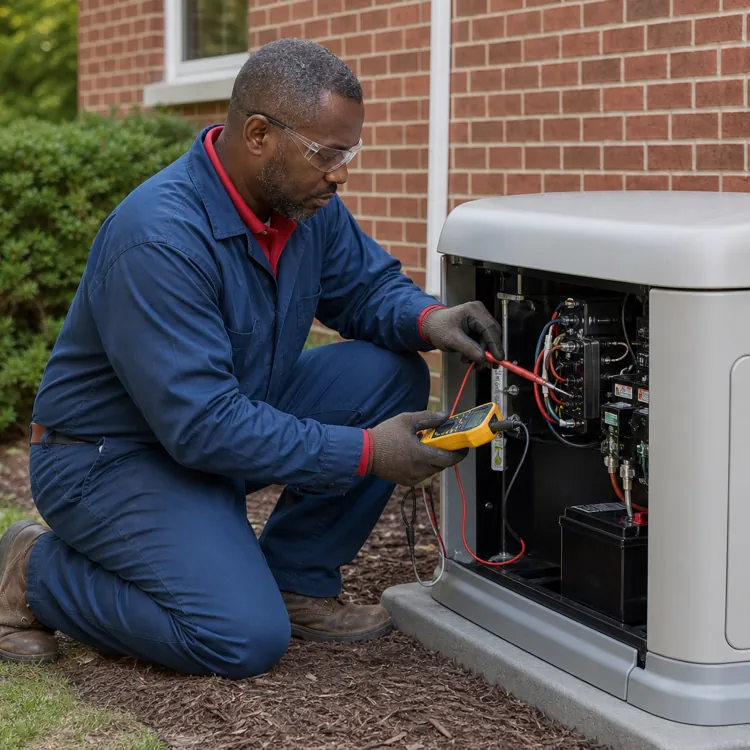
Generator size for a 2,000-square-foot house
The average 2,000-square-foot home will need a generator that’s between 16,000 and 24,000 watts for whole-home backup power. Typically, this size whole-home generator costs between $7,600 and $25,400. A generator with 7,000 to 10,000 watts can provide essentials only, including well pumps, lighting and a refrigerator. This size unit can cost between $3,650 and $10,600.
Emergency backup needs can vary depending on whether you rely on a well pump for water. If you have public water, you’ll likely only need a 7,000-watt unit to power the essentials in your home, but it’s better to aim for at least 10,000 watts. If you know you want whole-home backup power, there are a few key things to consider to determine if you’ll need closer to 16,000 watts or 24,000 watts.
- Heating system: Traditional heating systems, like burners and furnaces that run on oil or gas, use minimal electricity (usually under 500 watts) and put only a small demand on a generator. If you have electric baseboards, you’ll need closer to 2,000 watts just for your heating system, which means a larger generator.
- Cooling system: Cooling systems demand much more power than heating systems because they don’t rely on fossil fuels, but the type of AC you have matters. A central AC has running wattages of between 3,000 and 5,000, while ductless mini-splits require 2,000 to 4,000 watts. Window ACs require just 400 to 1,000 watts, so you can use them with much smaller generators.
- Water heater: Oil-, gas- or propane-fired water heaters require almost no electricity, so you can run them on very small generators. Electric tank-style water heaters demand 4,000 to 6,100 watts, and electric tankless water heaters can require up to 36,000 watts, meaning they’ll require some of the largest standby generators available.
- Well pumps: Well pumps use around 1,000 watts while running, but can peak at 3,000 watts during startup. If you’re on well water, you may need to upsize your generator, even for emergency-only power.
- Additional demands: You’ll have to consider other electrical demands when sizing your generator if you want no interruption to your daily routine during outages. Pay particular attention to high-demand items, like pool pumps, EV chargers, gaming PCs and electric dryers.
A 20-kW generator is usually ideal for the average 2,000-sq-ft home because it balances upfront cost and utility, providing plenty of power for emergency uses, like well pumps, lights and your refrigerator, while also providing some comfort items, like air conditioning and hot water.
Ideal generator size based on demand
It’s better to size your generator based on your power demands rather than your home size, so you can use the table below to estimate what size unit will suit your expectations.
| Generator size (kW) | Items covered |
|---|---|
| 7 to 10 | Emergency backup only (lights, fridge and well pump) |
| 12 to 20 | Whole-home coverage for an average 2,000-sq-ft house |
| 22 to 30 | Whole-home coverage for a 2,000-sq-ft house with high electricity demands (electric heat, electric dryer, electric tank-style water heater) |
| 30 to 80 or more | Whole-home coverage for a 2,000-sq-ft house with very high demands (electric heat, electric dryer, electric tankless water heater, EV charger) |
Calculate running watts and surge watts
Choosing the right generator size demands that you look at everything you want backup power for, and you’ll need your unit to be able to handle both the running watts and the starting watts for your appliances and devices. Generators sized only for running watts can sustain damage from surges, and your powered item may also get damaged or fail to start.
The term “running watts” refers to the power draw during normal operation, while “starting watts” or “surge watts” refers to the momentary but much higher demand for electricity while certain appliances and units are starting. You’ll need to account for high surge watt requirements with items that use compressors, motors or pumps, including the following:
- Central AC compressors
- Ductless AC compressors
- Heat pumps
- Window ACs
- Well pumps
- Sump pumps
- Pool pumps
In some cases, the starting watts for these items can sit two to six times higher than their running loads, so failing to account for just one of these items kicking on could mean an undersized generator.
How to calculate the wattage you need
It’s best to have a professional perform a load calculation to make sure you size your generator properly, but you can also follow the steps below to get an idea of the output you’ll need.
- Make a list of what you want backup power for. Start by listing out everything you’d want to run during an outage. Start with the essentials, like well pumps, lighting and your refrigerator to avoid food spoilage. Then add in other items for comfort and convenience, like air conditioning and other kitchen appliances. You can tier these items based on importance if you’re not sure what size generator you can afford.
- Decide what you’ll be running simultaneously. Next, try to figure out which of the items on your list you’ll need to run at the same time. For example, if you want your lights and refrigerator to remain on while you use well water, then all three would be simultaneous needs.
- Find the running and starting loads for each item on your list. Figure out the starting loads and running loads for each item on your list. For appliances, you can check the info plates, usually on the rear of the units or the inside of the doors. You can also check manuals for HVAC equipment and other devices to find the information.
- Add together concurrent loads. Add together the running loads of everything you may need power for simultaneously in your home, and then add the highest starting load on your list. When in doubt, it’s always safer to upsize your generator rather than go too small, so be generous when adding concurrent loads.
- Upsize for safety. You should add 20% to 30% to that baseline number to account for multiple items calling for starting loads at the same time, as well as to avoid maxing out your generator’s capacity, which can damage the unit over time.
Generator types for 2,000-square-foot homes
Most homeowners sizing generators for 2,000-square-foot homes want whole-house backup, which means a standby generator is going to be the best option for backup power at home. However, there are three types of generators you can choose from, depending on your needs.
- Portable generators: Portable generators are on a self-contained metal frame with wheels. When you’re ready to use the unit, you roll it outside, add fuel and start it manually. Portable generators have limited capacity, so you’re looking at the basics for a 2,000-square-foot home, including lights, a fridge and a well pump. You can either plug individual appliances or devices into these, or you can connect them to your home using a manual transfer switch or an interlock switch. These are far less convenient than standby generators, but they only cost between $300 and $3,000.
- Inverter generators: Inverter generators work with your home the same way portable generators do, but they have an even more limited capacity, typically topping out at around 4,000 watts. For a 2,000-square-foot home, you may not even be able to run the basics. However, inverter generators are ideal for powering individual sensitive electronics, like phones and laptops. They convert energy back and forth between production and distribution, which means smooth, even power that won’t cause surge damage.
- Standby generators: Whole-house generators cost much more than the other options, averaging between $7,600 and $25,400 for a 2,000-square-foot house, but they’re much more convenient. They kick on automatically, usually within 30 seconds of an outage, and they have a constant source of fuel, so you don’t have to do anything to switch to backup power. They also always connect to your home’s electrical system, so you can go about your daily routine without having to plug appliances or devices into a portable generator.
Comparing generator options for a 2,000-square-foot house
Here’s a quick breakdown of how these three types of generators differ, which should help you decide which is right for your situation.
| Portable generator | Inverter generator | Standby generator | |
|---|---|---|---|
| Typical watt range | 5,000 to 12,000 | 1,000 to 4,000 | 12,000 to 30,000 |
| Capabilities for a 2,000 sq. ft. | Lights, refrigerator and well pump; additional devices/appliances possible | Individual devices only | Emergency-only or whole-house backup with no interruption to daily routine |
| Noise level | High | Low | Moderate |
| Fuel options | Gasoline or diesel | Gasoline or diesel | Natural gas or propane |
| Fuel efficiency | Moderate | Moderate to high | High |
| Installation requirements | None (may need manual transfer switch installed) | None (may need manual transfer switch installed) | Professional and permanent installation and utility connections |
| Maintenance requirements | Oil changes and spark plug replacements | Oil changes and spark plug replacements | Annual maintenance from a professional |
Fuel type effects on generator sizing
Your generator’s fuel type won’t affect the size of the unit you need, as the power output requirements will be the same regardless of the efficiency of the fuel. However, different fuel types come with varying upfront and ongoing costs, so you may want to downsize your generator and support fewer appliances and devices based on fuel options.
Portable and inverter generators use gasoline or diesel in most cases, although some run on propane, and dual-fuel models can take either liquid gas or propane. As such, if you want to use gasoline or diesel fuel, you’re looking at a generator that can handle loads between 1,000 watts and 12,000 watts, meaning emergency backup only for a 2,000-square-foot home.
Standby generators typically run on propane or natural gas. These units are much larger, so if you go with propane or gas, you can get an output of anywhere from 7,000 watts to 80,000 watts or more. For a 2,000-square-foot home, that means anything from emergency backup only to whole-home backup power with minimal interruption to your normal daily routine.
Fuel type effect on upfront costs
You might need to base your generator size on the upfront costs, which can vary by fuel type.
- Gasoline: If you choose gasoline as your fuel type, you’ll be limited to a portable or inverter generator. You won’t need to worry about installation costs unless you want a manual transfer switch or an interlock switch, which can add hundreds of dollars to your upfront costs. You should also set aside money for gas tanks and fuel stabilizers for storage.
- Diesel: Diesel is another option for portable and inverter generators, so you’re looking at similar costs to regular gasoline. Fuel cost is higher, but so is energy output per gallon, so your costs are about equal.
- Propane: If you want to use propane as your fuel, a standby generator becomes an option. Upfront costs average between $7,600 and $25,400 for a 2,000-square-foot house. However, you may also need to consider permit fees, which can add $80 to $500 to your total. Other upfront costs include fuel line and tank installation ($2,000 or more), site preparation ($150 to $600 or more), electrical panel upgrades ($1,000 to $2,200) and automatic transfer switch installation ($600 to $1,200). You’ll also need to budget for routine propane tank inspections.
- Natural gas: Using natural gas as a fuel also means a standby generator, which comes with similar costs and potential add-ons to propane. However, you may also need to pay to connect your home to gas if it isn’t already connected, and pressure tests can add to your total.



FAQ
What size generator do I need to run my whole house?
Most homes need between a 12-kW and a 20-kW generator for whole-home backup. It’s best to have a professional size your system to determine your actual electricity demands and ensure your generator can handle both running and starting loads for everything you want to power during an outage.
Can I run my whole house on a 12,000-watt generator?
A 12,000-watt generator is on the low end of what most homeowners need for whole-home backup, but if you have a smaller house with relatively low electricity demands, then this size might work for you. You should do a load calculation or have a professional perform one in your home to see exactly how much power you need before deciding what size generator would suit your home.
Will a 20 kW generator run a 2,000-square-foot house?
A 20-kW generator is big enough to run an average 2,000-square-foot house with whole-home backup. However, the size you need depends on many factors, so it’s always best to have a professional determine what size suits your demand. You may need a much larger generator if you need to power high-demand items, like electric tankless water heaters, electric baseboards, EV chargers and more.
Should you get a bigger or smaller generator?
It’s usually best to go bigger rather than smaller when it comes to generators. An oversized generator will produce plenty of power for your situation without getting near its capacity, while an undersized generator may lead to failed starts for appliances and systems, and even damage to your home or your generator.
Article sources
ConsumerAffairs writers primarily rely on government data, industry experts and original research from other reputable publications to inform their work. Specific sources for this article include:
- Ace Power Parts, "Standby Generator Sizing Calculator." Accessed Sept. 11, 2026.
- Commonwealth of Massachusetts, "Appendix G Generator Information." Accessed Sept. 11, 2026.