


Key insights
Standby generators detect power loss, then start the engine and transfer your home's electrical load from the grid to generator power in under 30 seconds.
Jump to insightThe system relies on four main components working together: an engine, an alternator that converts motor rotation to electricity, a control panel and a voltage regulator.
Jump to insightAn automatic transfer switch checks for incoming power; when there is a drop, it disconnects your home from the grid before connecting it to generator power.
Jump to insightHow a standby generator works
A standby generator offers almost immediate backup power to your home in the case of power loss, which means you can keep your appliances, devices, lights and HVAC systems running even when there’s no power coming in from your utility provider. The automation and long runtime provide peace of mind, making standby units the best home generators available.
Here’s a breakdown of how a standby generator works before, during and after an outage.
Before an outage
- Your generator stays off. While the grid powers your home, a standby generator remains off except for a brief weekly maintenance cycle.
- It keeps watch. The automatic transfer switch (ATS) continuously monitors the grid for signs of an outage, so your generator is ready to respond when needed.
During an outage
- Your generator starts automatically. When the ATS detects a loss of grid power, it signals the generator to start. There’s typically a short delay, but your home should be back on generator power in less than 30 seconds.
- Your home disconnects from the grid. The ATS isolates your electrical system from the utility grid before generator power flows into your home. This prevents dangerous backflow through power lines and helps protect utility workers.
- Your generator powers your home. An alternator converts the engine’s mechanical energy into electricity, which flows into your home through its electrical system.
- Your generator adjusts to demand. The control system increases or decreases output based on how much electricity you’re using. It produces less power for lights and devices and ramps up for equipment such as HVAC systems or multiple appliances.
After an outage
- Your home switches back to grid power. When the ATS detects that utility power has returned, it reconnects your home to the grid and shuts down the generator, usually after a brief cool-down cycle.
- Your generator returns to standby. Once the generator shuts down, it resumes monitoring the grid and a weekly maintenance schedule, ready for the next outage.
Standby generator components and what they do
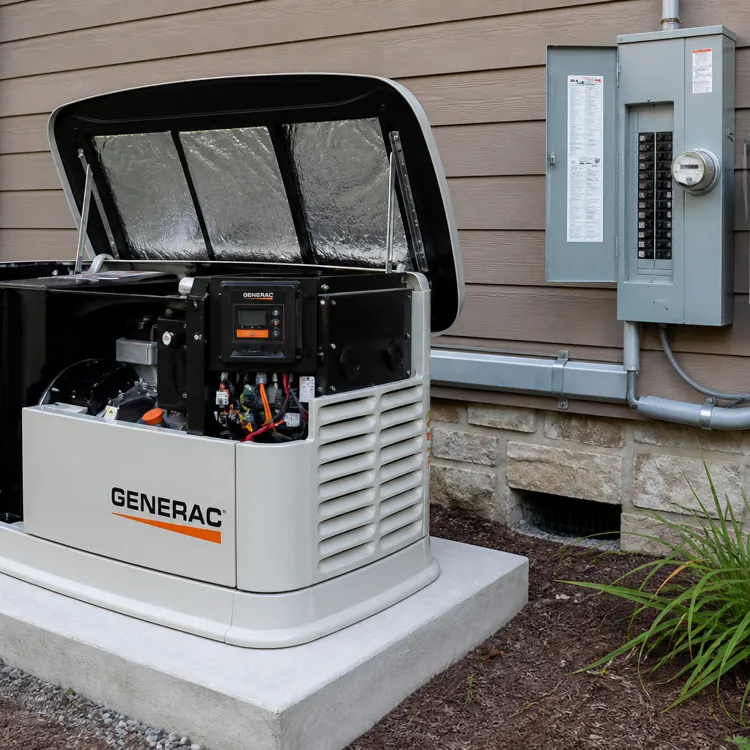
Standby generators are complicated systems that manage fuel storage, power monitoring, power production and energy delivery to your home.
Several key parts allow the system to run smoothly.
Propane tanks or natural gas connection
Standby generators use either propane or natural gas, so they require a connection to one of those fuel sources. Propane generators require on-site propane tanks, while natural gas generators require a connection to a natural gas line.
Propane is a slightly better generator fuel type for emergency preparedness, while natural gas is best for continuous operation with no interruptions and no risk of running out of fuel.
Fuel lines
Fuel lines connect your generator to the fuel source. These often run underground and deliver either natural gas or propane to your unit.
Primary unit engine
The largest part of the outdoor generator unit is the engine, which burns either propane or natural gas, converting fuel energy to mechanical energy.
Automatic transfer switch
The ATS continuously monitors power coming from the grid and switches your home to backup power if there’s an outage. It also disconnects your home from the grid during outages for safety purposes and monitors for incoming power to detect when it’s restored. It then transfers your home back to grid power and triggers your generator to shut off once power is back on.
Alternator
The alternator converts mechanical energy to electrical energy using electromagnetic induction, similar to how an alternator in a car with an internal combustion engine works.
Voltage regulator
Sizing a whole-home generator means accounting for the highest possible load your generator will need to accommodate. However, that’s rarely what your home actually calls for.
The voltage regulator in your unit regulates how much power your generator produces to align with your demands. This ensures consistent power and protects your appliances and devices from surges that could otherwise cause damage.
Control panel
Standby generators have control panels that run weekly maintenance cycles. Modern units can also run diagnostics to alert you automatically to issues or let you access information about outages, remaining generator life and maintenance needs through an app.
Enclosure
The enclosure around your generator protects the internal components from inclement weather, falling tree debris and other damage. The casing usually includes cooling fans to keep the components inside at a safe temperature, even during operation.
»RELATED: Home repair resources and expert advice
Automatic transfer switch explained
The ATS is the critical component that allows your unit to turn on and off when your home loses and regains power from the grid. Without the ATS, you’d need to start your generator manually — like a portable generator — and you’d have no power until you did.
The ATS has three important jobs.
1. It spots the outage
If the power goes out, the ATS detects the loss of grid power and tells your generator to start. If the grid is still supplying electricity, the ATS keeps the generator from powering your home, reducing the risk of power surges and allowing routine maintenance cycles to run safely.
For example, during a nighttime outage, the ATS can detect the problem and start the generator without you having to get out of bed.
2. It safely switches to generator power
If your generator starts, the ATS first disconnects your home from the grid before directing generator power to your electrical system. This prevents generator electricity from flowing back through utility lines, protecting both your home and utility workers.
Think of the ATS as a gatekeeper: It closes the gate to the grid before opening the gate to your generator.
3. It switches you back to the grid
If grid power returns, the ATS detects it and reverses the process. It stops generator power from flowing to your home, reconnects your electrical system to the grid and puts the generator into cool-down mode before shutting it off.
So when the utility restores power, your generator can step aside automatically — you don't have to flip a switch.
Types of automatic transfer switches
There are two types of automatic transfer switches: whole-home and partial-home. They work similarly, but there are a few important differences.
Both ATS types switch almost seamlessly between grid and backup power with little interruption.
Whole-home switches
Whole-home switches control the flow of power from the grid to your main electrical panel and from the generator to your main electrical panel. They’re ideal for whole-house generators that provide power to your entire home.
Partial-home switches
Partial-home switches control the flow of power from the grid to a particular part of your home, usually one that’s on a sub-panel, and from the generator to that sub-panel. These are ideal for homeowners who don’t think a whole-house generator is worth it and instead want emergency power for individual appliances or sections of the home.
Standby generator fuel types and runtime
Standby generators either run on propane or natural gas. Portable generators typically run on gasoline or diesel, but these fuel options aren’t realistic for whole-home standby generators since fuel storage timelines are limited and manual refueling is necessary.
When you’re choosing a fuel type for your standby generator, you should consider storage requirements, fuel availability, potential runtime needs, equipment installation costs, fuel costs and more. Both options have their pros, cons and ideal use cases.
Comparing propane and natural gas for generator fuel
Use the table below to see how these fuel types compare in upfront cost, functionality, performance and accessibility.
| Propane | Natural gas | |
|---|---|---|
| Storage demands | Requires on-site storage in mounted tanks | No storage required |
| Fuel line needs | Requires fuel lines running from tanks to your unit | Requires fuel lines running from your natural gas connection to your unit |
| Existing utility availability | Suitable for areas that don’t have nearby gas supply lines | Only realistic where natural gas lines are already available at the street |
| Site requirements | Demands permanent concrete pads for the unit and storage tanks | Only demands permanent concrete pad for the unit |
| Potential run time | Depends on electricity demands, but often for 3+ days of whole-home power | Indefinite |
| Emergency preparedness | Very high — gas is on-site, so there are no interruptions to service | Moderate — gas comes through underground pipes, so disruptions to those lines can interrupt service |
| Delivery | Requires professional delivery to refill tanks; always a risk of running out | Automatic and continuous; no risk of running out |
| Safety concerns | Explosions, although rare; low risk of carbon monoxide | Gas leaks and explosions; low risk of carbon monoxide |
| Installation costs to consider | Propane tank installation, which can cost thousands; additional site prep for tanks at $150 to $600+ | Gas line installation at $500 to $2,000 |
| Maintenance costs | $200 to $500 annually; recertification for propane tanks every 5 to 12 years | $200 to $500 annually |



FAQ
What are the disadvantages of a standby generator?
The primary disadvantage of a standby generator is the upfront cost, which averages between $10,000 and $25,000. They also take up space in your yard, produce quite a bit of noise during operation and run weekly maintenance cycles that can disrupt you and your neighbors. Standby generators also carry an inherent risk of gas leaks and explosions, although rare.
How much gas does a Generac generator use in 24 hours?
On average, a Generac generator running at half load will use 2 gallons of propane per hour (48 per 24 hours) or 180 to 220 cubic feet of natural gas per hour (4,800 cubic feet per 24 hours). Your consumption can vary widely based on how much electricity you need in your home, your generator's efficiency and more.
How long do backup generators last?
Most standby generators last for 15 to 25 years, provided you carry out routine maintenance. The actual lifespan of your unit depends on how often you call on it for backup power, how well you keep up with maintenance and repairs and the climate in your area. Many companies offer a manufacturer’s warranty closer to five years.
How do generators work without electricity?
Generators contain a motor that burns fossil fuel, either propane, natural gas, gasoline or diesel fuel, to convert fuel energy into mechanical energy. They also contain an alternator that uses electromagnetic induction to convert mechanical energy into electrical energy. That electrical energy then powers your devices or your home.
Article sources
ConsumerAffairs writers primarily rely on government data, industry experts and original research from other reputable publications to inform their work. Specific sources for this article include:
- AmeriGas Propane, "BTUs: What They Are and Why You Should Care." Accessed Aug. 20, 2026.
- U.S. Energy Information Administration, "Energy conversion calculators." Accessed Aug. 20, 2026.
- U.S. Energy Information Administration, "How much electricity does an American home use?" Accessed Aug. 20, 2026.
- Generac Power Systems, "What Does My Home Standby Generator Warranty Cover?" Accessed Aug. 20, 2026.
- Kohler Generators, "KOHLER Generator Warranties: Protection for Your Investment." Accessed Aug. 20, 2026.