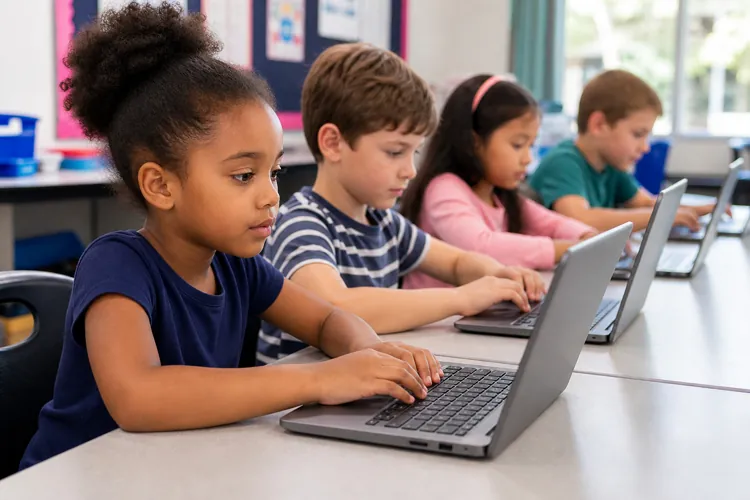

New York City is imposing a one-year moratorium on student-facing generative AI for students from 2-K through eighth grade.
High school students will receive AI literacy lessons, while a small number of classrooms will test five approved AI programs.
The new policy also limits screen time for younger students and requires technology used in schools to undergo a more thorough review.
Artificial intelligence is showing up in more parts of everyday life, and classrooms are no exception. But New York City is taking a cautious approach to how much of the technology students should use at school.
Mayor Zohran Mamdani and Schools Chancellor Kamar H. Samuels announced a new policy that combines restrictions on student-facing generative AI with age-appropriate screen time limits. The changes will affect nearly 600,000 public school students, or about two-thirds of the system's total enrollment.
The policy puts a one-year moratorium on student-facing generative AI for students in 2-K through eighth grade during the 2026-27 school year. Companion chatbots will be prohibited across all grades.
“Children need teachers and human connection in order to learn and grow. They need to develop skills alongside their peers, build relationships with educators and wrestle with tough problems on their own,” Mayor Mamdani said in a news release.
“The tech industry wants us to believe that AI-powered early education is not only inevitable, but necessary. We do not see it that way. That’s why we’re implementing a moratorium on generative AI for students in 2-K through 8th grade and spending the next year studying the impacts of this technology.”
What the new policy includes
High school students won't be completely shut out from AI. Instead, all high school students will have access to two 45-minute AI literacy lessons each year. The classes will cover what AI is and isn't, along with topics including bias, risks, ethics, and potential effects on careers and future skills.
The city will also introduce five limited AI pilots in high schools. The programs will be available to a maximum of 50,000 general education students, or about 5% of the city's public school population.
The programs include:
Quill: Accessed by English language arts classrooms, Quill is designed to support close reading, text analysis and the use of evidence to support claims. Students will use Quill for no more than 15 minutes per week.
Edia: Accessed by math classrooms, Edia is designed to provide step-by-step coaching and prompt students to explain their reasoning. Students will use Edia for no more than 20 minutes per week.
Brisk Teaching: Accessed through teacher-created activities, Brisk Teaching is designed to provide guided practice using teacher-selected texts or videos, with objectives and guardrails set by the teacher. Students will use Brisk Boost for 10 to 20 minutes once or twice per week.
Playlab: To be used across multiple subjects, Playlab is designed to help students engage with assignment-specific applications and examine AI outputs for bias and reasoning. No more than two assignments per marking period will use Playlab.
Intel AI-Ready Schools: To be used across multiple subjects, Intel AI-Ready Schools is designed to help students identify community problems and develop AI solutions through semester-long projects. Students will use the tool for one period per week.
Use will be tightly controlled. Each high school can offer the pilots in no more than five classes, and students must use the tools under direct supervision from a trained educator. The programs also have specific limits on how frequently students can use them.
Meanwhile, more than 38 previously allowed programs will have their AI components discontinued or disabled if they don't meet the city's new standards.
Screen time limits
The policy also addresses screen use more broadly. Students in second grade and younger will have restrictions on individual screen time, while the city recommends a maximum of 30 minutes a day for students in third through fifth grade and 45 minutes for students in sixth through eighth grade.
There are some exceptions. Students with disabilities, multilingual students, and students in career-preparation programs such as computer science can receive exceptions for assistive technology.
Teachers can also continue using AI for lesson planning and administrative tasks when the tools meet NYC Public Schools' safety requirements.
What this means for families
For parents of younger NYC public school students, the biggest change is straightforward: their children won't be using student-facing generative AI at school during the coming school year.
“As Chancellor and as a parent, I believe our job is to protect what makes learning work, while ensuring every child has the critical thinking skills they need before graduating,” said Chancellor Samuels.
“We’re putting guardrails in place to protect the human connection, curiosity, and creativity that help children grow. We’re standing firmly in our belief that innovation does not mean more technology, and over the next year, we will lead with evidence to make sure technology serves learning — not the other way around.”
The city says the policy is intentionally temporary. A new Technology in Schools Coalition will spend the 2026-27 school year evaluating the moratorium and pilot programs before publishing recommendations for future school years.
“As a former middle school teacher, I'm so pleased to see that Mayo Mamdani r is taking a nuanced approach to a new and rapidly changing educational tool,” said State Senator Jabari Brisport.
“We took too long to respond to the effects of social media and smart phones on our youth. This combination of a one-year ban with select pilot programs allows us to take a serious look at AI usage in schools and find a path that allows our students to adapt to our changing world in a safe manner.”