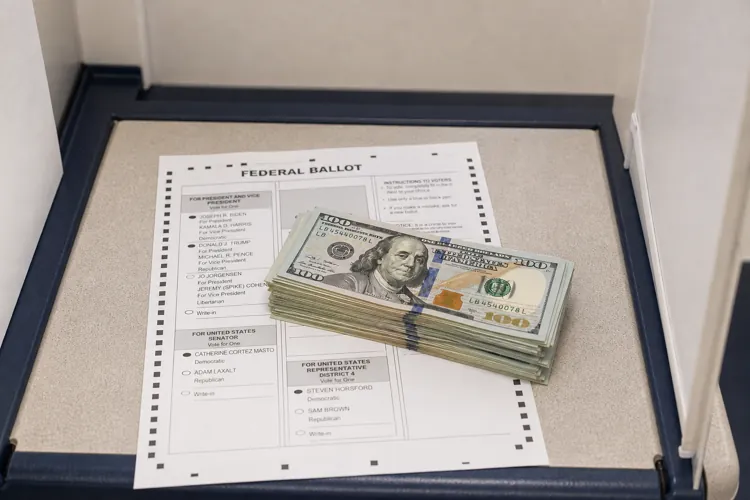

President Trump says every adult U.S. citizen would receive a $5,000 “Trump Dividend” if Republicans win control of Congress in the November midterm elections.
The president could not simply order the Treasury to send out the checks; Congress would have to authorize and fund the payments.
Federal law prohibits paying people in exchange for their votes, but legal experts say Trump's proposal appears different because the payment would not depend on how an individual voted.
Addressing the Republican Midterm Convention in Dallas Wednesday evening, President Trump made a stunning announcement: If Republicans win control of Congress in November, every adult American citizen would receive $5,000.
“If the Republicans win, you win with us, and you get $5,000,” Trump said. He also suggested the proposal “should win the midterms.”
However, the promise immediately raises an obvious question: Can a president legally promise voters thousands of dollars if his party wins an election? The answer is more complicated than a simple yes or no.
Congress controls the money
The biggest legal obstacle is not necessarily election law. It's the Constitution.
The Constitution's Appropriations Clause gives Congress control over federal spending. Money generally cannot be withdrawn from the Treasury unless Congress has authorized the expenditure.
That means Trump could not simply direct the Treasury Department to send $5,000 checks to every adult American. Congress would have to enact legislation authorizing and funding the payments.
Even with Republican majorities in both chambers, passage would not be automatic. Lawmakers would have to agree on the eligibility rules, funding and other details of the program.
The price tag would also be substantial. With roughly 240 million adults in the United States, distributing $5,000 to each would cost about $1.2 trillion, which would be added to the $40 trillion national debt. Trump has not yet presented a detailed funding plan for the proposal.
Is it buying votes?
A second question involves federal election law.
Federal law, 18 U.S.C. §597, makes it a crime to offer or make an expenditure to someone in exchange for voting, withholding a vote or voting for or against a particular candidate.
On its face, however, Trump's proposal is different from the traditional definition of vote buying.
Trump isn't offering an individual $5,000 on the condition that the person votes Republican.
Under the proposal as described, eligible Americans would apparently receive the payment regardless of whether they voted Republican, Democratic, for another party or didn't vote at all.
Under current law, the proposal appears to be a campaign promise rather than an illegal payment in exchange for an individual's vote.
Politicians routinely campaign on promises that could financially benefit voters — tax cuts, tax credits, increased Social Security benefits, student-loan relief and government subsidies, for example.
The difference here is how explicitly Trump has connected the proposed benefit to his party winning the election.
An unusual legal question
That connection could invite additional scrutiny. Trump isn't merely advocating a policy and asking voters to support candidates who favor it. He has directly said Americans would receive $5,000 if Republicans win Congress.
However, the federal vote-buying statute focuses on providing something of value in exchange for an individual's vote. A government benefit available to people regardless of how they personally voted is a significantly different arrangement.
Ultimately, the more immediate barrier to Americans receiving a $5,000 check may be Congress rather than election law.