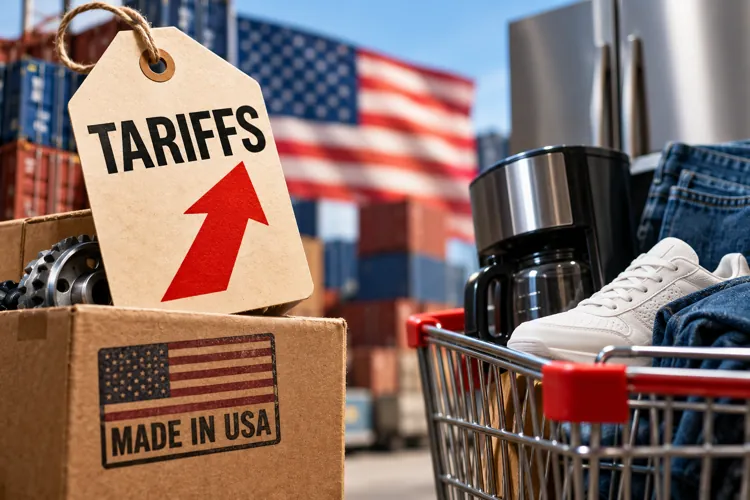

Tariffs hit American-made products, too: Roughly one-third of tariff-related consumer price increases come from goods manufactured in the United States.
Price hikes take time: Imported products typically get more expensive first, while American-made goods can take six to 12 months to reflect higher costs.
Higher prices can linger: Even when tariff-related inflation slows, shoppers may continue paying more than they otherwise would.
If you've been wondering why prices keep creeping higher, even on products made right here in America, new research from the Federal Reserve Bank of New York offers an explanation.
And it turns out tariffs can keep affecting prices long after they're announced.
In a new report, researchers examined how tariffs work their way through the economy before eventually reaching consumers.
Their big finding is that for every 10 percentage-point increase in average tariffs, consumer goods prices rise approximately 2.6% after a year. And it's not just imported products getting more expensive.
Even American-made products are getting pricier
It's easy to assume tariffs only affect products manufactured overseas. But researchers found that roughly one-third of tariff-related consumer price increases come from products manufactured in the United States.
There are two main reasons worth considering.
First, American manufacturers often depend on imported materials and components.
For example, think about a car assembled in Michigan. While it might be put together in America, it often contains imported steel, electronics, rubber, or aluminum.
So when those materials become more expensive because of tariffs, manufacturers will naturally face higher production costs that can eventually reach consumers’ wallets.
Second, tariffs can give American companies more room to raise prices.
When imported competitors become more expensive, domestic manufacturers face less pressure to keep their own prices low.
The researchers found evidence of both effects, although rising production costs played the larger role.
The price increases can take a full year
Here's something particularly interesting for shoppers: Tariff-related price increases don't necessarily happen when tariffs first take effect.
Researchers found that nearly 90% of the tariffs studied were passed through to U.S. import prices, often almost immediately.
But those higher costs take time to reach store shelves. About half of the direct effect on retail prices appears within three months, with the full direct effect arriving after approximately six months.
American-made goods take even longer. Their price increases generally build over six to 12 months as manufacturers adjust to higher costs.
That means shoppers can continue seeing tariff-related price pressure long after the initial announcements have faded from the headlines.
Slower inflation doesn't mean lower prices
The New York Fed estimates that tariffs pushed consumer goods prices nearly 3% above where they otherwise would have been in February 2026.
That effect eased to approximately 2% by August following changes in tariff policy.
But there's an important distinction between inflation slowing and prices actually coming down. Even if tariffs stop adding to inflation, the higher prices they caused can remain.
In other words, a product that became more expensive because of tariffs doesn't automatically return to its old price when tariff-related inflation slows.
What shoppers can do to protect their budgets
Unfortunately, there's no simple way to avoid tariffs entirely, especially when American-made products can be affected, too.
But a few shopping strategies can help:
Don't assume buying American avoids tariff costs. Because many domestic products contain imported materials, if you’re on a budget, it’s smart to compare prices rather than relying solely on country-of-origin labels.
Track prices before big purchases. For electronics, appliances, and other expensive items, use price-history tools like Keepa or CamelCamelCamel to determine whether a sale is actually a good deal.
Consider refurbished and open-box products.These can offer meaningful savings compared with buying new.
Don't panic-buy because of tariff headlines. Price increases can take months to reach consumers, and not every product will be affected equally.