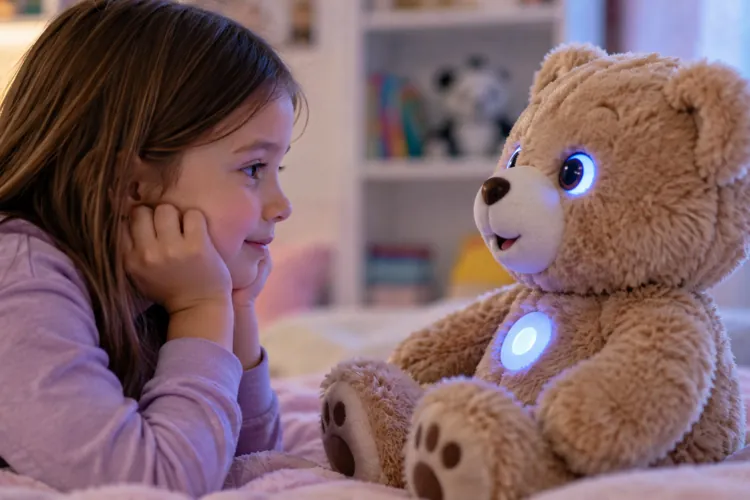

Kids initially treated AI toys like new friends, asking their names, birthdays, and favorite things.
However, then, the interactions changed, as some children insulted the toys, tried to trick them, and even physically provoked them to see how they'd respond.
The toys rarely pushed back, raising questions about what kids may learn from relationships with AI companions that tolerate behavior humans wouldn't.
Give a kid a talking AI toy and what happens? At first they might try to make a new friend.
But give them a little more time and they may start trying to figure out just how much abuse their new AI buddy will take.
Researchers from the University of Washington and Rutgers University recently watched eight children between the ages of 6 and 11 interact with three AI-powered plush toys from Curio.
The toys use generative AI to carry on conversations, remember previous interactions, and personalize their responses.
Researchers wanted to understand something we're likely to hear a lot more about as AI moves into the toy box: How do kids actually interact with a toy that can talk back?
The answer was surprisingly complicated.
First came friendship
Initially, many of the interactions looked a lot like two kids meeting for the first time. Children asked the toys their names, birthdays, and favorite things and tried to find common interests.
But once the novelty wore off, some kids started testing the technology.
They asked increasingly difficult questions and tried to figure out what the toy knew — and what would make it react.
Then things got more confrontational. Children called the toys names including "ugly," "dumb," and "evil." Some physically poked or provoked them. In other words, the AI toy went from a potential buddy to more of a technological punching bag.
The toys didn't react the way another kid might
Rather than getting angry, setting boundaries, or refusing to continue the conversation, the AI tended to remain friendly, apologize, or steer the conversation elsewhere.
And that's something researchers believe deserves more attention.
A child who repeatedly insults another child will probably get some immediate feedback. But an AI toy designed to remain endlessly agreeable may teach a very different lesson about how relationships work and offer some insights into bullying.
Researchers also found that kids were actively trying to understand what these toys actually were. They would sometimes treat them as social companions and other times they clearly recognized them as machines they could experiment with.
Don't panic over eight kids
There are some major limitations here:
Only eight children participated in the study.
They interacted with the toys during two research sessions.
Researchers examined toys from just one company.
So this study doesn't tell us that AI toys make children mean or that kids who play with them will start treating people differently.
Instead, it offers an early glimpse into a question parents may increasingly have to consider as conversational AI moves from computer screens into stuffed animals.
And behavior isn't the only concern. Separate research, published this year, reviewed 51 studies involving AI and connected toys and identified concerns involving privacy, cybersecurity, data collection, and children's tendency to place trust in toys that can behave like social companions.
What parents should consider
Before buying an AI-powered toy, find out whether it has a microphone or camera, what information it collects, whether conversations are stored, and whether that information is shared with third parties.
It's also worth actually watching your child use it. Ask them what they think the toy is, whether they believe it's a friend, and whether they think what they tell it is private.
Because the biggest difference between Teddy Ruxpin and the newest generation of talking toys isn't simply that today's toys can answer back. It's that kids may start forming relationships with technology before they fully understand what's on the other side of the conversation.