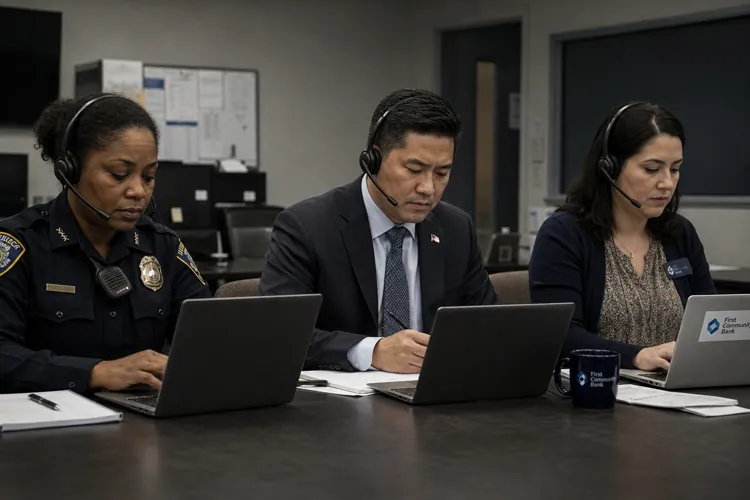

Scammers are increasingly working in teams, with different people posing as bank employees, lawyers, government agents, or couriers.
Multiple voices make a false story seem independently verified and recreate the experience of dealing with a legitimate organization.
Consumers should end the conversation and contact the purported organization through a verified phone number.
Scammers have discovered that a lie can sound more believable when several people tell it.
Instead of relying on a single caller, many criminal operations now use teams in which participants play different roles. One may pose as a bank employee, another as a government investigator, and a third as a courier sent to collect money.
The handoffs can make the situation appear legitimate. After all, if a bank representative, an attorney, and a police officer all tell you the same thing, it may seem as though the story has been independently confirmed.
But the supposed officials may be sitting in the same room and following the same script.
The Federal Trade Commission (FTC) says scammers increasingly impersonate more than one organization during a single scheme. For example, someone posing as an Amazon employee might transfer a consumer to a fake bank representative and then to a supposed FBI or FTC agent.
Those impersonation scams are taking a heavy financial toll. Consumers reported losing $3.5 billion to imposter scams in 2025, according to the FTC. Nearly one out of every three fraud reports received by the agency that year involved an imposter.
Each scammer has a role
Federal criminal cases illustrate how sophisticated that teamwork can become.
In organized grandparent scams, one caller may pretend to be a grandchild who has been arrested or injured. A second person then poses as an attorney, while another claims to work for a court or law-enforcement agency.
A courier may eventually appear at the victim’s home to collect bail money or legal fees. The Justice Department has prosecuted cases involving overseas call centers and couriers operating inside the United States.
In one alleged nationwide scheme, victims were given the courier’s name, a description of the courier’s clothing, and sometimes a password to confirm the person was authorized to collect their cash or gold. Those details made the transaction resemble a secure, official process, according to the Justice Department.
Romance and cryptocurrency scams may involve even larger organizations. One participant builds a relationship with the victim, while others operate fake investment websites, produce documents, provide supposed customer service, or move stolen money through bank and cryptocurrency accounts.
The Justice Department says organized crime groups operate scam centers, particularly in Southeast Asia, that carry out cryptocurrency investment and other online fraud. Some people working in those compounds are themselves trafficking victims forced to participate.
Why the approach works
Using several participants gives the scam false credibility in several ways:
Different voices appear to provide independent confirmation.
Transfers between “departments” resemble normal corporate procedures.
Specialized participants can concentrate on gaining trust, creating fear, or giving financial instructions.
Case numbers, supervisors, security codes, and couriers create the appearance of a professional organization.
Repeated warnings to maintain secrecy prevent the victim from consulting someone outside the scammers’ control.
A particularly dangerous version begins with a supposed fraud alert. A caller claims someone is stealing from the consumer’s account and says the money must be transferred to a “safe” government or bank account.
The second person may pose as an investigator who confirms the danger. The fact that two people agree is part of the deception — not evidence that the threat is real.
How to protect yourself
Never treat a call transfer as verification. If someone claims to represent a bank, retailer, or government agency, hang up and contact the organization independently.
Use the telephone number printed on the back of your payment card, shown on an account statement, or published on an official government website. Don’t call a number provided in the original text, email, or pop-up message.
Consumers should also remember:
Banks and government agencies will not tell you to move money to protect it.
Legitimate investigators don’t demand payment by gift card, cryptocurrency, cash, or gold.
A real agency will not send a courier to collect valuables from your home.
Anyone telling you to hide the matter from relatives, bank employees, or police is trying to isolate you.
Caller ID, employee badges, and official-looking documents can all be falsified.
Before sending money, tell a trusted friend or family member what happened. That outside conversation can break the illusion the scammers’ team has worked so carefully to create.
Suspected scams can be reported at ReportFraud.ftc.gov. Internet-enabled crimes may also be reported to the FBI’s Internet Crime Complaint Center.