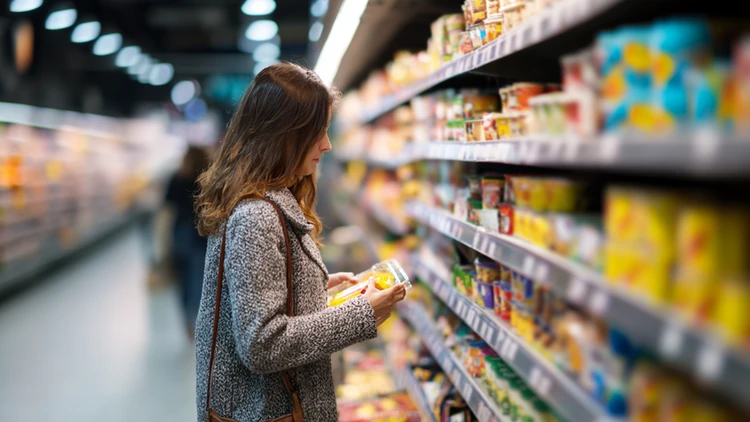

“Natural” isn’t tightly defined. The Food and Drug Administration offers guidance, but there’s no strict, enforceable definition — and it says nothing about pesticides or processing.
“Low” and “light” can be misleading. Lower than what? Even legitimate claims like “low sodium” can hinge on unrealistically small serving sizes.
Feel-good words aren’t proof. Terms like “green,” “sustainable,” and “free range” often lack real oversight — and may be more marketing than standard.
Most shoppers know to scan the ingredient list and avoid products with stuff you can't pronounce.
But according to Tasting Table, one of the biggest food-label red flags is often printed boldly on the front of the package — but it’s frequently just vague, feel-good language with no clear definition.
Specifically, terms like “natural,” “light,” “low sugar,” “green,” and “sustainable” can create the illusion of healthy eating, without guaranteeing much of anything.
Don’t assume 'natural' means regulated
The word “natural” sounds reassuring, but it remains loosely defined.
The Food and Drug Administration has issued guidance suggesting “natural” means no artificial or synthetic ingredients and no added colors.
However there is no formal, enforceable definition. As Tasting Table points out, it does not address how ingredients were grown, whether pesticides were used, or how processed the product may be.
In short, “natural” does not automatically mean minimally processed or chemical-free.
Question claims like 'low' and 'light'
Words such as “low fat,” “low sugar,” and “light” are often relative.
Lower than what? A previous version? A competitor? Some undefined benchmark?
Even when a term has a technical definition, such as “low sodium,” the serving sizes can be small enough to make numbers look way better than they are.
This serves as a great reminder that without context, these labels can be misleading.
Be skeptical of environmental buzzwords
Labels like “green,” “sustainable,” “free range,” and “pasture raised” may suggest higher standards, but many of these terms lack strict oversight or enforcement.
In actuality, they can signal positive practices, or simply be smart marketing ploys.
Look for certifications with real standards
Not all labels are created equal.
For example, any products marked “organic” must meet federal requirements. Also, third-party certifications like “Fair Trade Certified,” overseen by Fair Trade USA, involve defined criteria and a verification process that you can rely on.
When a product carries independent certification, there’s at least a measurable standard behind the claim.
The bottom line
I love the way Tasting Table sums it up by saying, “Does a company care enough to prove the claims it's making, or does it just want you to swallow what it's selling?”
So, the next time you see packaging with the words “light” or “sustainable” plastered on the front, it’s up to us to figure out what that means. Unfortunately, this makes eating a healthier diet a more time-consuming activity when standing in the grocery aisle.